Wednesday, March 19, 2014

March 20, 2014 (Tokyo)


March 20, 2014

As I woke up freezing cold this morning, thinking when the hell will spring come to Meguro, I realized that it was nineteen years ago that the Subway Sarin Incident took place on the Hibya Line in Tokyo.  At the time I was (and still am) went back and forth to Tokyo, but when I lived in Ebisu, I would take the Hibya Line to Roppongi to my favorite record store at the time, The Wave which was located in their own building on Roppongi Dori.  There were two shocking incidents for me. One is the Sarin attack on the subway, and the other is the disappearance of The Wave building.  This was a six-story building, where each floor was allocated for a specific type of music.  In the basement they showed films from Europe, and the top floor had one of the best bookstores I have ever been to.  At the time, the Seibu department store brought a certain amount of culture as well as shops in its empire like touch on the retail world.  For instance, they would have a theater on the seventh floor in their department store where they showed nothing but ‘underground’ or avant-garde theater or exhibitions.  That all has changed due to the economic bubble bursting during the late 90s.   And on top of that was the Sarin attack on innocent Tokyo citizens.
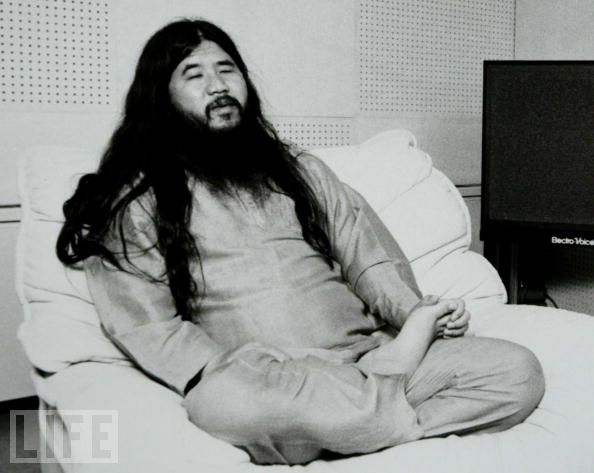


The Hibya Line runs from Naka-Meguro in Meguro and Kita-Senju in Adachi.  It is actually a perfect line because it reaches hot spots such as Roppongi, Ebisu, and Kayabachō.   So logically, this would be a perfect spot for a terrorist to take action on.  I remember being totally shocked that something like this can take place in Tokyo.  For most people in my world, 9/11 is the date where the world changed for them, but for me it was clearly what the Japanese officially call the Subway Sarin incident.  It is widely known that the attack was made by an outsider group called Aum Shinrikyo (now known as “Aleph”).  The movement was created by Shoko Asahara, and it started off as a yoga and meditation class. Eventually over a short period of time it had grown up to become a terrorist organization.   Like a lot of spiritual groups, the leader conveys himself as “Christ.” And then as they say in a fairy tale, all things start to rot from the inside to the outside.


Tragically thirteen were murdered by the attack, and at the very least (as it was last reported) up to 1,300 people were wounded from the incident.  Again, I have difficulty getting my head around why anyone would want to do this for whatever their reason is.  Mr. Asahara, is like any other egotist, who sees the world in a certain light and needs to convey that point-of-view at all costs.   Then there are others like the Norwegian playwright Henrik Ibsen, who has an insightful point-of-view of how society and culture works.  In his play “,An Enemy of the People” (original Norwegian title: En folkefiende) is about a doctor in a small town that realizes a lot of the illness is coming from the local business which is the public baths.  Many of its citizens and even more important, many tourists are coming to this town for these ‘public baths.' The Doctor finds out that actual waste material is contaminating the local waters which in turn, affects the local baths community.  As the doctor brings the news up, the industry and the public refuse to listen to him.  Due to the fact that the main economy comes from these baths.


Shockingly enough, this is exactly the same situation we are in now with the climate warming as well as the various issues of the nuclear industry.  Health and well-being for its citizens vs. the economy.   The majority of the population usually sides with the economy when it comes to the issues of public health against the money-making machines that are out there.  It comes to mind the eminent psychologist and behaviorist B. F. Skinner, who saw ‘free will’ as an illusion.  He believed in the reinforcement system where if the consequences were bad, there were chances that the behavior would not be repeated.  If they were good, then the consequences will be allowed.  I think the economic system is sort of based on this theory.   Economic wealth or health is more important than emotional or physical health to many.  So therefore, most citizens would side with those who promise either the illusion of wealth or the actual delivery of the physical goods.  Skinner invented a laboratory apparatus known as the “Skinner box” where animals, like a rat is tested with respect to positive and negative reinforcement.  Ironically enough, a lot of slot machines and online games are built on the Skinner box theory.


I often think that shows from the 1950s and 1960s such as The Adventues of Ozzie and Harriet, which had a long run as a series on the ABC network from 1952 to 1966.  It was a real family, yet contained as a fictional TV show as sorts.  I often thought of that the show as an entertainment version of the Skinner box.  Also I think a lot of reality TV shows are built on the same premise as well.  It is interesting that when we have that scratch, and we scratch it, the evil just pours out of our system.

Tuesday, March 18, 2014

March 19, 2014 (Tokyo)


March 19, 2014

Whenever I go on a long trip, like to Japan, for instance, I like to imagine myself as Richard Francis Burton, the great British explorer, spy, a man who can speak 29 languages, translator, poet, orientalist, soldier, and some say a sex fiend.  More than imaging myself, I decided to study Japanese as my first language after English, which I am still grappling with.  Even though I was born in America, and have been an American for the last 59 years, I am still overwhelmed with the difference between the words “has” and “have.” Nevertheless I made a decision to study Japanese and then perhaps go into French language studies.  I purchased a Japanese language application for my computer and within ten minutes became terribly bored with it.

With respect to the Japanese language, I discovered when I am by myself, I can easily feed myself in a country, where English is another language.  Luckily I found a sushi place near where I’m staying in Meguro that when you sit down, a piece of sushi comes to your seat on a conveyor belt.  All you have to do is pick it off from the belt, and eat it.   Once you are finished, they (not you) count the dishes, which are priced differently and they can tell by the design of the plate, what the price is. As a practice, I always give them the biggest currency bill as possible.  This way, I don’t have to look for coins in my pocket, nor look embarrassed trying to find the exact amount for the bill. The thing is, I want to look like I fit in Japanese society as effortlessly as Richard Burton did when he traveled in the Middle East.

Before I came to Japan, my only knowledge of this country was through the film “Merry Christmas Mr. Lawrence, ” which by the way, I don’t recommend as an introduction to Japanese culture.  On the other hand, like other eminent orientalists from the past, I imagine myself as a distinguished explorer, especially when I go shopping in Shinjuku for used vinyl or CDs.    What I mostly find is the complete works of Terry Hall, who was (and is) the lead singer for The Specials.  Since the 1980s, he has been around in various band line-up’s making intriguing music.  A person who I feel was in the right place and at the right time.


Terry Hall always reminded me of the actor Patrick McGoohan, who starred in the TV shows “Danger Man” (aka “Secret Agent Man” in the U.S.) and the classic “The Prisoner.” Both artists I felt came from a very British perspective on life in the U.K. and sometimes beyond, but with a British sensibility. And like McGoohan’s character in “The Prisoner” I often felt like I’m a prisoner here on Japan.  Basically this country consists of a series of islands, and the U.K. is looked upon as an island as well.  My dream is tantamount to wake up one morning, and I can’t ever escape from Japan.


Monday, March 17, 2014

March 18, 2014 (Tokyo)


March 18, 2014

One of my all time favorite characters in the film world is Edward Everett Horton.  For two reasons alone: the Fred Astaire starring film  “Top Hat” and doing a lot of the voices for the cartoon series “Fractured Fairy Tales,” which is part of the great “Rocky and Bullwinkle Show.” I was very much raised by hearing his voice telling or re-telling famous fairy tale stories, but altered by the genius Jay Ward and others.  Even that, going to work everyday on the bus I would pass the iconic “Bullwinkle” statue on the Sunset Strip, almost directly across from the equally iconic Chateau Marmont.


When I was a young teenager, I have a distinct memory of suffering from a severe flu, that kept me in bed for at least a week.  My only companion was a portable black and white TV set, that had rabbit ears and more often, lousy reception.  This was the moment and place that I saw my first viewing of “Top Hat, ” and due to my fever and mind-set of the time, this film (to this day) has a lot of meaning for me.  Due to the bad reception that was very much regular TV viewing in Topanga Canyon, I only saw Fred Astaire, Ginger Rogers, and the great Edward Horton in a screen full of fuzzy images, but also each character and object had a double or shadow, due to the poor reception.   Still, it was probably one of the key moments for me, due that I learned elegance through difficult times is indeed a customary way of living.


Ever since then, Horton came to me in various methods and ways.  He succumbed to cancer in 1970, at his home in Encino, which was not far away from Topanga.   I imagine it was around this time I was watching “Top Hat,” and not knowing his last breath was taking place within six miles away from my home.   The big appeal for me was his voice, which was very high-pitched, but also sarcastic in its delivery.  It was a perfect match with “Fractured Fairy Tales.” For me, it wasn’t the tales themselves that were important, but the delivery of his narrative.  I got the feeling that he was relaying another type of story within the fairy tale context.  One of my all-time favorite poets is Stéphane Mallarmé, who wrote a piece called “Un Coup de Dés Jamais N'Abolira Le Hasard” (A Throw of the Dice will Never Abolish Chance).   Many claim that this French work cannot be translated into English or any other language due to the many layers of textural meaning as well as the sound of the words, which triggers different effects in the piece.  Also the poem was laid out in a way where the spacing between the words has just as much meaning as the actual words themselves.  

Sometime in the 1960s, Edward Horton made a recording of this poem, both in French and in English.   He did the recording for a BBC radio broadcast that was transmitted over the airwaves once.  The recording disappeared in thin air afterwards.  Some have claimed that the recording was found, but up to this day (moment!) it has never appeared on the Internet.   Therefore we have a mystery, and lord knows I love a mystery!


Sunday, March 16, 2014

March 17, 2014


March 17, 2014

My wife and a close friend of mine, who tragically passed away a couple of years ago, Nick Faigin went to a motel very close to the Los Angeles Airport (LAX) to interview Rudy Ray Moore.  It wasn’t clear at the time if he lived at the motel, or was just staying there.   Most of his work as a stand-up comedian was in Las Vegas, but it seemed he was trying to raise funds to make another “Dolemite” film.   At the time, there were at least three Dolemite films.  The original, then came “The Human Tornado, ” and the last was “The Return of Dolemite.” The premise of the films was that Dolemite was framed with stolen goods and had to serve a prison sentence.   Once out, a pair of detectives, who framed him originally, are making an effort to send him back to prison.  Lucklly Rudy Ray is surrounded by an army of attractive women who are also karate experts.

 Rudy Ray was a stand-up comedian, and is seen to be the grandpa of rap, and also very much the king of exploration films.  His classic album “The Beatnik Scene” is very much of a collector’s item, and I actually saw a copy of the original vinyl here in Tokyo, but way too expensive for me to purchase.  The interview took place and my wife and Nick got along quite well with Ruby Ray.  Nick was important part of the interview, because he had encyclopedic knowledge of Rudy Ray’s work and life.  I’m grateful for Nick for introducing me to the works of Iceberg Slim as well.  At the time, he was working for a porn magazine, and for some odd reason they needed a writer to write about literature.  Why Literature and porn together?  That was never answered, and may be the reason I worked on this magazine for only one issue.  Nevertheless, I wrote the ultimate essay on Iceberg’s work.  I reviewed all his book from Holloway House, which at the time can only be purchased from the newsstand on Cahuenga and Hollywood Boulevard.


In my mind, Iceberg and Rudy Ray are part of the same world. The tradition of life during the post war years for Black Americans I think was a very rich culture.  Not only the music, but the humor of Red Foxx, Moms Mabley, and of course Rudy Ray Moore added to the soup that made their experience so appealing for those who were not part of that world.  Being exactly who I am, and only knowing the surface of the black experience, and mostly only through music and films, I have difficulty understanding Rudy Ray’s accent or language.  I get the ‘drift’ but not the whole story.  But what I gather I am missing is something truly excellent.  At home I have all of his DVD’s. A friend of mine told me that the great Russian ballet dancer Rudolf Nureyev, also was a huge Rudy Ray Moore fan.  When he first came to the states, he studied American culture through Ruby Ray’s albums.   One wonder if that influence has somehow made it up on the ballet stage, but alas, culture is sometimes seeped into one’s DNA, and therefore we will never know for sure.


Saturday, March 15, 2014

March 16, 2014


March 16, 2014

As most of you know that I’m in Tokyo, so today is Sunday.  Sunday, for me, is a day of reflection, but I suspect in Japan it is just another work day.  On March 16, 1968, it’s the anniversary of the My Lai massacre during the Vietnam war. Forty-six years ago, the world at least changed in the U.S. for the worst.  It was a shock to one’s system to realize that evil can occur in any country or culture.  It is just not a national issue, but also how one looks at the or perhaps better stated ‘their’ world.   What makes a group of U.S. soldiers commit murder on innocent villagers.  Not only the male adults, but the aged, the women, and of course the children.  What makes a soldier put a group of these people in a hut, and shoot them in the head.  Or launch a live grenade in a space full of people.  Was it out of fear, or nerves?  How can one order a village to be wiped out, including the food supply there as well as every living animal?   Yet after the investigation, they found one soldier, guilty of the crime.  Eventually he was sentenced to life, but alas, he was let go within a couple of years.


By a weird coincidence, the Nazi SS doctor Josef Mengele was born today, the same date as the My Lai massacre.  He had an obsession with twins from the concentration camps, and committed unthinkable experiments on them.  He was also nice to the children at the camps, but within hours he could have those kids killed without giving a second thought.  It was pointed out that when he experimented on living people, he would whistle a melody. History doesn’t know the song, and perhaps that is all for the best.  He killed countless people, perhaps it is a good thing that we are spared to know the song or classical piece.


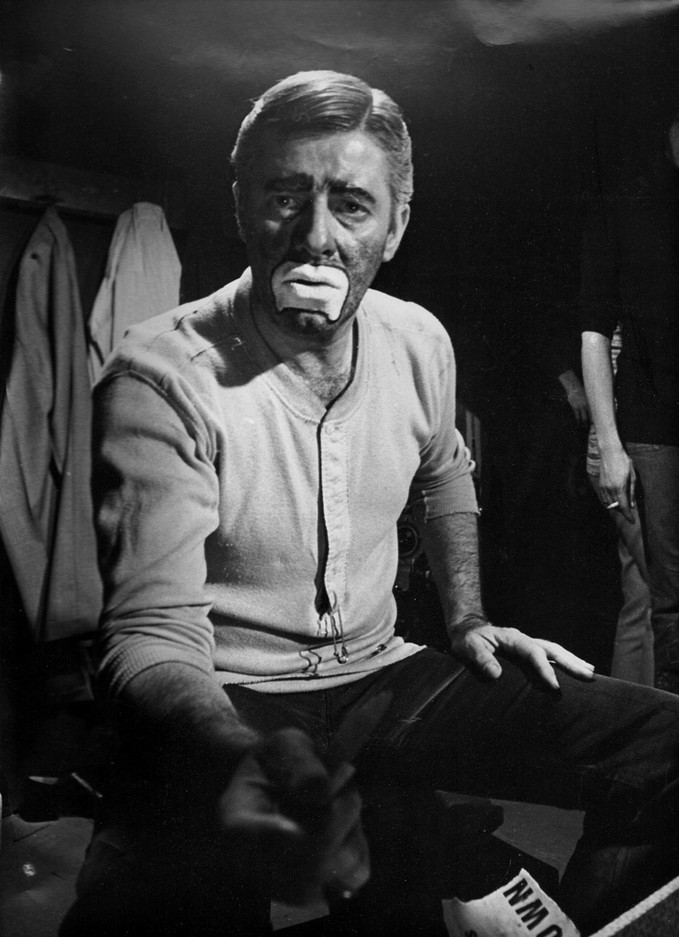
As I write this on a very sunny chilly morning in Tokyo, I think how is it possible for me to write a horror narrative that actually took place.  Jean-Luc Godard has mentioned that it’s impossible to film the Holocaust because the images are too unspeakable.  Alain Renasis by passed that by making his “Night and Fog” into a work of memory, which made the horror even more intense and disturbing. Famously, Jerry Lewis tried to film an aspect of the Holocaust in his unreleased film "The Day The Clown Cried." It doesn't work, because the imagination fails to grasp such horror.   Even looking at a picture of Mengele and Second Lieutenant William Calley, who was responsible for the massacre at My Lai, is obscene to me.

Oddly enough, Calley was not admired by his troops.  It has been noted that he had trouble reading maps and compass.  A must for a person in his position, yet he had no trouble following orders to kill an entire village.  The dispute is who gave the orders.  Calley claimed he got direct orders to do the massacre from Captain Ernest Median.  The confusion is between the wording of the actual order.  According to Captain Median, he ordered that all Viet Cong soldiers are expected to be killed, but Calley read this order as killing all the Vietnese in the village.   A misunderstanding of the wording of an order?  Captain Median was acquitted, but Calley was sentenced to life imprisonment and hard labor.  This caused a great deal of debate in the United States, where many felt that Calley was a scapegoat, or the fact that he was the only one convicted in the crime.   Some even saw him as a hero!  Ironically the most interesting defense came from Commanding Officer Chae Myung Shin, who was in the South Korean Vietnam Expeditonary Forces.  He commented that "Calley tried to get revenge for the deaths of his troops. In a war, this is natural. ”

Nevertheless evil is evil.  Dr. Mengele disappeared to South America after the war, and Calley ended up paroled by President Nixon.  Calley at the time served under house arrest for three and a half years.  On August 19, 2009, he spoke to the Kiwanis Club of Greater Columbus.  He was quoted as saying:

“There is not a day that goes by that I do not feel remorse for what happened that day in My Lai. I feel remorse for the Vietnamese who were killed, for their families, for the American soldiers involved and their families. I am very sorry....If you are asking why I did not stand up to them when I was given the orders, I will have to say that I was a 2nd lieutenant getting orders from my commander and I followed them—foolishly, I guess. ”

Friday, March 14, 2014

March 15, 2014


March 15, 2014

I had the oddest dream last night when I went to a show, and Howard Devoto was playing and after he sang his one song, "The Light Pours Out Of Me", there was only one person in the audience besides me, and every time he clapped, it made a shallow echo sound.  He clapped very slowly keeping a steady rhythm.  I woke up in Meguro still hearing that sound.  Slowly I realized it was my wife gently snoring in a soft rhythm, one could barely hear her, but somehow I picked up the sound and it became a major part of my dream.


The second thought that came to my mind was Howard Devoto.  Why, of all places and time, was I thinking of him in such a freezing cold morning here. I had to piss, and even that, was a little bit difficult, due to the cold.  As I mentioned every room in a Japanese house is chilly.  Some are colder than others, but nevertheless all are cold. So standing up, going to the hallway, which is the coldest by the way, and going to the toilet, a degree less than the hallway.  Even going to the toilet brings up feelings of oddness.   In Japan, the toilet is kept separate from the bathroom, so it is usually in a small room that only one person can fit in. On top of that all the toilets in Japan are mechanically controlled with kanji describing each purpose.  One is a soft flush, the other a full flush, one shoots water up the butt for cleaning purposes, the other is…. A softer version of the water spray and the other is a bidet.  Some have a heater blowing up your butt, but this one doesn’t but I really could use a heater there.  The toilet seat itself is heated so that is a blessing.

I went back to my futon and looked at the ceiling.  The image of Devoto stayed in my head, and I started to hum “The Light Pours Out of Me.” The wife was still asleep so I got up and put on my black jeans on, and went upstairs to make myself a cup of coffee.  I opened up my laptop to determine where I left off with respect to my ongoing ‘memoir’ that I have been working off and on for the last ten years.   It’s kind of amazing moment when you realize that the work you have been working on, sucks.

The first thought is that the Howard Devoto dream was trying to tell me something. The one man clapping slowly, maybe that was not towards Devoto, but me.  Maybe that guy was taunting me, because now thinking of it, he was staring at me when he applauded slowly, not at Howard on the stage.  I realized I found myself in a bad mood this morning because of that figure in my dream.  I needed something uplifting like a Sly Stone song, but that strangely made me think of Devoto again, because he recorded a Sly song with his second band Magazine.   Owing to the cold, the coffee was getting cold after each sip.  I was slowly going down a spiral staircase, with a painful scratch on my back.  I needed to pull myself up out of this misery, because it will spoil my entire day.  And a day wasted is not a proper day my young man (and woman).


I decided to forget about the memoir at this moment, and concentrate on getting myself ready to go out and locate the DVD “Dillinger” starring Lawrence Tierney.  When I was at a DVD rental I saw the package, and I thought to myself this will be perfect for me to study Japanese while watching one of my favorite films with my fave actor in it.   It dawned on me at that moment I’m attracted to figures that carry a certain amount of depression.  All my role models have at its best, a tinge of despair, or worst, total head-on depression.   It got worse when I couldn’t find the Dillinger film at the store, but on the other hand, they did have “J’irai crater sur vis tombes, a film based on the Boris Vian novel, and directed by Michel Gast.  The movie stars Christian Marquand, playing a light-skinned African-American who goes after a whole town, due to the lynching death of his brother.  Vian hated the film, in fact it was the last thing he saw, due that he died during the screening.  Marquand is an interesting actor who had a long career in films.  Nevertheless I rented the film, which made it even weirder to me, because the film is made in France, with French being spoken, about Americans, and the subtitles are in Japanese.  Being an American watching, this was a very disoriented experience.  But then again, just trying to figure out something common-like with a Japanese toilet is equally disorientating as well.

By late afternoon I was determined to go back to my futon bed, and just look at the ceiling till sleep took over me.  Not a perfect day by any means, but alas, I now have some creative thoughts regarding the ceiling in my room.  Life goes on!

Wednesday, March 12, 2014

March 13, 2014


March 13, 2014

Like all writers, I have an obsession with what is good and what is bad.  But for me, it’s a blurry line at times.  Which makes it even more evil.  When one looks away from evil, is it because you prefer evil over good?  I never read the works by Paul Morand, but he was an aristocrat wealthy man who counted Jean Cocteau as a friend and actually dined with Marcel Proust. Yet, he was very much part of and supported the Vichy government.  He was also seen as a modernist and a member of Imagist.  That was a literary movement that favored precision of imagery and clear, sharp language.  Which one can gather by now, is not exactly my aesthetic!

On the other hand I have a deep interest in artists who went along the facist route, and I try to think if that is also in their own work as well.  Cocteau was a real mystery to me in a sense, because he was the poet who sees everything as an extension of poetry.  In other words, an art for art’s sake.  Which to be honest is what I pretty much follow.   But if that art leads one to a darker political path, is it good for the soul?  Is the soul important?  Often participants on both sides of the road, when it involves art, are trying to find a moral ground to stand on.  But I am not sure if that is what art is about.  I think it's about a lot of things, and it’s best to accept the good, but one has to acknowledge the evil as well.  Like Robert Mitchum’s character in “,The Night of the Hunter” when he grasps both hands to show the tattoo “love” and “hate” on the other.  

What I can’t fully understand is why Morand would be for a government that would want to stop the zazous from having a good time listening to jazz and records from America?  Why would he want to hunt down children, who eventually will turn out to be Serge Gainsbourg or Roman Polanski?  In my mind, there are two different types of “art for art’s sake” groupings.  There is the Oscar Wilde, who for sure was a man involved in his world, and acknowledge the political affairs of his time and age.  Then there are people like Morand and perhaps Cocteau, who ‘ignore’ the shit around them.  One uses art to build a wall between the outside world and themselves, and Wilde I think just wanted to make a difference or to being in a world of shit, and somehow stand beyond it.   Celine (who I love as a writer by the way), Cocteau and Morand seemed to love the company of power, or at least acknowledge that power as almost as a turn-on for their art.   Well, let me take Celine back, I reckon he was just nutty.  But Cocteau and Morand were not nutty.  They must have understood what was happening at that time, and while Cocteau’s role is sort of cloudy in those years, what was Morand’s excuse?

What’s interesting is the Imagist movement, because of its need to see things clearly.  Art to me is naturally messy, like nature.  The need to make order out of a mess is a very strong aesthetic, which I have to admit, I share.  But alas I think that need is also the root of an inner-fascism.


Around the same time, Lee Falk, who was a theater person, created the comic strip “The Phantom, ” and “Mandrake the Magician.” As a kid I loved both comics, and to this day I have an obsession with Mandrake.  Again, for me, the visual clothing Mandrake wears - the top hat, the tuxedo, and cape is very extractive to me.  Also in those comic strips there was evil, and evil had to be destroyed.  There were not any gray areas, and it makes one life easier to grasp.  I pretty much follow the comic strips and Oscar Wilde!


I’m also intrigued by someone like L. Ron Hubbard, who was a science fiction writer who somewhere down the line decided to be something much bigger than a pulp writer.   Yet, I feel the organization he started is very much in a pulp tradition.  Its history reads like a noir Southern California fantasy.  It’s interesting how an artist can make a utopia of sorts, and perhaps Morand wanted one as well, to express his wealth, and his stance in the 20th century.  Oddly enough, only one of his novels is available in English.  I must read it!

Tuesday, March 11, 2014

March 12, 2014 (Tokyo)


March 12, 2014

To experience one’s first death can be such a life-changer, with respect to a loss of a parent.  Reading about Julia Lennon, John’s mom, was very moving to me.  Since I lost a parent, I feel that it was the one defining moment in my life.  I imagine it was the same for Lennon, because I suspect that beyond anything else, it was the one lost that compel him to go for broke with respect to his art and music.  He succeeded greatly, but there is always that price that people are not aware of.  It’s a black hole in one’s life that is not exactly empty but a space that is reserved for a certain amount of pain.  People react to this ‘hole’ in their own distinctive ways.  For Lennon, I think it gave him focus to do the things he had to do.  You’re not afraid of failure because you know the conceptual death is not beyond one’s comprehension.  I think of Liza Minnelli as well, due that she had a parent that was genius-like and lived with incredible intensity, and then dies.  When a parent like Julia or Judy passes away, it for sure has a strong effect on their off-spring.  Especially if they’re doing something creative or performing in front of an audience.


When my dad was alive, we got a phone call from the artist and friend Ed Ruscha that he’s coming over to our house to bring some friends with him.  I was shocked when Liza and her boyfriend at the time, Edward Albert showed up in our living room with Ed.  It was the peak of Liza’s fame and greatness, I believe “Cabaret” was still in the theaters, and she was doing her TV spectaculars, which even for someone like me who knows nothing of the craft and skill of that world, well, I was deeply impressed with her talent.  I never came in the presence of a movie and stage star before, so I didn’t know how I should act in front of her.  The truth is she was very easy to talk to, and very sweet as well as Edward.  I was even impressed with him because I was a huge “Green Acres” fan, and his dad was the star of that show.  

It wasn’t till my dad died, that I started thinking about Liza and John Lennon.  Although Julia, John’s mum, wasn’t a star, it seems she was an outstanding personality.  Someone who was perhaps a bridge between one era of Liverpool life that was restricted and quite conservative, into another more adventuresome world.  Julia introduced John to the joys of rock n’ roll, and therefore I imagine very much that she influenced him greatly.   I wish I can talk to Liza, but surely to have a parent like Judy Garland, must have some effect.  And when a legend like that dies, it becomes really a big deal to the daughter or son.   The thing is John and Liza went on, but forcefully made a new identity of sorts - something that was in honor of their parent, but also they had to leave that influence on the other side of the stage when they performed.


The one fear that we all share is the fear of insanity or losing it.  Lennon and Minnelli, if media reports are accurate, surely touched the edge, where looking down is the abyss.   My dad had an obsession and love for the ballet dancer Vaslav Nijinsky, for whom reasons we can only suspect, totally lost it through his years of not dancing or performing.  If one doesn’t have the outlet to create, to write, to sing, to make music or to write… what is there in life?  I think about that when I look at my blank screen, before I type even one letter.

Boris Vian's "Red Grass" (translated by Paul Knobloch) on the BTBA Fiction Longlist


It's nice to have our book "Red Grass" by Boris Vian (translated by Paul Knobloch) on the BTBA Fiction Longlist. Congrats on the others on the list as well. It is a honor to be on such a list. Merci!
http://www.rochester.edu/College/translation/threepercent/index.php?id=9922

Monday, March 10, 2014

March 11, 2014


March 11, 2014

I woke up early this morning to locate a pirated DVD version of Timothy Carey’s film “The World’s Greatest Siinner," with an original score by Frank Zappa.  I never was a fan of Zappa’s work, because his humor was always too obvious for me, but on the other hand I was always intrigued by Carey.  I first discovered him as a kid watching Stanley Kubrick’s “The Killing, ” which I must have seen ten times over the years.  It is among those films that I play but only in a special celebratory mood, which believed me, doesn’t often come upon me.

II’m usually lucky to locate pirated DVDs in the Shinjuku area, but the nature of the business is sometimes sketchy, and the storefront that is set up in an almost deserted office building can be gone like steam leaving a boiling pot of water.  I have a bad memory of names, especially if it is Japanese, and also I don’t read Kanji, so I have to guess what floor the shop is, and on top of that, if I’m wrong, I go to each floor till I find it.  So by the time I get to the 9th floor and I can’t find the shop, I’m putting it mildly feeling a little bit of a disappointment coming upon me.  It is like each floor that I go to, as I get higher, I become a low.

I’ve been intrigued to see “The World’s Greatest Sinner” ever since I was a teenager and my dad told me about it.  Carey invited him to a screening sometime in the mid-1960s and after seeing the film, he could never stop talking about it.  To this day I don’t know if he actually liked the film, but he liked and admired Carey, even though they weren’t close friends.  More of a friend-of-a-friend type of thing.  The one thing that I never forgot is when my dad told me that whenever anyone shook Carey’s hand, he would give out a loud fart.  At first it was kind of funny, but after doing it on a regular basis, it becomes slightly and disturbingly weird.  Also one might think that he was making a comment on the people he was just meeting.  My dad wasn’t insulted and he always wanted to see the film again, but like the fart that leaves the ass, the smell is there, but not the actual fart.   I guess for a while now I have been looking for that ‘fart, ’ even in Tokyo.


Timothy Carey passed away in 1994, and the only other story I know of him was when I was going out with a girlfriend in the 70s and she was the waitress at a Sambo’s diner in the San Fernando Valley.   She worked the night shift, which at that time was midnight to dawn.  Carey would come in around 3AM to eat breakfast, obviously he was a man who kept his own hours.   It went against the rules, but during her break she would go out with him for a drive on Ventura Boulevard.  She told me that he would have a 8-track tape of Henry Cowell’s music with the volume playing at full-blast.  It was not possible to have a conversation with him, and he didn’t talk, just drove from one end to Ventura and then make a u-turn and take her back to her work.   Surely I thought something sexual happened between the both of them, but that didn’t appear to be the case at all.  He just enjoyed the company while playing Cowell’s music in the car.


In our household, my father had this weird obsession of watching the squarest program on TV, The Lawrence Welk Show.  At first I thought it was a joke, but he seemed to like the music, the production, and the aesthetic quality of Welk’s performance and his music of course.   My dad had exceptional insight into pop culture and all of its weird side-effects on our world.  I loved him for it, and to be honest, I love him for bringing Timothy Carey’s film to my attention.  It may be a film that I will never see, but for sure, I will never smell a Timothy Carey fart.


Sunday, March 9, 2014

March 10, 2014 (Tokyo)


March 10, 2014

March 10 is Boris Vian’s birthday.  Today, it’s the date, and I’m going to spend my time today thinking about nothing except Boris Vian.  He is in fact very much part of my life in Japan.    In 1989, when I first went to Tokyo, I was writing short stories, that my wife Lun*na told me that it reminded her of Vian’s fiction.   At the time I sort of knew his name, but the only thing that seemed clear to me was that he was French, and he played French jazz.  Beyond that, I knew nothing of him.  Lun*na took me to Parco Book Center in Shibuya to show the range of Vian titles that were translated into Japanese.  I was amazed that there was a French writer, who was famous in Japan, yet totally unknown in the United States.

It was around this time that I made the decision to start up a press, TamTam Books, to devote itself to the works of Boris Vian.   Mind you that I haven’t read one word from this man, yet my gut reaction was that he was an important figure and more likely a fantastic writer.    Once I came home to Los Angeles, I went to the Downtown Library on 5th and Flower to research Vian’s work, as well as get practical information in starting a business and a publishing house.  The first book I read by Vian is “I Spit on Your Grave.” At first I was confused because there was a quickie - exploration film with the same title.  The narrative was a bit similar, but a totally different context.   I was fascinated with Vian’s interest in American black pop culture, including the jazz music that was being made in the late 40’s. I xeroxed the whole text from “I Spit….” and went home thinking that this will be the source for the first TamTam publication.  Alas, just by chance, I asked the French publisher to send me the Vian novel that he himself translated into English.   His original English title was “I Shall Spit on Your Graves.”  Plus there were some editorial changes in the American mass market edition that came out in the early 60’s.   I restored the title as “I Spit On Your Graves,” and pretty much kept the original Vian translation that he did with an American army buddy at the time.

So that was my first title, the second title I needed was “L’écume des jours.” This is considered to be Vian’s masterpiece.  I had two choices, either re-publish the American or British translation that came out in the 60s, or start from scratch.  I met Brian Harper through the Internet world, and he already wrote a translation of the Vian classic, and sent it off to the Vian estate for approval.  They loved it, and I even liked it more than the other translations.  Also with my edition of the novel, there are end-notes describing the real occurrences that took place during the writing of this novel, as well as some of the more obscure references that are throughout the book.   You could read the original text with no problem, but if you want, you can also read the end notes at a separate time or at the same time while reading the novel.  You choose!   The Brian Harper edition is called “Foam of the Daze.”  

The other editions that came out in the 60s were called “Mood Indigo” in America and the British edition is called “Froth on a Daydream.” Of the two, “Froth is a better title, the American edition had trouble with the poetic title of “L’´ecume des jours, and just used the title of a Duke Ellington song, that is not even mentioned in the novel!  Nevertheless, “Foam of the Daze” is another poetic interpretation of the title, and I am happy with it.  Harper kept the poetry images of the novel intact, and I believe it's a beautiful read.

Over the years, I pretty much published every major Vian title, including his Vernon Sullivan titles “I Spit On Your Graves, ” “To Hell With The Ugly, ” and “The Dead Have No Skin.” All great by the way!


Along with Vian, I also published Serge Gainsbourg.  His short novel “Evguenie Sokolov” and a major biography by Gilles Verlant “Gainsbourg.” The connection between Vian and Gainsbourg is a very strong one.  Vian was one of the first notable figures in France to give Serge attention to his music.   Besides that I also published Guy Debord’s “Considerations on the Assassination of Gérard Lebvoici.” It’s a book about Debord’s friend and publisher, Lebvoici, who was assassinated under mysterious circumstances.  Just right before his death, Lebovici published the French gangster Jacques Mesrine’s “The Death Instinct.” That will be my next and last French literary work I will publish.  “The Death Instinct will come out winter 2014/2015.


Recently I published “In The Words of Sparks… Selected Lyrics, which is edited by Ron and Russell Mael of that band, with an introduction by Morrissey.  First of all, there is not anything better in life than Sparks.  If you don’t like this band, don’t even take the trouble to talk to me.   Having Morrissey taking part in this book is beyond a feverish dream for me.  I love Morrissey, and I love Sparks.  I also love my Lun*na, and I will be publishing her book “A Ring Around The Collar.” After that I am going to retire from publishing and focus on being an internationally known writer.  If I don’t win the Nobel Prize for literature before I turn 80, I will be deeply disappointed and quite bitter over the experience of being looked over by my peers.  Thank you very much for reading and supporting my passion.


Saturday, March 8, 2014

March 9, 2014 (Tokyo)


March 9, 2014


At the Spiral in Aoyama Tokyo, they’re did a re-enactment of Bobby Fischer’s famous chess game with Russia’s Boris Spassky entitled “Match of the Century.” The theater piece was done in real time and the match was originally in Reykjavik Iceland.  Fischer was notorious for making demands before he even made a step to Reykjavik.  For instance, he demanded more money, as well as obsessing over the lighting and the cushion in the seat. In fact, he almost forfeited the match, but showed up within hours before the agreed time for the first match.


I know nothing about chess, but I was intrigued by the spectacle surrounding the “Match of the Century.” Tickets were very expensive and there were ten separate performances.  Each performance was for each game, and every performance was conducted in real time.   The original game took place at the height of the Cold War between Russia and the United States. Spassky was supported by the Soviet Empire with all its resources, but Fischer worked totally independently from anyone else.  He was secluded and totally focused on the games once it started.

It is interesting that the re-enactment games are held in Tokyo.  Fischer was a prisoner of sorts when the U.S. provoked his passport, and therefore Fischer went to Japan without the proper documents.  I’m not sure if he was in jail or just ‘stranded’ in Japan, but it has been reports that he married a Japanese woman, before he got citizenship in Iceland.  So in a sense everything here is a circle.  His most renowned game took place in Iceland, and many years later he becomes a citizen of that country.  And here’s another circle of sorts, where the re-enactment is carried out in Tokyo.

For me, chess has to be the most least interesting thing to see, and I couldn’t believe that I actually went to all the performances, all ten games.  The presentation was not that far off from a traditional Noh theater, where time is extended on the stage, or messed about.

To be honest, I found the theater piece boring, but still, I was even intrigued that they even had fake TV cameras on the stage, and they even actually got the chess board as well as the chairs from the actual games.  The only thing that is ‘fake’ is the actors.   But they did hire a Russian actor to play Spassky, and they even went out of their way to find an actor, who at least from a distance, looks exactly like Bobby Fischer.


After ten days straight watching the “Match of the Century, ” I had to lose myself in some other form of activity.  I went to Union Disk to purchase a John Cale CD “Helen of Troy,” which I used to own when I lived in Los Angeles, but somehow got lost over time.  It’s my favorite Cale album, and he remains one of my favorite songwriters as well.  I always admired how he uses external sources for his work.  In a way, he’s very much of a short story writer, who uses non-rock n’ roll narratives to express a horrific world.   I rushed to my favorite bar in Tokyo called Kinema, which is located in Shimokitazawa.  The bar is devoted to Shuji Terayama, and once you enter this wonderful world, you are confronted with books and images by and of Terayama.  Funny enough, and maybe due to the “Match of the Century” I feel like i 'm in a daily theater piece of my choice.  My whole life is a type of re-enactment, but in this case, I don’t know how it ends.


Friday, March 7, 2014

March 8, 2014 (Tokyo)


March 8, 2014

The first Compact Disc demonstrated in front of an audience mostly press and music nerds in 1979.  The excitement must have been intense, because this provided a new avenue of profit for the music record companies.  Few people know this, but the original Compact Disc was my first (and only) solo album “One More For The Road, ” and it was with this specific disc that was played for journalists and music industry people.


I wasn’t there, but of course, was honored that they chose my album as a demonstration to expose the full dynamics of the CD format.  “One For The Road” was very much a conceptual album.   Originally it was a double vinyl set, but I think the CD medium is ideal for my album.   The music is basically one track and it lasts for 80 minutes, which are the correct amount of music for the CD.  My label at the time, Philips, arranged for me to obtain a full orchestra as well as a Rumba band from Cuba to back me up.  I played guitar, baritone sax, and electric organ on the album.

The concept of the album is a narrative where I tell my girlfriend at the time that I want to make love to her for the last time.  What I told her was “one more for the road, ” which at that moment and time I decided was a perfect title for a song and album.  The first ten minutes of the record are actual love-making noise and sounds - and then eventually you hear me start up the car, and I go off on a road trip.   It has been commented that the German band Kraftwerk either ripped me off or as an homage, recorded what many consider their classic album “Autobahn. ”


I never was upset, and in fact, was honored that the German Fab Four recorded this album.   Sadly my record was never a success, and both the vinyl and CD version of the album are very rare.   The last time I looked at Discogs, no one seems to want or to buy the album.  Which is a pity, because now, I am forced to do what I was born to do - and that is to write.   I started off being a publisher of obscure French literature translated into English, but alas, like my recording career, very little interest in my books or work.   So, after working at a bookstore, I made the decision to throw caution against the wind (which on a windy day it often hits me right in the face) and focus on writing.   But I must say with great pride, that my album, one can say, changed the entire music industry - for that one brief moment on March 8 in Amsterdam.

Thursday, March 6, 2014

March 7, 2014


March 7, 2014

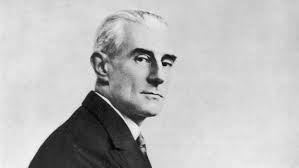
Over the bus sound system in Tokyo, they were playing Maurice Ravel’s “Bolero as I was heading towards a Piet Mondrian retrospective at the Meguro Museum of Modern Art.  As it is raining, I can’t really can’t see clearly out of the bus window due to the heating system in the bus makes the windows foggy.  I use my hand as a window wiper, and with the music, I go back and forth accordingly to its seductive rhythm.  Since it is nighttime, the mixture of neon lighting and the headlights of the coming traffic give a visual that is blurry, with respect that all the edges from objects, including pedestrians into an expressionist painting.  So unlike Mondrian!   I just wonder if he was on this bus at this very moment, what his thoughts would be.


Once I get off my bus stop, I realize that it was a colossal mistake, due that it's freezing and I’m not wearing the proper clothing for this type of weather.  It’s wet, and I shouldn’t be wearing a lightweight v-neck sweater and open sandals.  What was I thinking?  My need to wear what I think is fashionable is always a major problem for me, with great respect to that day’s or night’s weather.  I have a tendency to ignore whatever the temperature is or if it's raining, snowing, or sunshine.  I wear what I always want to wear and damn everything else!  I think i 'm trying to go for a Jean Marais “Orpheus” look, for tonight’s opening at the Meguro Museum.  Once I got in, I realized by the way people who were looking at me, that I appeared to look stupid. One should not go to a Mondrian opening looking soaked and for god sake wearing open sandals.  What was I thinking?


Since I was by myself, I walked around the gallery looking at the paintings with a profound expression on my face.  I don’t normally have an opinion on Mondrian’s work, but before I checked out of the house tonight, I practiced in the mirror various expressions while looking at a painting.  For sure I just wanted to look smart, and if possible, handsome.  But it's really weird that how you look at yourself in a mirror is quite different from how people look at you.


Nevertheless, the exhibition was excellent.  My life is just so chaotic, so actually looking at a Mondrian painting gives me a sense of peace or security.  The same goes for Ravel’s “Bolero” because musically it goes towards a certain distance, and doesn’t let you off till the end of the piece.  What I like about art is one that leads the viewer/listener to a plateau and lets you hang-out before you go back to your messy and unorganized life.

 Afterwards, feeling cold, wet, and not-that-hot looking, I went to an Asakusa music hall, where they had a tribute to French song and dance man Philippe Clay.  I always loved him, because he was so unusual looking, and tall.  He’s renowned for doing songs by Boris Vian and Serge Gainsbourg, but somehow never got the proper attention in the United States.  In other words, he went off the map.  Another artist/writer I like is Georges Perec, because his writing is very formalized in that it is a puzzle of sorts.  Like Mondrian, he was a self-contained visionary who sees the world as one vast workable structure of some sort.  Sadly I am totally the opposite.  I’m reminded of that fact with the feeling of cold rain water smacking against my toes, due to my open sandals, on this very rainy night out in Tokyo.