Showing posts with label Elvis Presley. Show all posts

Wednesday, February 17, 2021

BOOK MUSIK Playlist for "From Elvis to Memphis"


For Book Musik, I put together the ultimate playlist for the album "From Elvis to Memphis." Not only do you hear the actual album, but also the original recordings by artists that inspired Elvis to do this album. As well as some post-recordings such as Nick Cave's "In The Ghetto." Enjoy!


Monday, February 15, 2021

BOOK MUSIK: "From Elvis in Memphis (331/3)" - discussion with author ERIC WOLFSON


Tosh and Kimley are joined by author Eric Wolfson to discuss his new book Elvis Presley’s From Elvis in Memphis (33 1/3). Elvis is a paradox who became the mold for all rock stars to follow. He was the King of Rock in the 50s and then the king of schlock in the 60s but made an impressive comeback with the release of this album in 1969 that reinforced his place in the rock ‘n’ roll pantheon. Going back to Memphis where he started and working at the gritty, down-to-earth American Sound Studio helped him create what is considered by many to be his best studio album.

Links to Eric’s social media:
www.fromelvisinmemphis.com
Twitter: @FromElvisIn333
Instagram: @PresleyDayByDay

Theme music: “Behind Our Efforts, Let There Be Found Our Efforts” by LG17


Wednesday, April 1, 2020

BOOK MUSIK 019 - "It Gets Me Home, This Curving Track" by Ian Penman


Book Musik 019 – It Gets Me Home, This Curving Track by Ian Penman
It Gets Me Home, This Curving Track by Ian Penman CoverTosh and Kimley discuss It Gets Me Home, This Curving Track by Ian Penman. Penman is a well-established British music journalist who has been writing since the 70s. This book of some of his more recent longform essays covers the mod music scene of the 1960s and seven additional essays on music icons James Brown, Charlie Parker, Frank Sinatra, Elvis Presley, John Fahey, Steely Dan/Donald Fagen and Prince. Penman digs deep and examines the broader cultural context of each of these amazing musicians. This is the book that every smart music junky craves.
Theme music: “Behind Our Efforts, Let There Be Found Our Efforts” by LG17


Saturday, July 23, 2016

The Evening Series: Volume 3


The Evening Series : Volume 3

When the sun goes down, and the stars come out, it is at that moment I put on Elvis’ “Worldwide 50 Gold Award Hits: Volume 1” on the turntable.  The recordings are in Mono, and what I have here are the original Mono mixes.  The sounds bounce out of the speakers with a certain amount of intensity.   I met Elvis once when I was a child.  He and his buddies used to play touch football in our neighborhood park every Saturday when he was in town.  “Town” being Los Angeles.  To be specific I’m talking about Beverly Glen Park on Beverly Glen Blvd .  He would show up late afternoon, and they would play till the darkness came.  They left at dusk in a series of expensive looking cars, and it was like seeing ghosts during the daylight hours. 

The last time I saw Elvis was not long ago.   I was at the Four Oaks cafe having a beer, late at night, you know around 11ish.  That’s late for me. I have to get up early for work, especially on the weekends.  He came in by himself, and there was no one else in the cafe.  He took the counter seat across from me.  He told the waitress behind the counter that he wanted to have a coke in a bottle.  She served him the coke by getting it out of the fridge and sliding it across the countertop - and he caught the bottle before it was about to fall off the end of the counter.  He said to her “Thanks Mam.” He looked at me, and I looked at him.  She looked at her dish towel while drying a dish or two.


As I was finishing off my beer, he called out to me ‘hey do you want another?” I just smiled at him and said “sure.” He then got the waitress’s attention, and said “give Tosh another beer.” I was surprised that he knew my name, even though we have met briefly in the park, it was some time ago.   “Tosh, do you mind if I sit with you?” I said “sure, come around.” I then asked afterwards saying that, “or do you want me to come over there.” He smiled, and made a gesture to get up, but then sat down again.  As I got up, he then got up, and I sat down.  We did this for a few more seconds, and we began to laugh hysterically.   He then said, “tell you what, I’ll meet you half-way.” I said “OK.” “I’ll count up to five, and we will both get out of our seats at the same time.” I counted one, he counted two, I counted three, he counted four, I counted…. Five!  And we both got out of our seats by five, and we sat in the middle of the counter bar. “Wow that was something.” Elvis had a funny way of phrasing the most obvious thing, at the right time and place. 

There was a juke box in the corner of the cafe. I asked him if he minded if I played a song. He said “sure go ahead.” I went over and found a song by The Cramps called “Human Fly.” I put the quarter in, and the needle hit the vinyl, and I began to shake. I started to dance for about a few seconds, and then Elvis got up and started dancing with me.  We danced really close without touching each other.  He took out his comb, which was like a switchblade. He opened it and began to comb his hair while dancing.  He then handed me the comb and I put it through my hair as well. I can sense the hair cream on his comb, and it felt good to put it in my hair.  After the song was over, we went back to our seats. 


I bought him another Coke.  I immediately thought of the Frank O’Hara poem about drinking Coke.  Elvis knew the poem and he said that he loved it.  He started to recite it to me:

“Having a Coke with You
is even more fun than going to San Sebastian, Irún, Hendaye, Biarritz, Bayonne
or being sick to my stomach on the Travesera de Gracia in Barcelona
partly because in your orange shirt you look like a better happier St. Sebastian
partly because of my love for you, partly because of your love for yoghurt
partly because of the fluorescent orange tulips around the birches
partly because of the secrecy…”

I told him to stop there.     

We sat there for a while without saying a word to each other.  I still had his comb in my hand, and I gave it to him.  He took it, and put it through his hair, just once.  He drank down his coke in one gulp, sort of burped, and he then smiled at me.  He got up, and rubbed my two shoulders, and said “I’ll be seeing you.” And I said, something like “Yeah.” He walked out of the cafe, and went straight into the darkness outside. He disappeared.  I finished my beer, and I got up, and I too went into the darkness.  Who knows what we will find in total darkness?  

- Tosh Berman, July 23, 2016 (7:30 PM to 8:30 PM)  (Poem by Frank O’Hara)


Tuesday, November 24, 2015

"Sam Phillips : The Man Who Invented Rock n' Roll" by Peter Guralnick

ISBN: 978-0-316-04274-1 Little Brown and Company

"Sam Phillips: The Man Who Invented Rock n' Roll" by Peter Guralnick

I'm a mega-fan of Peter Guralnick's two volume biographies on Elvis Presley.   For sure I thought a biography on Sam Phillips, the brains and sound maker for Sun Records, would be equally fascinating.   But the truth is no.   For one, this biography is way too long.  Without a doubt, Guralnick feels very close to his subject matter, and clearly he loves the music that came out of Sun. Still, I had a hard time keeping my attention to this book.   One also gets the feeling that Phillips was right behind Guralnick's shoulder as he was writing it.  On many levels, it reads like an authorized biography - which can be good or bad.

Sam Phillips was a brilliant record producer.  The Sun Records sound is a very eccentric noise.  Which is not odd, considering that Phillips was an eccentric recording other eccentric artists.  Elvis was the man who fell to Earth.  Probably the closest thing to an alien in the early 1950s.   I feel Phillips captured all the oddness in this young singer's recordings.  One of the reasons why Sun Records era Elvis never sounds like an oldie, because it is still fresh due to the essence of his performance and voice.   In my opinion, there is no such thing as a bad Sun Records release.  My favorite is Carl Mann, and sadly he only gets a page or so out of this 660 page book. 
Sam's life is not really that dramatic compared to Elvis.  The narration of Elvis is a fascinating one, and it has all the trademarks of a tragic Shakespeare play.  Guralnick beautifully played out on the heights and the super lows of Elvis, and Sam Phillips just doesn't have the emotional range four such a biography.   Still, Sam Phillips is an interesting man.  It would have been more interesting to me if there was a book length Q & A format, instead of the biography.  Or even Guralnick's narration on knowing Phillips and what it meant to him.   He writes about that in the second part of the book, which I think could have been a stand alone piece.  

Still, this is a must read for anyone interested in Memphis or its musical history.   The shocking thing to me, especially admiring and reading his Elvis bios, that this book should have been the essential read on that subject matter.  It's up there, but not the best.  

- Tosh Berman

Friday, March 28, 2014

March 28, 2014


March 28, 2014

My not-so-distant relative the film producer Pandro S. Berman wanted to make a quick exploration film for MGM regarding the upcoming “Beat” scene that was happening at that time.  He just finished the production work for the Elvis Presley starring “Jailhouse Rock” and was interested in doing a film where Elvis played a ‘beatnik poet. ' For research, Elvis actually went to City Lights bookstore to pick up on the vibe of the store as well as the local North Beach scene.  He made an effort to get a job at City Lights as a book clerk, but that obviously wasn’t going to work out.  There was also talk of Berman producing a film version of Jack Kerouac’s novel “On The Road, ” with Elvis playing “Dean Moriarty” and British actor Dirk Bogarde playing Salvatore “Sal” Paradise, the novel’s narrator.


Bogarde flew out of London to meet Elvis in San Francisco.  At the time Elvis never drank, but still, he met Dirk at the bar Vesuvio, that was practically next door to City Lights.  Dirk just wanted to talk to Elvis personally without any managers around or studio people.  He had very little knowledge of the beats, and basically his understanding of that scene, for him, came from his knowledge regarding the Teddy Boys.  He knew and heard of the existentialist scene in Paris that was occurring at the time, but the beats were a totally foreign concept to him.   But he desperately wanted to make changes to his image from teen idol to a serious actor.  There was a darker side to Bogarde, and he felt he needed to express that side more.  But wasn’t sure how, and on top of that he was getting frustrated with the studios back in the U.K. He felt that this could be the role for him to change everything.  Also he had a great admiration for Elvis.  He didn’t really understand the music, or that type of culture, but he saw something that was sincere and raw in Elvis’ approach to music and image.


Elvis was a truck driver before singer, and he could identify with Dean with respect to his natural energy to go out and get going.  Also in his mind, the name “Dean’ relates to his favorite actor James Dean.  He was aware that his films were kind of lightweight, compared to the world of James Dean, and he wanted an ‘in’ as much as Dirk did.   Bogarde ordered himself a Pabst Blue Ribbon beer, thinking it was very American type of thing to order in a San Francisco bar, and Elvis, being Elvis, ordered a bottle of Coke.   They went together to City Lights and they each bought a copy of “On The Road, ” and looked and commented on each page of that novel over their beer and coke.

Sitting in the bar, in one of its small tables, Dirk was all of sudden taken back by him being there with the actual iconic Elvis, discussing what they both felt was an iconic novel that surely can be a film vehicle for the both of them.  With the help of Berman, they couldn’t possibly imagine this to be a failure.   Nevertheless, history has a way of by-passing moments like these for something that eventually will not be important.  And who knew at this point and time, that Dirk Bogarde would enter a second chance in the Briitsh film world as one of its most amazing actors.

Wednesday, January 8, 2014

January 8, 2014


January 8, 2014

I met Elvis Presley when I was around 10 years old.  In Beverly Glen there is a park off the main street where every Saturday Elvis and his Memphis friends would team up to play touch football against, and mostly, the citizens of Bervely Glen Canyon.   My father would join these pick-up games occasionally and it seems to start up around 2:00 P.M.   I was with my father watching him play football, when one  of Elvis' buddies came up to me and ask if I want to meet Elvis. I said sure, or however a 10 year-old says 'sure' and he lead me to Elvis as we approached him towards his back.  He was sitting on the park bench by himself watching the games, and he was wearing a blue double-breasted jacket with crisp white slacks, a sailors cap, and wrapped around sunglasses.   His friend, who was directly behind Elvis at this point said to him "Elvis meet Tosh."   Elvis without turning around or looking at me stretched his arm and hand towards me and I put my little hand in his to shake.  He didn't say a word nor looked at me.

I never met David Bowie, but I did go to his Santa Monica Civic show in October 1972.  My father and mother took me, and I must have been around 17 or 18 years old.  It was my first time seeing such a 'production' in a rock n' roll show.  I was struck by him physically being on stage and the fact that his movements was very stylized and not overly emotional or friendly-like. About a year later I went to the Long Beach Arena to see his "Aladdin Sane" show, and again I was struck by his sense of theater, or his ability to raise the rock n' roll show into another medium.  I never seen anything like that before.  Also I was with a girl and her girlfriend ,and I liked the girl very much.  But alas, she never liked me the same way.  So the memory of this show is one of the highest of the highs, and the lowest of the lows.  The next time I saw him was at his Diamond Dogs show.  This was very special because Toni Basil got us tickets for this performance, and we sat next to Steve Allen and his wife Jayne Meadows, who were old friends of Toni's.  It was amazing to me that I was sitting with Mr. and Mrs. Allen, which at the time I felt I was on a TV chat show.  The last time I saw Bowie was where I used to work, at a bookstore.  He came in and pretty much purchased every new fiction hardcover book on that trip.  When he paid for his books, I was physically very close to him and I noticed the difference between his eyes.  One was a different color from the other and it was kind of breath-taking beautiful.


Saturday, January 4, 2014

Dancing in the Street - A Rock And Roll History episode 1


A fascinating BBC multi-segement documentary on Rock n' Roll history.  This is part one and it is a narrative I know about, but still... it's great to hear these people tell their tale.  Watch it!

Sunday, March 11, 2012

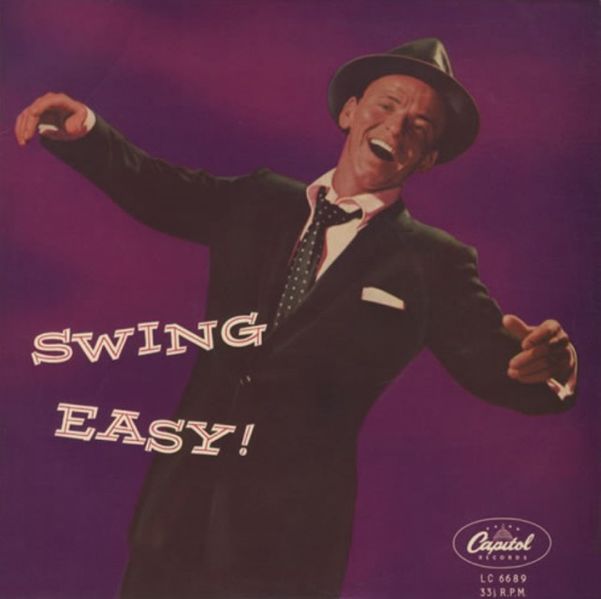
Frank Sinatra's "Swing Easy" on Vinyl

For the obvious reason I am always interested in works that came out in 1954, the year of my birth.  Elvis' Sun recordings as well that year.  Its interesting to compare both Frank Sinatra's "Swing Easy" with Elvis and what they were doing at the time.  One was a weird hybrid of popular music filtered through the genius of Sam Phillips via the voice of Elvis and his remarkable band.   Sinatra on the other hand was making one-theme  albums - in a way his recordings for Capital were like narratives that was separated by side one and side two. "Swing Easy" is basically all up-beat pieces arrangement wise as well as for its lyrics.  There is always a dark cloud roaming somewhere around Sinatra's neighborhood, but overall he's fighting that down feeling with being forcefully upbeat.  So there is tension in the recordings.  
Also I am curious to know if he was listening to Sun Recordings.  "Lean Baby" reminds me of Elvis. Now having Sam Phillips behind the recording board for Sinatra....that would have been interesting.  


Thursday, January 26, 2012

Elaine Dundy's "The Old Man and Me"

The late and great Elaine Dundy is a very interesting woman, who lived near Book Soup and was a customer as well.  Little did I know of her writing career till I read "The Dud Avocado" which is fantastic by the way.  So her history is fascinating in that she was married to British theater critic great Kenneth Tynan and also wrote the first serious in depth biography on Elvis.

So of course "The Old Man and Me' would be of interest, but beyond that, it is quite a remarkable novel on various levels.  The thing that really caught my attention is that she really got into the language of the British and its difference from American English.   Two, she has some knowledge (of course) on the British personality and how that works with the American personality.  And three, this is a really smart novel about how cultures merge - especially in early 1960's London.   The main character resembles a much sweeter Patricia Highsmith twisted character who is dealing with identity and revenge of sorts.  She knows what she wants, but does not know why she wants it.  And that is the main problem with "Honey Flood."   She goes out to seduce, but she gets seduced and its a weird journey from naive to knowing.  

The book captures the culture of London in the early 1960's -before the Beatles and in some ways London itself is one of the characters in this novel.   It's a great piece of London literature. 


Friday, December 16, 2011

Sunday, May 23, 2010

"Return of the King" by Gillian G. Gaar

Return of the King: Elvis Presley's Great Comeback Return of the King: Elvis Presley's Great Comeback by Gillian G. Gaar


My rating: 3 of 5 stars
Elvis Presley = sadness. It is truly the most depressing story of an icon music legend. On one level one would think Elvis was just dumb, but also he was a man who had the moment and the time (1950's) and he was sort of the force that got us over to the 1960's. The concept of Elvis is genius, but the life that is Elvis is not genius, but rather pathetic or someone caught is a strange depressive state of mind and body.

"Return of the King" is a well written researched book that focuses on Elvis' comeback years that quickly turned into a march to death. The great bio on Elvis is the two volume set by Peter Guralnick, and all others are just a shadow to that particular biography. Saying that, this is a very good book, but it has been said before, so there is really nothing new regarding Elvis and his world.

But for sure, anything on Elvis, one has to talk about Memphis and its culture. The Southern (gothic) culture basically made Elvis, and you can sort of see his world via the images of the great Southern photographer William Egglestion. Roughly both men are in the same generation, but it is interesting to see how outside influences such as the Southern family and settings can make a person tick. The big picture of Elvis is not his sad life, but how is life is part of a bigger puzzle that is the 20th Century South.

Elvis is fascinating in so many ways. A man who wore pink pants and eye make-up in his teenage years, and who adopted black culture as well as country music to make a hybrid sound - or a Frankenstein monster in a sense. Gillian Gaar is good with the facts, but there is no real analysis with those facts. She interviews all the key players but none can penetrate the Elvis wall. And I think even Elvis couldn't penetrate that wall.

So yeah if you are a Elvis fanatic this is a good book. But it has all been said in the Guralnick bio - but then again, like a car accident repeated in front of your eyes again and again, its hard to look the other way.

Also I want to note that the publisher Jaw Bone is fantastic. They don't do poorly designed books, and "Return of the King" is a beautiful production. Great cover, thick pages, nice photos - the whole package is great.

View all my reviews >>