Wednesday, August 15, 2012

"I Am Sitting in a Room" by Brian Dillon


This morning I was researching writers for future projects, and a fellow writer recommended this writer.    I tracked down this book in the D.A.P. catalog and I was immediately turned on by the idea of this book. I bought the book at Book Soup this afternoon (around 3PM west coast time), and read it on the bus heading towards home. Brian Dillon, an editor for the great journal "Cabnet" has started a project where a writer sits (or stands up) and writes a book within 24 hours i.e. one day.

The first title of this new series is Dillon's "I Am Sitting in a Room."  The author worked in his office at Cabinet Books and from December 10th, 10 A.M to December 11th, 10 A.M wrote and finished this book.

Brian Dillon at his temporary desk at Cabinet writing this book
And I have to say its a really good book.  The big part of the book is about writers and their writing spaces.  I don't know if readers are interested in this subject matter, but for sure writers are. In fact space, time, and place are important for an writer, as well as his/hers writing equipment, desk, and whatever books are on that writing table as well.  

So there is structure set in place and part of the charm of this book is to see what he ate or drank within the 24 hour period as well as a list of his favorite writing spots/places.  The one thing I find odd is that he doesn't seem to be listening to music while writing.   Maybe on his computer?  But he doesn't mention it. 

Nevertheless this is a perfectly charming book and a meditation on the importance of location, but also he treats writing as a fetish, and its quite a seductive world between the writer and the reader.  

Tosh Berman while writing this particular blog on Brian Dillon


Sunday, August 12, 2012

TamTam Books' Tribute to Glenn O'Brien


Its not easy to find men of great taste, but as a teenager I was a huge fan of "Interview" magazine, not really because of Andy Warhol (who's pretty good), but the monthly writings of Glenn O'Brien and his column "Glenn O'Brien's Beat."   I enjoyed his work because his take on music was super interesting to me at the time, and also he was a man who seemed to be well-read and knew culture from the bottom to the top.

Just recently I discovered his cable show from the 1970's "TV Party" which is an incredible snapshot of Manhattan being truly Manhattan.


First episode of Glenn O'Brien's "TV Party" (December 18, 1978)


TV Party "Halloween Show" (October 1979)


Survey of music guests on Glenn O'Brien's "TV Party" (with Blondie, Klaus, etc)


Jean-Michel Basquiat (SAMO) on Glenn O'Brien's "TV Party

O'Brien also wrote about the visual arts, and very recently on fashion.  Again, it is his character that makes his work so appealing to me - and the fact that he's very good on the page.


Glenn O'Brien's interview regarding fashion and his book "How To Be  A Man"


Glenn O'Brien on how to wear a pocket square


Interview with Glenn O'Brien

Here's a book review i did on his collection of essays: "Soapbox."

Soapbox: Essays, Diatribes, Homilies and Screeds 1980-1997Soapbox: Essays, Diatribes, Homilies and Screeds 1980-1997 by Glenn O'Brien


Whenever I see the name "Glenn O'Brien" in a magazine I usually buy that issue. I first discovered him during the highlight years of Andy Warhol's Interview magazine. He always struck me at that time as the perfect Manhattan journalist. He had good music taste, loved the visual arts, and was super urban witty in that classic Algonquin Round Table mode. One would think he would know Dorothy Parker, but alas, different generation and perhaps taste.So what we have here are a collection of essays originally published in Interview and Artforum and other locations. They deal with big issues like gender, art, music, sports, and culture among other subject matters. But the genius of O'Brien is that he makes these subjects personal and he is also peppered the writing with his good nature. Christopher Hitchens without the emotional up and down, just straight forward clear thinking yet a touch odd point of the view look at the world. Also buying this book in the used section at the Strand made it kind of an essential type of purchase in New York City.


Wikipedia on Glenn O'Brien:  http://en.wikipedia.org/wiki/Glenn_O'Brien

Glenn O'Brien's website and blog (with an incredible interview with Gore Vidal) /http://glennobrien.com/

Alain Goraguer's great score for J'IRAI CRACHER SUR VOS TOMBES (I Spit On Your Graves) 1959

Front Cover

Back Cover

Side Two of J'IRAI CRACHER SUR VOS TOMBES


Friday, August 10, 2012

"Many Subtle Channels" by Daniel Levin Becker


Superb book that is both the history and the explanation of the great literary group OULIPO. Daniel Levn Becker, the author, actually became an official member of the OULIPO, and it's with great humor and appreciation of these rather 'eccentric' characters that make up this group that are obsessed with word games and how those games turn into literature.

When I first picked up the book I thought it maybe a very dry look or approach to OULIPO, but alas, it is anything but. "Many Subtle Channels" is a personal look into the works of Georges Perec, Raymond Queneau, Harry Mathews, Jacques Roubaud and others. What sounds like party games is actually a deeply involvement with literature and how it works. But done with great humor and wit. An important book on its subject matter, but also a great read.

"Bookworm" with Michael Silverblatt.  Interviewing members of Oulupo.

Oulupo at work

Georges Perec

Raymond Queneau

Jacques Roubaud

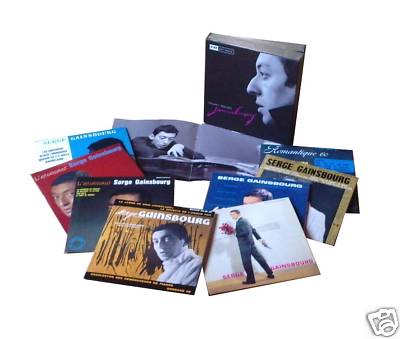
Serge Gainsbourg Volume 1 1958-1962

Serge Gainsbourg Volume 1: 1958-1962

My Serge Gainsbourg obsession is not going to die out.  Especially now that I published Gilles Verlant's amazing biography on the man ("Gainsbourg").  Not that long ago I bought this incredible vinyl box set of Serge's early 7 inch 45 rpm EP's.   Mono recordings. Beautiful package.  All with original front covers and back covers and it comes with  a little booklet.  

Ah, but what about the music?  Well for me, the iconic one can't do wrong, but without a doubt my favorite time period - musically speaking - is his work from the 1950's to the early 60's.  I love his jazz foundations for his songs.  Alain Goraguer is sort of my arranger god, and his work with Gainsbourg is amazing.  Like his work with Boris Vian recordings, Goraguer knows how to serve the artist - and its really a beautiful relationship between Gainsbourg and Goraguer.  Reading the Verlant bio, they had an up and down relationship - but overall a good one.  

Serge Gainsbourg Volume 1: 1958-1962


Thursday, August 9, 2012

"All Night Long" a JAZZ film by Basil Dearden


Sometime ago I bought "All Night Long"  as an import DVD, but now Criterion has put it out and its a really interesting film that captures early 60's British Jazz with Americans Charles Mingus and David Brubeck.  The film takes place at a British apartment full of jazz-heads and musicians.  Patrick McGoohan plays a drummer who has a band and is trying to snag a singer away from another combo - but alas this story is based on Othello and deals with the backstabbing of the music world ...of sorts.


Patrick McGoohan on drums!


Dave Brubeck

Charles Mingus

I have a vinyl of this album
So its a fantastic moment when I found a copy of this album. All is well in this world.


The Seduction of Ingmar Bergman by Sparks (live footage)


One of the great shows....Ever!  I am just amazed in how they always come up with something so unique.  They never get tired, and seems to eat age like a fine dish, and make it young and beautiful.  Love Sparks.

Sunday, August 5, 2012

"Dublinesque" by Enrique Vila-Matas


Enrique Vila-Matas can't do wrong in my book.  "Dublinesque"  starts off with a publisher on his last publishing days, approaching 60, and an ex-drunk.  How can I not like this book?   There is a strong narrative in this novel, but like his other books its a full length literary criticism as well as its history told in a novel form.   The focus on "Dublinesque" is the world of James Joyce via the eyes of Samuel Beckett and other Irish writers.   Riba, the main character, is aware of the beginning of the dying days of literature - and is compelled to visit Dublin, a city that he never been to -in a sense pay his lasting respects to a certain type of literature.   It is also a picture of a marriage disappearing in the cracks of indifference, literature, and drink.   A wonderful book.

Tom Recchion's new album "Proscenium"


Composer (and TamTam Books' designer) Tom Recchion's first solo album in six years!   A year without a new Tom record is not a good thing.  "Proscenium" is issued in a limited edition of 500 copies. The package consist of a LP and 7-inch.  

The tracklist:

01. the mesmerized chair
02. entrance music no. 2
03. entrance music no. 1
04. exit music no. 1
05. the haunted laboratory
06. lean your eye into the picture


Saturday, August 4, 2012

"Pull My Daisy" by Robert Frank, Alfred Leslie & Jack Kerouac

photograph by John Cohen

A book or object by the German publisher Steidl is always excellent. They simply do not put out bad titles or books. And for the past so-many years they are the press to go to with respect to the works of Robert Frank. "Pull My Daisy" is a film made by Frank and Alfred Leslie that is basically ground zero for the Beat Generation. Based on an un-produced play by Jack Kerouac, this 28 minute film stars poets Allen Ginsberg, Gregory Corso, and painter Larry Rivers. With Alice Neal and David Amram. And a totally improvised voice-over by Kerouac. 

This is a work that has 'charm' all over it. In many ways a goof, but as one knows in the Beat world, a goof is sort of a heightened experience. Kerouac is a genius, and there is no bad Jack. Sometimes there is weak Jack, or Jack-can-be-better - but overall this titan of Beat can really do no wrong with me.

For around $28 you get a beautifully (and simply) designed box with two books. The 'script' with essay and another book by the great photographer John Cohen with his footage of the making of this film and other images of them just hanging out. Simply essential in a goofy way.


Photo by John Cohen, Jack Kerouac & Robert Frank

Tuesday, July 31, 2012

Social Page: "Gainsbourg" Event at ARTBOOK@ Paper Chase


EVENTS

DATE: 7/30/2012 | BY JANE BROWN

A Gainsbourg Evening at ARTBOOK @ Paper Chase


On a warm Tuesday evening at the ARTBOOK @ Paper Chaseshowroom in Hollywood, the Paris-based biographer Gilles Verlantwaxed poetic about the life and times of the legendary French chanteur, actor and director Serge Gainsbourg. Joining Verlant wereTamTam Books publisher Tosh Berman and translator Paul Knobloch. Tuesday's event was a celebration of Verlant's newly translated Gainsbourg biography. The panel kept the standing-room-only crowd riveted with stories and anecdotes about the late, great pop icon—the French Cole Porter.
In putting together this biography, Verlant spent hundreds of hours interviewing Gainsbourg himself, as well as his relatives, and, of course, his many lovers—including Jane Birkin and Brigitte Bardot.

A Gainsbourg Evening at ARTBOOK @ Paper Chase
Translator Paul Knobloch with publisher Tosh Berman and author Gilles Verlant.

A Gainsbourg Evening at ARTBOOK @ Paper Chase
Aperture’s Leslie Martin with Ice Plant’s Mike Slack.

A Gainsbourg Evening at ARTBOOK @ Paper Chase
Jane Brown and Maripol.

A Gainsbourg Evening at ARTBOOK @ Paper Chase
Mikie Shioya and Japanese journalist Kiichiro Yanashita.

A Gainsbourg Evening at ARTBOOK @ Paper Chase
Paris Photo organizers Jean-Christophe Harel and Julien Frydman.

A Gainsbourg Evening at ARTBOOK @ Paper Chase
Marc Jacobs' Jennifer Baker and Randy Shelp.

A Gainsbourg Evening at ARTBOOK @ Paper Chase
Gilles Verlant with Tracey Quiqley and Fawn Hall.

A Gainsbourg Evening at ARTBOOK @ Paper Chase
Leslie Rubinoff and Libby Kauper.

Sunday, July 22, 2012

"Paris!, Photos 1950-1954" by Ed Van Der Elsken


A very personal book on city life by the great photographer Ed Van Der Elsken.  i first discovered his book "Love on the Left Bank" some years ago, when I first got interested in Situationists/Letterists and every other movement that came from St. Germain des Prés (Hello Boris Vian!).

What i find striking is that as the Beat Era was happening, so was the urge to find a better creative life as well in Paris.  Boho culture is Boho culture, and it goes beyond national, international or via a very readable sense of time-line history.  When you look at these images from the early 1950's, you think you are looking at Punk era 1977.  Its amazing how history repeats itself in such mysterious ways.   Beautiful book "Paris! Photos 1950-1954" and its great that I found it at my local used bookstore (Alias East on Glendale).

All images down below are from "Paris! Photos 1950-1954."

Photo by Ed Van Der Elsken

Photo by Ed Van Der Elsken

Self-Portrait by Ed Van Der Elsken

photo by Ed Van Der Elsken

Photo by Ed Van Der Elsken

Photo by Ed Van Der Elsken


Saturday, July 21, 2012

"No Regrets: Writings on Scott Walker" edited by Rob Young


Personally, my life would be kind of empty without the sounds of Sparks and Scott Walker.  Both are on this world, yet they seemed kind of removed from the world as well.   And both have huge cultural baggage of sorts, but cannot be put in a box or simply explained.  They have to be experienced - and "No Regrets: Writings on Scott Walker" is a super enjoyable read (i.e. experience) that goes through out the career of Scott.  

The book is put together by Rob Young via the great British music magazine 'The Wire.'   And this is the perfect publication to do an anthology all on the subject of Scott Walker's music.  Included are late interviews with the composer/songwriter/singer, but more interesting to me are the essays on certain aspects of Scott Walker's albums.

To give one who isn't exposed to the world of Scott Waler, it is best that I give him and his music a brief introduction.  Scott Walker was a member of the Walker Brothers (none were actual  brothers), from America but went to London during the British invasion.  Unlike the Beat groups of that time, The Walker Brothers specialize in Phil Spector style big production ballads - with Scott as lead vocalist.  An incredible voice who knew how to relay a lyric like it was a simple act of putting butter on a hot piece of toast.  Over a short period of time they became teen idols of sorts, and for Scott this was a sign of total despair.   A man of humor, but a sort of humor that laughs with Ingmar Bergman films than say the Carry on films.


In the mid-60's to late 60's he made a series of solo albums that are now considered to be classics.  And they were very odd albums compared to the swinging 60's of London.  Huge orchestrations, beautiful voice singing Jacques Brel songs as well as his own material - which at the time were very much influenced by Brel and the whole French style of singing about personal and earthy narratives.  While everyone in the world of pop was tuning in- or dropping out - Scott was sort of a hipper version of Jack Jones (a singer he admired at the time) or a throw back to the pop crooner.   So that alone made him stand out with respect to the Pop explosion of the 1960's.


In the 70's he lost the pilot of sorts (and reading this book now I have second thoughts on this period)  and sort of sang for his supper - till the late 1980's where he made a series of albums every 10 to 12 years that are totally unique, odd, beautiful, disturbing, and well, fantastic art.   This book covers all different aspects of Scott Walkers very long but fascinating career.


The longest piece is by Ian Penman, focusing on the albums that no no really cares about - including Scott!  But here you can see how this 'dead' period gave fuel for him to make his future masterpieces - and therefore cannot be denied!  The beauty of Walker's life in music is that they are all pieces of a puzzle - and you have to spend the time going over those pieces or putting them together to see the whole picture, which of course is a masterpiece.  And this book helps the listener put the pieces together.   Pennman with great wit, writes about the down years of Scott that to me are not wasted, but career wise must have been a downer for him.


And there is not really a downer of an essay in this book.  Young did a remarkable job in giving an intriguing picture of Scott Walker.  I am so happy that this book exists.


Friday, July 20, 2012

Gilles Verlant & Tosh Berman at the Tosca Cafe, San Francisco on July 24th at 7PM


Gilles Verlant on Serge Gainsbourg
Tuesday, July 24, 2012, 7:00 P.M., Tosca Cafe, 242 Columbus Avenue San Francisco, CA 94133


City Lights in conjunction with Litquake's Epicenter Reading Series present
An evening of discussion, music and video
Gilles Verlant in conversation with Tosh Berman
at Tosca Cafe, 242 Columbus Avenue San Francisco, CA 94133
21 and over, please
celebrating the release of
Gainsbourg: The Biography
by Gilles Verlant
translated by Paul Knobloch

When Serge Gainsbourg died in 1991, France went into mourning: François Mitterand himself proclaimed him "our Baudelaire, our Apollinaire." Gainsbourg redefined French pop, from his beginnings as cynical chansonnier and mambo-influenced jazz artist to the ironic "yé-yé" beat and lush orchestration of his 1960s work to his launching of French reggae in the 1970s to the electric funk and disco of his last albums. But mourned as much as his music was Gainsbourg the man: the self-proclaimed ugly lover of such beauties as Brigitte Bardot and Jane Birkin, the iconic provocateur whose heavy-breathing "Je t'aime moi non plus" was banned from airwaves throughout Europe and whose reggae version of the “Marseillais” earned him death threats from the right, and the dirty-old-boy wordsmith who could slip double-entendres about oral sex into the lyrics of a teenybopper ditty and make a crude sexual proposition to Whitney Houston on live television.
Gilles Verlant's biography of Gainsbourg is the best and most authoritative in any language. Drawing from numerous interviews and their own friendship, Verlant provides a fascinating look at the inner workings of 1950s–1990s French pop culture and the conflicted and driven songwriter, actor, director and author that emerged from it: the young boy wearing a yellow star during the German Occupation; the young art student trying to woo Tolstoy's granddaughter; the musical collaborator of Petula Clark, Juliette Greco and Sly and Robbie; the seasoned composer of the Lolita of pop albums, Histoire de Melody Nelson; the cultural icon who transformed scandal and song into a new form of delirium.
Gilles Verlant is a journalist, editor, and a TV / radio personality in France for the past 30 years, specializing in rock music and the french chanson. From 1980 to 1990, Verlant interviewed Serge Gainsbourg and had full access to his archives. He has written the most complete biography on Gainsbourg, who revolutionized French pop music in the second half of the 20th Century. Twenty years after his death, Serge Gainsbourg remains the very essence of scandal, sexual intrigue, and music brilliance.
Tosh Berman is the publisher of Tam Tam Books.
Visit: Tam Tam Books

Books related to this event:

Product image
Gainsbourg
The Biography
Gilles Verlant
2012 Edition
Gilles Verlant's biography of Gainsbourg is the best and most authoritative in any language. Drawing from numerous interviews and their own friendship, Verlant provides a fascinating look at the inner workings of 1950s–1990s French pop culture and...