"Sinatra : The Chairman" by James Kaplan (Doubleday)
A horror story. I couldn't stop reading this biography, and it is over 800 and something-like pages, and it strikes me as the ultimate American tale, and as its nightmare. Frank Sinatra, without over-stating, is without a doubt a great figure in American culture. He is also a monster. Nevertheless, a truly great pop(ular) artist who can cut through the bullshit by just singing. It is when he's not singing is when trouble lurks like a bad disease.
I read James Kaaplan's first volume, "Frank: The Voice, ' with incredible pleasure. What made the book sing out so greatly was Kaplan's ability to capture the early years of Sinatra and make the reader understand the world that he lived in, and the life of a big band vocalist. Also the author has a firm grip on the music itself, so it wasn't all just punches, drinking - there was also the music aspect of Sinatra's life. "Sinatra: The Chairman" is like an everlasting hang-over that never gets better.

It is interesting how Kaplan entitled these two parts of the biography. "Frank: The Voice" is very much an intimate read on one's music and character. He used the first name, and also brings up the subject matter of his instrument of choice - the voice. The second volume is his family name "Sinatra" and it is about power "The Chairman." And for me, this is what I find both interesting and troublesome about the second volume. First of all, I don't feel like it's the author's fault. I think the publisher or editor should have made this biography into three separate volumes. The early years (The Voice), then perhaps a book on the rest of the 1950s to the 1960s - and then perhaps the last volume could focus on his aging life. The thing is with Sinatra you can make just a book just on his relationship with the Mafia/Kennedy, or one focusing on his films, and it would be a fascinating individual read.
After reading "The Chairman" I feel like I was in a boxing match with Sinatra. This is a man who gave as well as obtained pain for himself. Not a long death mind you, but for sure he's a soul who got beaten up over and over again. I can't feel sorry for him, but I also feel really tired after finishing this book. It is sort of like taking care of a sick relative and they're driving you crazy, even though you love them. Frank Sinatra, was a total creep. A nice creep at times, and he had the moves of a person who had the social grace. But like someone who experiences life as if someone turned off and on the lights in one's house, he must have been a dangerous man to hang out with.
For me, when I listen to a classic Sinatra album, I'm totally lost in what he's saying to me at that moment when the needle hits the vinyl or I push the button on the CD player, or on my computer. He is one of the few singers, that I have to stop everything to listen to hm. His dictation or voice makes me follow the lyrics. He is probably one of the great American vocalists, where the lyrics are front and center. It is never lost in the mix of the recording. The wording is so important to his aesthetic. He had taste, and he understood the concept of the recording, so therefore he had a vision as well. This has nothing to do with his cruelty in his private life whatsoever. Nor do I think it has anything to do with his personal relationships. He comes upon a song, and bingo, he can express the full emotional aspect of that piece.
When I hear a Sinatra recording, I'm not thinking of the Mafia, his women, or anything in his life. I'm listening to someone who can articulate a certain joy or pain, that I can easily identify with. As a listener, I can't imagine myself as a jet-setting playboy, but I too know the stings and joy of love, and that is what is so masterful regarding Sinatra's talents. The noise of his private life is just that, noise. Of course, he had a fascinating life. The media is so psychotic and Sinatra had the misfortune (or talent) to feed that engine that never tired.
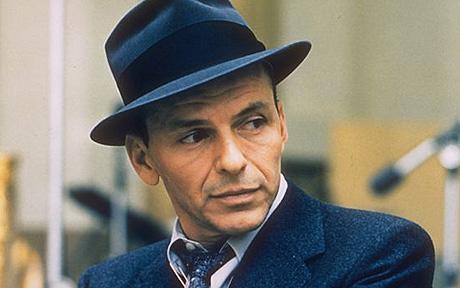
The problem of dealing with Sinatra's 100th birthday is that we are kind of forced to take his whole package. Therefore we can comment on his lifestyle and cruelty, and that somehow makes his art less appealing. Which is understandable, but the fact is he was a fantastic participant in record / music making, and that is what we should remember him for. The mid-life crisis that is the Rat Pack, his moronic relationship with certain girlfriends and male friends alike - all are interesting. But when I play a good Sinatra record, I totally forget all of that, and fall into the mist or landscape that is a combination of magic and vision. Sinatra had the ability to transform the listener, and that is what I like to remember him by.
"The Voice" and "The Chairman" is surely the last of the biographies on this gigantic figure. If you want to know who this man is, was, and his role in pop culture, these books will lead you to that path. On the other hand, I would recommend the Capital and some of the Reprise label material, that really addresses his importance to pop culture.
- Tosh Berman


.jpeg)


.jpg)


 Posts
Posts