Thursday, March 9, 2017

March 10, 2017 (Tosh's Diary) Japan


March 10, 2017 (Tosh's Diary) Japan

I'm ill.  Something is decaying in my body, and I tried every measure to piss or poop it out.   David Bowie went from station to station, but I'm going from toilet to toilet.   Every station has a bathroom as well as every public building.  In Los Angeles, I'm consistently reminded that there are very few public toilets in the city.   Tokyo and other cities in Japan seem to take the route that public bathrooms are a human's right to pee.   In the United States, you need to buy a cup of coffee before being allowed to the bathroom.  So in other words, one must have the currency of some sort to pee in a proper manner.


The Japanese toilet has other problems.  Well, the toilet itself doesn't have a problem, but the foreigner who can't read Kanji may have an issue with the object that's the toilet.   There are two types of toilets in Japan.   The western style, but has the added features to spray water on your behind, both hard and soft, as well as a bidet for the female.  Some come with a dryer, but all have a heated seat.  Even when I don't want to use the toilet, I like to sit on the warm seat and read.


One has to be careful in which button they're pushing.  Some years ago, I was in a public toilet in an expensive restaurant, and after I had peed, I played the game eenie meenie moe to select the right button.   "Meenie" led me to push a button where all of sudden a pipe came out of the toilet bowl and sprayed warm water all over my crotch.  I was wearing white levis, and it seems the entire restaurant knew what happened to me in that particular toilet.


The other is the 'squat' toilet.  This is the standard toilet you find in small Japanese towns or the countryside.  Some old department stores as well have them.  One can usually make a choice.  The Western toilet is very common now.  Still, I have never used this type of toilet because I could never figure how to use it.   I presume one had to sit or hover over it, but at what part of the toilet do you release your obscene insides?

Japan has an understanding of the need for the bathroom.  In fact, it is almost an art piece.  The structure of the 'squat' toilet is something that a fan of Marcel Duchamp can appreciate.  The other thing one must remember, especially if you are in someone's home - never bring the outside slippers into the toilet area.   There are toilet slippers, and they are to be used only in the toilet room.   This is an important rule to follow.   There is nothing more disgusting when someone uses the same pair of slippers for inside the house as well as in the toilet area.  That alone is making me ill at the moment.


But back to my illness.  It's impossible for one not to get sick when facing thousands of people on a daily level in the streets of Tokyo or any other major Japanese city.  If you travel on the train during the rush hour, you will be more likely to be kissing distance to either female or male.   Often I have opened my mouth, and someone would cough right into my open port.  So as I write, I'm feeling sick and of course, not in the greatest mood.

- Tosh Berman

Images of Japan Part Two: Photos by Tosh Berman


Tuesday, March 7, 2017

Le Lion Cafe in Shibuya Tokyo


I was going to walk to a bookstore but decided to visit Le Lion Cafe which is in the Shibuya area of Tokyo.  I go here often over the years. It is one of my favorite places and by far my favorite cafe.  Their specialty and only specialty is that they play classical albums - mostly vinyl.  The coffee there cost 550¥, and it’s not that good.  What you’re paying for is someone to play records for you.  A vintage DJ set where one plays music for another.   They have these two massive wooden cabinet speakers facing the coffee drinkers.  One is not allowed to converse at the cafe.  There are small wooden chairs and covered seats.  All were facing the direction of the three turntables, various amps, and a CD machine or two.


When I walked in, they were playing Schubert’s “The Four Seasons” on vinyl.  Before and after each record, the waiter/waitress gives an introduction to the music being played.  Usually, they give the composer and the piece, but they also read from what looks like an old hardcover book on classical music, to provide detail about either the recording or the orchestra/musician/composer.  Last night after each playing, the waitress cleaned the vinyl before and after playing the record.   The next record was, I think, a piece of music by Tchaikovsky.  All introductions are done in Japanese, and they do exhibit the album cover on a stand in front of the speakers, but the lighting is so dark it’s hard to make out what the print says on the record cover.  She then played a recording of Handel’s harpsichord music.


I casually looked around the small room, and there are three people there drinking coffee and listening to the music.  There is an upstairs as well, that is the balcony, and the seating arrangement is the same as the bottom floor.  When you see the speakers, one would think that it will be loud.  The volume is somewhere in the middle.  What's interesting is that the music doesn't drown out the noise outside the cafe.  You can hear people laughing and walking pass the Lion Cafe, and one is aware that there is life outside the listening room.  The other thing one notices is that the architecture inside and outside represents a baroque era.  It is almost if you were walking down a street in the 17th century Vienna and you come upon this coffee house.  It's European but with the oversight of a Japanese aesthetic.

There are many things here that I find impressive, but one is sitting by yourself and being confronted with Western culture in an Eastern country.   The cafe is located in the Red Light District in Shibuya.  There are nothing here but bars and love hotels.   One would think that the perfect location for Le Lion Cafe would be the Ginza or West Shinjuku.  Here in Playland is the ultimate escape from the 21st century into the world that is both real and imagined.  The best 550¥ ever spent.

Sunday, March 5, 2017

DAVID BOWIE IS.... In Tokyo


DAVID BOWIE IS ... An Exhibition in Tokyo, Japan

As most of my friends and enemies know, I love David Bowie.   I have been thinking of David Bowie for every day since 1972 when I purchased "Honky Dory."   My whole life is mapped out by Bowie's releases of album and singles.   To say he's important to me is like asking if humans need to drink water.    I actually don't understand people who don't like Bowie's music.  I have met them, but for me, they're truly alien from another hostile planet.  So, one would think I would be bananas over the David Bowie Is" exhibition.   The truth is I like it, as a spectacle, but I think they could have done much more of a better show.


I now imagine myself as the curator.  First of all, Bowie didn't curate this show.  I suspect he looked at it with a very critical eye and his opinion mattered much in the choices and the way the show is exhibited.   According to the Victoria & Albert Museum (who put the show together), he had no say in the exhibition.   I find this hard to believe.  What the show consists of are his stage costumes for both concert tours and videos, as well as his drawings, paintings, and notes.   In many ways, the exhibition reminds me of two other museum shows - and both were in Las Vegas.  Liberace's museum (no longer exists) and Debbie Reynolds exhibition of her Hollywood costume collection (that too, does not exist).   Of the three, the Liberace collection is more impressive because it expresses his aesthetic and attitude toward showbiz world.   Like Bowie's costumes, Liberace's clothing for the stage is superbly made and designed.   And the Liberace message comes through its narrative that runs through his collection with respect how it was displayed in that Vegas strip-mall.   The problem with Bowie's exhibition is not the content, but how the work is presented as well as lacking a narrative sense or place in history.

The chronicle order of showing the costumes is messed-up, and I would think it would confuse the new Bowie lurker.   I don't know the difference between the London and Tokyo show, but here in Japan, the exhibit starts off with John Cage and Gilbert & George.   My first reaction is why Cage and Gilbert & George?   I can understand Bowie's appreciation of these two artists, but to put them at the beginning of the show lacks a narrative, and this exhibition needs a definite beginning, middle, and end.   The opening of the exhibit does deal with literature and place and time in London during Bowie's teenage years, but then loses that sense of placement as one wonders on to the other rooms.

As a Bowie fanatic I see the exhibition going in another direction.  If I were the curator, I would make this show larger by bringing the outside world into the Bowie cosmos.   The beauty of Bowie is that he had always commented on the world around him.  That context is important throughout his career.   The exhibition needs not only his costumes, and personal papers - but also a film retrospective, panel discussions, and the whole subject of glam rock via T. Rex, Jobrieth, N.Y. Dolls and so forth.    A nice touch of adding Anthony Newley into the exhibit, but it would have been fantastic to show performances by Newley as well as Scott Walker,  Jacques Brel and others who influenced Bowie.

This, of course, is my fantasy of the Bowie exhibition, and I understand what the show is, and what it is not - but I feel that this is a lost opportunity to show the importance of this great artist.  The auction of Bowie's art collection that was recently sold has a stronger presence than what is shown here in the exhibition.   Still, I'm a starving man in the wilderness, and seeing the Bowie exhibition was a great pleasure.

Thursday, March 2, 2017

FREAK OUT RECORDS in Kobe


As we wander through Kobe without a thought in our heads, Lun*na and I came upon the greatest record store in the world.  It's called FREAK OUT RECORDS, and it's a tiny store that is packed full of used vinyl albums and CDs.   Right away it reminds me of the Paris bookstore Un Regard Moderne which is a store that is impossible to walk through due to the stacks of books from floor to the ceiling.  There is a very good chance that one may have a stack of books fall on you as you walk in the store.   In fact, only one person at a time can walk in that store.  FREAK OUT RECORDS must have been either inspired by the Paris bookstore or great minds think a like. 

When you enter, basically only one person can walk down the aisle due to the gigantic stack of albums from floor to (almost) ceiling.  There are record and CD bins and they are in order, but then there are boxes and boxes of vinyl placed throughout the store.  They have every category of music - Glam, rock, classical, Japanese rock, Enka, Japanese pops, soundtracks, French pop and so forth.  


There are areas in the store that is impossible to get to, due that stacks of albums are blocking other stacks or boxes.  There is insanity here but in a vinyl lovers imagination.  One can't possibly imagine that such a store exists.  I went though some of the stacks, and even that is difficult.  If you pull one album out of the stack, it will cause the entire pile to fall over.  So, clearly one has to have a certain skill in obtaining that album that is three feet away from you. 


The photos here really don't capture the essense of the space.  It's non-existent.  I was also intrigued with the various 45 rpm singles in various shoeboxes throughout the store.  I saw a great box of singels dealing with British invasion stuff  - mostly Japanese editions.  All picture sleeves.  


Even pulling a record out of the bin is great difficultly.  All records are in there very tight.  Not easy to use your fingertips to look at each album.  The best thing one can do is grab a handful and look them over on the top of the bin.   Outside there are boxes of vinyl and cds stacked upon other boxes as well.  FREAK OUT RECORDS is clearly an adventure in itself.  

FREAK OUT RECORDS:  Kobe Motokoh 1 Bangai  Phone 078-393-0240


Tuesday, February 28, 2017

March 1, 2017 (Tosh's Diary) Japan


March 1, 2017

My last full day in Moji-Ko.  Sometime tomorrow we will go back to Tokyo on the Shinkansen (Bullet Train).  I spent the last hour or so at the arcade, revisiting old stationary shops and one crucial music store called Nitchicu.  In 1989, I wandered into this store to look for some Enka cassettes.  What I found on CD is the Japanese edition of the first two Honeycombs albums on one disc.  The first is "The Honeycombs" and the second and more obscure album is "All Systems Go!"  The only song I remembered was "Have I The Right," which was and still is my favorite record.   At the time I was having severe feelings of being isolated, not only due to being in Japan but the fact that my wife had to go through a period of time getting her papers in order to come back to the United States.  The whole process took a year.  So when that happened, I was forcibly exiled in Moji-Ko.  My second home became a precious image to my writing and in essence, my heart as well.  Purchasing The Honeycombs CD was not only a pleasurable surprise but also a direct connection to my youth.


At the time, I had a portable CD Walkman from Sony.   The Honeycombs CD was the only music I had in this city, and therefore when I went on my daily long walks through the town, I would play this album.  It shouldn't be a shock to anyone that the entire album is a masterpiece.  Also, it was the first time I was introduced to the world of record producer Joe Meek. I discovered him at The Wave Record store the following year but didn't realize the connection between The Honeycombs and his other recordings.  "All Systems Go!" was the last album he made with a band.  After that, he shot his landlady and then killed himself.  At the time, I wasn't thinking of Meek, but more of the emotional power of the music as I wandered through the streets of Moji-Ko.


I didn't bring the CD or music with me on this trip, but I did revisit the spaces I spent time.  Oddly enough, very little changes here.  To be kind life is slow, or to be honest, perhaps died.  For reasons I'm not clear about, I find Japan to be a mixture of sadness with a touch of happiness.  There is little youth activity here.  I mostly see old people wandering around, and I realize that perhaps, I'm the same age as them.  A collective decay that is tattooed on the moldy side of the building structures.   There is a cat cafe located in a very dark area of the arcade.  Even the kitties here are as old as the residents of Moji-Ko.


One is never aware of the present.  The future is non-existent, but there are traces of the past throughout Moji-Ko.  Some on purpose and others to remind one that there is no future.  The present is the past, and the future, who knows?


I come upon an old coffee shop that has been opened since the 1920s. Perhaps using the same cups from that decade.   I ordered hot coffee because, for one, it is the only thing I can order using the Japanese language.  I was asked to choose a cup that was hanging by the entrance. I spent a full minute before choosing the striped cup from the bottom, the second cup.   When I sat down, it felt like I was in someone's living room.  There was a TV set playing old Astro Boy black and white cartoons, and as I sipped my coffee, I found myself totally engrossed with the images coming off the TV screen.  Science makes Mighty Atom (the proper term for "Astro Boy"), and there are touches of the wonderment and optimism of that period when things can get better.  Now, I think we all feel differently where that confidence was placed.


After finishing the coffee, I walk down the arcade, and I look up, and I notice a window on the second story that is covered with books and what looks like manuscripts.   I did see the entrance, and it seems to be a private residence.  No signage by the door, and if you look through the door opening there is a very steep and dark staircase that goes up to that room.  What kind of person would leave such a stack of stuff by the window, for everyone to see?   A writer of course!  It doesn't take that much of imagination to know that there are empty sake bottles and cigarette smoke in that room.  The poet of Moji-Ko is probably the same man who wrote "The Plum in Mr. Blum's Pudding."  A groundbreaking book of poetry that was written in 1990 at this very location.


I wander down the arcade, and I can hear the rain hitting the tin roof.  It's not loud but very rhythmic, and I can imagine the poet using the sound like a rhythm to his poems.  One hopes that there are more stores open here, but everything is from the past.  "Last Year at Moji-Ko" comes to mind when I think back at the time I have met a young student here.  I was looking for some girl to penetrate and release the tensions within me, but alas, we talked about literature and drank coffee till 5 pm.   She may have been a teenager, but her use of English as a second language was very sophisticated.  She told me she learned the language by watching various plays by Shakespeare on film.   Her "this" became "tis" but otherwise totally understandable and charming.  I had the feeling that she wanted me, but it is hard to tell from my point of view.  It's a crap shoot to acknowledge desire when one thinks too much about the cultural difference between us.  Although she spoke English, I can tell her thinking was in another frame of mind. I remember after finishing her coffee, she said goodbye and left the coffee shop not giving a farewell glance.  More like there is no future, and there is the present, and one will think of this as the past.


With those thoughts in my head, I realized I was walking not being aware of direction or where I'm.  I found myself in a small street that I have never seen before in Moji-Ko.   There is an old bicycle on my left, with a notice of some sort, I think it's a menu.  I went straight through without thinking of anything.  Andre Breton wrote about this feeling in his novel "Nadja."   Here he was looking for a girl throughout Paris, but now, I'm looking for nothing, just pushing my body through the narrow streets like there is a magnet down the street.
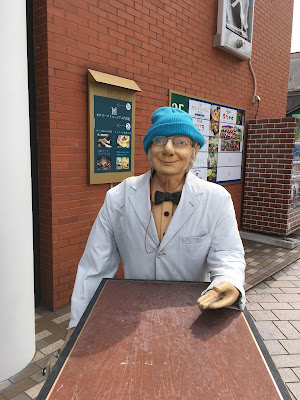


Around the corner, I came upon a man wearing a white waiter's jacket and a blue cap.  He had a bow-tie and a soft yellow button up shirt.  He didn't say anything, but with his gesture of the left hand told me to have a seat at his table.  His face reminded me a bit of the artist Paul McCarthy, but then again, after awhile, all foreigners to me looks like Paul McCarthy.   He didn't say a word to me, and I just acknowledge him by going to the cafe behind him and purchasing a glass of draft beer.  I put it in front of him, but he didn't say anything.  As I sat there nursing my glass of beer, I realized I never felt so content with the present.  I have this whole history behind me, and I can't see anything at the head of me.  I realize at that point and time that I'm going in the right direction, and when I look back, it's either death chasing me down, or something there to remind me of various things I have lost throughout my life.   It was then that I got up and realized I must leave Moji-Ko.  Like a stray cat that keeps coming back to its abandoned home, I will do the same.

- Tosh Berman, Moji-Ko, Japan


Monday, February 27, 2017

February 27, 2017 (Tosh's Diary) Japan

Albert Einstein's room in Moji-Ko, Japan

February 27, 2017 (Tosh's Diary) Japan

For the last couple of days, I have been in Moji-Ko, which is part of the southern island of Kyushu in Japan.   I'm here with my wife, and she is from this town.  In 1989, I lived here for a whole year.  It's ironic that I have always tried to avoid small towns, yet, always end up in one.  Moji-Ko is technically a port city, where across from the Japan Sea there's Korea.  Before World War II, Moji-Ko was the location to go back and forth to Korea.  It was a lively town full of adult entertainment as well as cinema, live theater, and Geisha action.  Albert Einstein came through Moji-Ko and stayed in a structure that is technically the next block where I'm writing this piece.  There's a plaque announcing the visit, but no image or photograph exists that I know of, having him here in the city.   When in doubt I always go with the narrative.  So there is no reason to question that he was here in Moji-Ko.

Moji-Ko Retro Observation Room, Japan


Compared to Kyoto or other parts of Japan, Moji-Ko's structures are not that old.  My guess is that the oldest building here is about 105 years old.  Still, there is a particular Meiji period feeling in the structures as well as the roadways.  I'm writing this report on the 31st floor of the observation deck.  The city is very much laid out in front of me, and it looks like I'm observing a google map, but I'm really here.  But have I ever been anywhere?

Dead Fugu, but still deadly, in Moji-Ko, Japan


I had dinner last night at a local restaurant.  Blow-Fish (Fugu) is the main specialized dish in Moji-Ko.  The fish is very toxic and lethally poisonous if you eat the wrong part of the Blow-Fish.   People in the West are alarmed, but the Japanese seem to take it in the style that nothing will happen to them if they eat Fugu.  The fish itself is delicious.  I ate it in many ways.  Sashimi style as well as cooked and served in soup.  I never felt in danger, because the people around me took it as being prepared by an experienced chef.   If you do get poisoned by eating the fish, the effects are similar to nerve gas such as Sarin or VX.  The victim is conscious, but their muscles will be paralyzed and eventually, one can't breathe and will die from asphyxiation. This happens time-to-time, but what are the chances of that happening to me?

Gentlemen who ate at the same restaurant


Back to the restaurant, we were sitting at the counter eating Fugu, when I notice the party next to me was sending a bottle of Shochu to another table.  They were drinking beer and what looked like bottles of Shochu.  They were bottle-keep, which means the customer buys the bottle and keeps it at the restaurant for themselves.   Hardcore Asian tradition of drinking in bars.  There were three of them.  One was a young woman, who looked like she killed a man or two.  Beautiful but I sense a hardness in her attitude.  The two guys she was with had various forms of jewelry on, including one who had two watches attached to each wrist.  He also had what looks like a diamond stone around his neck.  The other thing I notice is that anyone who walks into the restaurant made a gesture of being a friend or bowing to this trio.  To not to acknowledge them in a specific world would have been a deadly mistake.

The Author's laptop while writing this essay in the Observation Room in Moji-Ko


I made the Mojiko Retro Observation Room as my office while here.  I find it suitable to be on the 31st floor looking out to the Japan Sea and commenting on the town and people down below.  It's an idea space for a writer to do his or her's work.  From here, I can see my home in Moji-Ko. My wife and I live on the 13th floor of that building.   So at nighttime, I can sit in the outside hall and look at the place where I do my work. And oddly enough, I sit in the Observation Room watching the place where I live.
The Author lives on the 13th Floor of this buiding


I have a deep interest in my culture, especially when I'm in a foreign culture. It is what makes Americans so unique.   I had a beer, drinking some coffee now, and just had a chocolate cookie.  I'm all set, and about to go into the sunset and become one of the small people down below.

Moji-Ko Retro Observation Room at night; Photographed from my 13th Floor apartment across the way