Showing posts with label Louis Feuillade. Show all posts

Friday, January 15, 2016

"The Other Paris" by Luc Sante (FSG)

ISBN: 978-0-374-29932-3 FSG

The Other Paris" by Luc Sante (FSG)

Of all the cities in the world, Paris has a mythical hold on me. I don't know why? Los Angeles and Tokyo are my two other favorite cities, but somehow Paris has captured my imagination, and this book by Luc Sante, pretty much describes my imaginary Paris as a factual place. I have been there at least six times in my life, and yet, it never disappoints, just gives me a thrill whenever I'm confined in Paris. Sante's "The Other Paris" pretty much describes my fascination, as there is only my imagination that is the French city, and then there is "real" Paris.

Sante uncovers a Paris that is exposed in certain works of literature, such as "Fantomas" and the film works by Louis Feuillade. This is Paris history as if it was written by The Situationists International and the Surrealists. Crime, vice, a little bit of decadence here and there - it is what I imagine being in Paris, and therefore, clearly is. 

The book often reads and looks like a school textbook, and one wonder if "The Other Paris" will serve that role in a classroom. It should be. As well as being, without a doubt, one of the great books in English on the great city of my imagination and therefore known as Paris. I also realize by reading this book that Paris always had a great deal of street violence with respect to murders and bombs. What happened a few months ago in the city of light, is common, when compared to the Paris of the 19th century.

Beautifully illustrated throughout the book with images collected by Sante, so unlike other "history" or "travel" books, this seems to be a very personal work.  And that I think is one of the key aspects of this work, is making a public space or city into a personal landscape.    Luc Sante did this and he did it remarkably well.   A classic book.  

- Tosh Berman

Friday, May 30, 2014

May 30, 2014


May 30, 2014

I’m curious to know what my last day on this planet would be like, for instance, would I spent time at home reading, or would I go out for a long walk in the neighborhood, maybe dropping by at the local fish n’ chips shop to get some lunch.  I often dream at night of the perfect magazine stand, yet in reality, I never came upon such a printed version of utopia.  As a child I accustomed to roam over the magazine stand in Hollywood, thinking that it was just an incredible inventory of publications, but the truth is, the one in my head, is much better, way better in fact.  Often I would wake up from a marvelous dream of such a place, that had comic books from every part of the world, and of course the quality of the printing varies from country to country.  But by touching the pages of these comics, I felt I was touching the actual culture of that specific country.  As I got older, I got into record collecting, not necessary due to its music, but more of the case that these objects were produced in a certain time and in a specific place. I never travel, yet holding a publication or an object like a record takes me to that country of origin.  I never know for sure what that culture is like, but I imagine a world that is totally suitable for me.


I have always been fascinated with Paris, but it is a city that I never went to, but I have in a sense through its literature and films. I can be only thankful for Léon Gaumont, starting the first French film studio, and therefore leading me to Paris through the films of Louis Feuillade, who was my first introduction to the great city.  The city of lights for many, but through my aesthetic it became a city of shadows, and when I hear the word “terror” I immediately think of Paris.  It was much later in my life where I saw Agnès Varda’s “Cléo from 5 to 7” which was another version of Paris, seen through the eyes of perhaps someone dying, or at the very least, a major change will take place, and spending the day taking the images and sounds of that city, as if it was the last day.   As I get older, that film stays with me the most, I think owing that I am more aware, in one day, I will not be here anymore.


I like to think of myself as being more refined as I get older, but the truth is I desire chaos.  I’m motivated by emotion, passion, and need.  Life in a funny way is like a movie studio in the times of Irving Thalberg.  The “boy genius” who controlled the finances and studied the commercial market of production, by having sneak previews, to measure the opinions of the audience before the film is made public, is a world that I find disgusting.  As he studied balance sheets, this act alone caused him to fire Erich von Stroheim over the length of “Foolish Wives.” For von Stroheim, the aesthetic is everything, for Thalberg, yes aesthetic is important, but it's not everything. Making art and specifically making movies is a crap game in a dark alley at its best, but a talented gambler knows the odds and the landscape of the game and where it taking place.  Erich only knows the passion, and therefore is driven to have the images in his head on the screen, at all cost.  The ‘all cost’ part of the deal is where von Stroheim and Thalberg parted, like the Red Sea.


With respect to my publishing, I’m totally on the side of Erich von Stroheim.  I loathe the idea of budgets, or anyone sitting me down and giving yours truly a lecture on economics.  If I have a choice of being tortured by a thousand cuts, or go directly into the sun, I choose to wear sunglasses and head towards the heat and brightness that are life.  Nevertheless, till then, I walk among the shadows.

Sunday, January 26, 2014

The Beyond Baroque Literary Art Center's Film Festival (curated by Tosh Berman)


Being a poetry/fiction mad obsessed man, I pretty much hung out at Beyond Baroque Literary Arts Center in Venice California.  This was in 1991/1992.  Benjamin Weissman was the program director for literary readings, and he brought incredible talent to the center.  I asked him and the Director at the time if I could show films there.  Or maybe Benjamin asked me?  Nevertheless they said 'yes,' but I had to raise funds to purchase a pair of 16mm film projectors. With a little sweat, good luck, and kindness of a few backers, we got the equipment we needed.  All minimal, but nevertheless we could project 16mm films onto to a stand up screen.  Very old school.

With the help of Lun*na Menoh, and a couple of projectionists, but mostly with Relah Eckstein, we did a show.  One of the first ideas I had was to bring Buster Keaton in a more adventuresome  light.  Famous at the time of course, but still I felt people were looking at him as just as a slapstick clown.  In my eyes he was the ultimate 20th Century man.  I decided to put him on a program with Luis Bunuel films.  It was a perfect fit.


Alice Guy-Blaché and Lois Weber were pioneering filmmakers from the teens and Twenties.  Alice Guy was a major producer who ran a film studio in France.  The films she made were charming and funny.  The American Lois Weber's films dealt with the politics of its day.  When you think of it now quite daring for her time. 


Another program focusing on the works of pioneering women filmmakers. Here I focused on Weber and Guy but also Leni Reienstahl, and got a  nasty letter for showing her on this program.  

Add caption

Very interesting double-bill of classic kid novels but versions made in the teens.  "The Wizard of Oz " was actually directed by the book's author L. Frank Baum. 


Early Rene Clair films that were at the time very hard to see.  Remember this was the time of VHS, and a lot of these films didn't make it to the cross over.  "Crazy Ray" was a very funny Clair film. It was about a ray that could stop time, therefore everything is frozen.  Lighthearted yet had serious overtones.  Perfect match.


This was the only time where I actually had the filmmaker showing his films.  Harun Farocki is a German filmmaker, theorist, and writer.  The work was fascinating, and I was very lucky to get him to do this.   The Goethe Institute was very helpful with respect to this program.


At the time I was crazy about Peter Greenaway.  He was the only filmmaker at that time that drove people batty.  I never have been in an audience where someone's work really pissed people off.  These short films he made before he became big, were charming, funny, and hypnotic. 


What a wonderful night.  I showed all the classic Joseph Cornell films, but also a woman came by early with a film reel under her arm.  She told me that Cornell made this film for her, and she never saw it.  So the film has never been projected or shown to anyone.  It was a 'wow.'  But a secret 'wow' because no one, including me was expecting someone to bring such a treasure to our little place.


More Cornell!  Also films by Bruce Conner.  A nice combination because both used found footage in their work.  


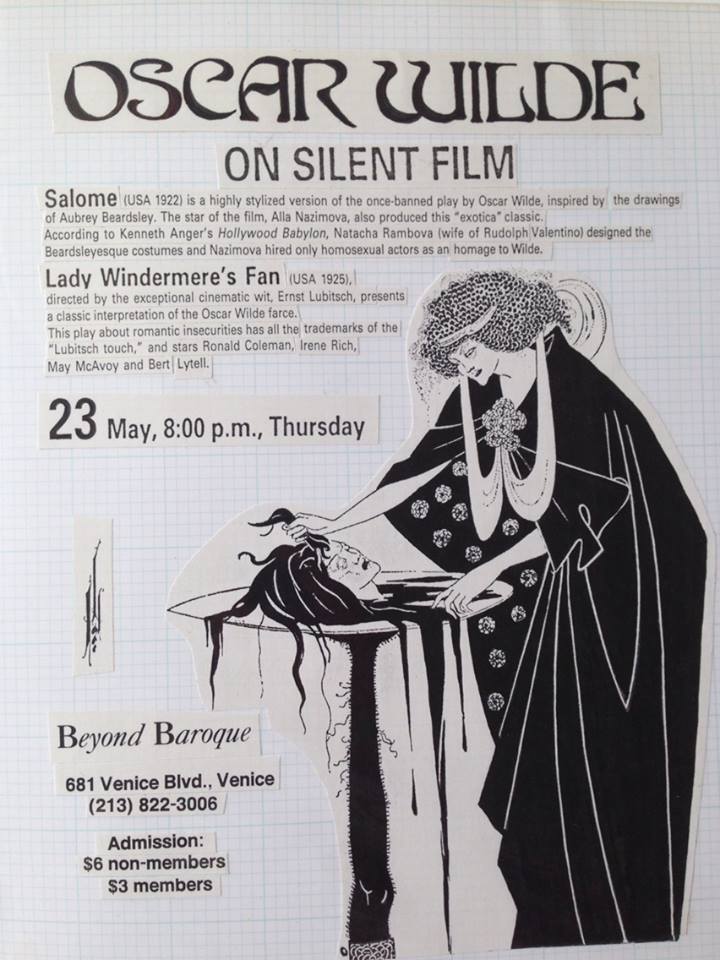
To me there was something subversive of showing a silent Oscar Wilde related films.  A man known for his words, yet we had silent versions of two of his major works.  "Lady Windermere's Fans" and the legendary "Salome."  Both films by the way were excellent.  A sold-out audience where no one was under 70 years old.  And all men!


Odd enough "Band of Outsiders" was not shown that much in Los Angeles at the time.  Nor was it on VHS.  This and a Godard short "All The Boys Called Patrick" was a magical night.  Dancing in the aisles!


It is amazing but right now I can look at the right side of the desk and see my French, British, and American edition of Louis Feuillade's "Fantomas" on DVD.  In 1991, the film was a total mystery and no one, and I mean no one was aware of this piece work.  The film is six 1 hour episodes in total. What I did was show Chapter 2, each episode was a separate and complete narrative - and it was an amazing film.  Without a doubt one of my all-time favorite films. 


The great and kind of tragic Edgar Ulmer.  Odd enough "Detour" was not available on VHS at the time.  So here was the perfect marriage of a film with no budget shown in an organization that barely had a budget.  Kind of sad, but beautiful at the same time.


Sunday, December 11, 2011

"Nuits Rouges" by Georges Franju


I just watched "Nuits Rouges" by Georges Franju for the second time in my life.  its a great film.  The above is just a very small  excerpt.  Nevertheless it has a very strong Fantomas appeal as well as a great mood.  And I only watch films mostly for their mood.

Monday, September 27, 2010

Fantomas - Kino on Video

Fantomas - Kino on Video

One of the great films of all time. Kino did a great job in over-all design for the 3-DVD set.

Monday, December 3, 2007

A Brief Thought on "Fantomas"

Fantomas, down below, is something that is part of my DNA at this point. I have a fascination with characters that can change identities and this particular character fits the model to a 'T.' Plus the fact that you get actual film footage of Paris circ. 1915 is simply amazing and beautiful.

But what is Fantomas? To me he always seems to be the collective fear of the powerful - and therefore is the 'charm' of the Fantomas series.

Saturday, September 15, 2007

Fantomas, My Love


I wrote this little essay on one of my favorite films: Louis Feuillade's "Fantomas." The DVD came out in France as well as in the U.K. I strongly recommend that you, the dear reader, pick up a copy. It's an amazing film in so many ways. Anyway I want to thank Alt X for first publishing this essay on their website. I got a lot of feedback and coverage due to them publishing it. Thank you.


Fantomas, My Love

by Tosh Berman
(c) 1995


The Surrealist Spanish filmmaker Luis Bunuel had transmitted that he to a great extent, preferred Louis Feuillade's Fantomas serial to any of the so-called avant-garde films made at the same interval during the early Twentieth Century. Bunuel perceived the serial as an art form without the useless baggage of art attached to it.

French filmmaker Alain Resnais was quoted as saying "Feuillade is my god. I had always been a fan of the Fantomas dime thriller novels, but when I finally saw the films at the Cinematheque in 1944, I learned from him how the fantastic could be more easily and effectively created in a natural exterior than in a studio. Feuillade's cinema is very close to dreams and is therefore perhaps the most realistic kind of all, paradoxical as this may sound."


This infatuation for the physical with an additional mixture of dreams illuminates the Surrealists love for Louis Feuillade and his cinematic version of Fantomas (1913-1914). Feuillade's blend of natural exteriors and interiors with the dreamlike conspiracies comprise an inner--world, where anything can happen at any place. What seems to be the axiom is usually just an illusion. Images which seem so natural are truthfully revelations that are disturbing to the subconscious.

Ever since my father's unexpected death in a car accident, non-reality and what I feel is fundamental has become an overheated tango dance. Persons who were close friends become strangers in a matter of hours. The world has changed positions by just one incident. When I saw one segment of the five-part serial, "Juve Contre Fantomas," the film had expressed my horror and fascination with images and people, and how they can mutate mysteriously into another disguise.

The fictional character of Fantomas represents the sleeping evil which rests in our subconscious, ready to strike at a moment's notice. Obviously whenever there is a misdeed somewhere on this world, Fantomas is behind the hideous crime. A majority of the public is not aware of this fact, except for the brilliant detective from the Paris police, Juve. Only he alone can stop evil, better known in his human form as Fantomas! As a master detective, Juve recognizes that Fantomas attacks from within: meaning he detects that Fantomas exists inside the subconscious -- particularly Juve's.

Here we find the eternal theme of two brilliant (and in most cases, indifferent from the rest of society) individuals fighting for the control of...actually control itself. Good and Evil sleeping together in a bed made for sexual passion and when it manifests itself into politics - the World explodes!


In the film series and books by Marcel Allain and Pierre Souvestre, Fantomas' victims are usually people in high society. There is an undercurrent cast of political terrorism in Fantomas' methods - kidnapping, pillaging, and killing members of the upper-class. The subject of control is very strong in the series, and the question that repeatedly comes up is: who is in supremacy, Juve (good) or Fantomas (evil)?


One wonders if Feuillade's version of Fantomas is not a politically motivated. One furthermore imagines why Fantomas and his gang only rob and murder victims placed in high society. Fantomas does not seem to be a man (spirit?) involved with politics of thought, but politics of consciousness. Fantomas steals and kills - therefore he exists!

For all we know his victims may be the living dead; perhaps only the brilliance of police inspector Juve and Fantomas can endure and the flesh (which Fantomas and Juve discard like old clothes, when in disguise) is an illusion when placed in a "real" ambiance.

Feuillade played with the real and unreal in natural settings in all of his serials. The Surrealists were the first ones to notice this quality in his work, and afterward, an even stronger influence appeared in the French new-wave films by Godard, Franju, and Resnais. There is a joy of illogical happenings in his films, which only a handful of filmmakers play with. Bunuel and Godard also show us that logic becomes boring after a while.


In writing about the Fantomas texts, the magnificent poet and critic of the nineteen-teens, Guillaume Apollinaire has been quoted as saying "that extraordinary novel, full of life and imagination...from the imaginative standpoint, Fantomas is one of the richest works that exist." The wild and characteristic vision of Surrealism which is in the novel and films were highly appreciated by the artists of that time. Besides Apollinaire, there were the poets Robert Desnos, Jean Cocteau, Max Jacob, and Blaise Cendrars; the painters Picasso, Juan Gris, and Magritte. All of them were fans who used the resource that is Fantomas, for their own work.


Juan Gris; "Fantomas (Pipe and Newspaper) 1915. Oil on Canvas. National Gallery of Art, Washington DC

All of these artists realized the dreamlike, irrational qualities of the Fantomas (film and book) series. Not the paint-by-numbers school of art that is currently being produced in a laboratory known as a classroom, but in that mysterious interval when the conscious becomes the subconscious. As art works are being hatched in this phantom transition, so are in a sense - the crimes of Fantomas.


Magritte with his "Fantomas" painting

There is a dauntless wild abandon when entangled with crime and art. The mad impulse to move from the so-called norm into another realm - is of course, an intoxicating act of creation. In this atmosphere, Fantomas is just as creative and mad as Antonin Artaud and Marquis de Sade. Both of these artists investigated their imagination and sanity to compose a weapon with words so as to antagonize society. Fantomas is a liteary creation used for the same purpose. Intentionally, the Fantomas film and books were produced only for amusement sake, but there are unmistakably undercurrents of dread, fear, anxiety, and perverse sexuality.


In Juve Contre Fantomas there are scenes which allude to bondage and S&M. In one particular scene Juve establishes a trap for Fantomas in his apartment. To protect himself from the assassin, Juve wears a truly bizarre garment consisting of spikes around his waist and arms. He then lingers for him in his own bed.

Fantomas also has a Rasputin charm over women. In one scene he is entertaining a pair of women at a posh restaurant. He also "dominates" a young lady, who is totally devoted to him and his cause. Another female is a love slave, awaiting at a large house for her master (usually in disguise) to appear. On the other hand, Juve seems to have no time for pleasure. His only passion is to catch Fantomas...And as I mentioned earlier, perhaps Juve wants to restrain Fantomas in his own bed!

The nature or lack of character is interesting, in that the "sexual" quality of Fantomas becomes stronger owing to the scarcity of a concrete identity. He is a master of disguises because of his line of work, but one wonder if this is not tied to his sexual identity. Each character he portrays is draped in fetishism. Juve is also a master of disguises, and likewise savors the changes his body makes.

Watching the film one sees a duel to make and relinquish as many identities as possible. In the beginning montage of Juve Contre Fantomas, each character (Juve & Fantomas) displays all the disguises that they will wear in the film. By the end of the film one sees identity being adjusted as simply as changing a soiled shirt. In most modern works of art, the need of identity or conscience is a source for the "lost man or woman." One thinks of Oscar Wilde's "Portrait of Doran Gray" or Luigi Pirandello's underrated novel, "The Late Mattia Pascal" which depicts the fall of one who is seduced into the conflict of good and evil. On the other hand, Feuillade/Fantomas relishes the chance to throw conscience out the window. The film is exhilarating in its love for anarchy, bondage, perverse sexuality, political consciousness and, more importantly, aesthetic revolution. Unintentionally, (which is the main ingredient for art-making) the film and novel are an inventive terrorist attack on the fear and mores of the bourgeoisie.

During the actual filming, Feuillade never used a shooting script. Andre Bazin - the film critic and theorist - wrote that "Feuillade had no idea what would happen next, and filmed step-by-step as the morning's inspiration came." The early pioneers of cinema all worked this way; it was not till the studios insisted on ideas put on paper for financial verification that things changed. Currently, Jean Luc-Godard is perhaps the only mainstream filmmaker who does not use a script, while shooting a film.

This also suggests that early cinema-making was a Surrealist technique in making art. Along with Feuillade, one thinks of the other "native" Surrealists such as Mack Sennett and Buster Keaton. Although their works were dissimilar, they contributed a suspicion on what is real and does it matter. It was not important to them to show "logic" moving from one scene to another. The early filmmakers shared a common dream occurrence where anything was allowed.

In the conclusion of "Juve Contre Fantomas" there is the magnificent image of Fantomas, dressed fully in black with a hood over his face, raising his arms in characteristic joy as he explodes the house with what he thinks is Juve still inside the structure. This is a spectacular moment and one wonders how many in the audience are thrilled with this commitment to artistic destruction? In certainty, since this was the end of the second segment out of five in the series, it ends with a large question mark (?) on the screen. This of course may center on what will happen in the ensuing segment...or is it a straightforward question to the conscientiousness of the public out there watching the film?