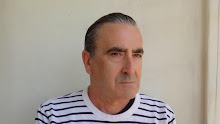
Wallace & I
(Originally published in Blastitude)
I wrote this little memoir about ten years ago, requested by Cary Loren for the great online blog/journal "Blastitude." At the time I was under a strict deadline, and I had something like a week to do this piece. For the past five or six years, I have been adding more stuff to it. This is not it! So one may look at this as a work in progress. So in that nature enjoy the piece.
 |
| By Wallace Berman (copyrighted by the Estate of Wallace Berman) |
My first introduction to the world of the arts is when a grown-up (always a suspicious lot to a young tot) asks me if I was going to be an artist just like my father. My dad usually got irritated when he overheard what was basically a simple question – which seems to happen on a regular basis at the time. But the question is anything but simple or basic: when you come right down to it, it’s inquiry in how does one follow the steps of such a genius like my father, Wallace Berman? The simple answer to a basically ‘almost rude’ question is ‘I never think about it.’ And to this day I haven’t thought of it. And I am sure my father never thought of it either. Although I gather, others have thought of it.
Although one usually hears the ugliness and the failure of living with the artist, in this case, the artist - my father - was a rather pleasant man who happened to be an artist with a lot of admirers, as well as a darn good dad. I was blessed to be raised by a Father and Mother who stayed together and loved their only son. So in a sense, I was raised in a world where the family unit was falling apart, but my folks stayed together in a very strong traditional family mode. Others were not so lucky, yet the general press at the time made it sound like my Father was the kingpin of a drug art ring. Which come to mind sounds great. But the actual story is much more mundane with a side touch of glamor with people falling down drunk and being able to have a front seat to the great currents of modern art and pop culture during the late 50’s and 60’s.
My early memories are a household of people. Some of them have faces and names to me, but mostly they are a secession of anonymous faces that took up space in our very tiny house in Beverly Glenn. It seems like that there was a 24-hour party that ran from Sunday to Saturday. In those twilight years, my first real memory was being in my bedroom – which in itself was a luxury because my parents slept in the very comfortable living room – of seeing a bloody face outside the window staring at me while I was laying awake in the crib. It was a horrifying sight, and what made it even creepier is that the face would appear from the bottom of the window to the middle of the windowpane in what seemed to be moving in a skulking slow motion matter. It was years later that I found out that the bloody face belonged to a folk singer named Ramblin’ Jack Elliot. Apparently, he fell down drunk outside my window and helped himself up by that windowpane. But to me, it seemed like a beast from hell was approaching my window. I must have been somewhere between 6 months to a year old when I saw this image that still to this day gives me shivers.
The small house itself had its share of spirit visitors as well as living and breathing ones. My mother told me that she had a loom in the living room – and one night it started to make its own fabric pattern. The next morning my parents moved the Loom to the storage down the hill. Also, I remember guests commenting that they saw an old person sitting in a rocking chair in our outside yard. I was never aware of this old person or the rocking chair.
In addition, there was the story about a friend of my parents bringing this additional guest along (everyone then brought an additional guest to our house) who he just met for the first time at a nearby bus stop. This particular guest had an odd speech pattern where he mostly spoke in Old English. It was like he was dropped on this planet but had the wrong time and year and was expecting the 5th Century instead of 1950’s Beverly Glenn. Maybe he got the 5’s mixed-up? As the evening went on it became the main suspicion that he was actually an alien visiting us – but somehow got the wrong time or really didn’t know the habits and communication skills of us Earthlings via 1950’s.
Anyway, my parents found him perfectly charming – as this particular guest was amazed at the function of a corkscrew (imagine an instrument that opens up a bottle of wine!) and other earthly objects. Later in the early morning, my parent’s friend dropped him off at a street corner – but felt guilty right away about leaving him at dawn on a deserted bus stop. When he went back the mysterious visitor disappeared. He looked all over the neighborhood – but obviously, he transported himself to his spaceship to give a full report on the advance technology of the corkscrew and the inside living habits of the Bohemia set. After 40 some years there is probably a monument to the corkscrew on some hilltop on Mars. Hopefully, in my lifetime I will be able to visit this monument.
I think the first time I realized that my Dad was an artist is when I went to his workplace on the left side of the living room in Beverly Glenn. The house was perfectly organized. The floor plan was a kitchen (the entrance), the living room, my bedroom and then a small bathroom. The right side of the living room was the bed. The bed was used for bringing me on to this planet as well as a mixture of a couch, and perfect reading space for devouring comic books. The left side of the living room was the studio that consisted of the work desk and stool. This is where my Father made his art. There were tools like hammers but what I mostly remember is the ‘Yes’ glue. This is the paste that my father used for his verfax collages. It stays in my mind because of the label. It looked like one of my beloved comic book illustrations that I consumed with great intensity at that time.
It was at this location that Andy Warhol shot his first full-length film ‘Tarzan and Jane…Regained.’ I have full memory of Taylor Mead and my father’s fight scene in the film. I also remember the woman who played ‘Jane.’ I remember playing Tarzan’s son ‘Boy.’ What I don’t remember is Andy Warhol. I know he was there, but he left no memory for me whatsoever. I recently saw the film and it struck me as a masterpiece. Sadly my wife refused to sit through it and she left before I came on. I then gave the tape to my Mother, thinking that she may possibly be overwhelmed with emotion seeing my father on the TV screen – but her only comment after seeing the film was ‘god what a boring film.’ Being the only child is sometimes a lonely adventure.
The situation then was that my Mother went out to work and my Father stayed home and took care of me. It was during this time that I noticed he was doing ‘art’ activity. Since the financial end was coming from my Mother’s work, I recognized that my Father too was ‘working.’ The thing is that his ‘work’ was not actually making currency (at the time). One of the side effects of being raised in this household was the notion of work. To this day I work every day, yet some of the work doesn’t equal or have anything to do with producing currency to contribute to the world and so forth. I never heard my parents talk about money matters of any sort. It wasn’t till I got married that I had my first proper ‘money matters’ talk with my wife. And I might add I was in my early 30’s at that point.
During this period of time (mid-fifties) my father had his first and last official gallery show at the now world famous Ferus Gallery. At the time Walter Hopps and artist Ed Keinholtz organized the gallery. What happened was someone called the L.A.P.D. and told him or her that there was a dirty picture being displayed. Although not proven, it has been suspected that Keinholtz called the authorities himself, probably for the purpose to get some publicity for the gallery. There was a day-long trial and my Father was found guilty of pornography and had to serve jail time. Luckily his good friend Dean Stockwell bailed him out of jail. It seems that Ed and Walter were happy enough that they got some sort of publicity and if my father rotted in a jail cell…what the hell! What’s worst is that the artwork in the exhibition was mysteriously destroyed.
After the disappointment of the Ferus show, the family moved up to San Francisco. My next memory is being on Scott Street in San Francisco. It was lovely. We lived in this giant mansion with a park across the street. But like the house, we lived in at Beverly Glenn this house too was full of people. Mostly artists living upstairs – which I have no memory of ever being up there. What I do remember is playing with the children on the block. I was impressed that one of my pals on the block had a Christmas tree up all year round. I thought that was fantastic, and of course a form of paradise for a child. It symbolizes that Christmas never ends!
Before San Francisco, my father started up Semina. This small publication would be called a zine these days. It was basically a collection of loose pages that consists of poetry, photographs and artwork. The edition would be a print run of 100, and all of it was done on a hand press at home. I think this was a way for my father to communicate with the world. Or in simple terms, to share something that he liked and wanted to show the work to others. Most of the editions were mailed or handed out for free. I think when he went to San Francisco he would have a couple on consignment at City Lights Bookstore. They sold for a dollar. The poets that were featured in the publication are Michael McClure, David Meltzer, Philip Lamantia and others. Now they’re priceless and it’s very difficult to find the original Semina’s. Especially one’s that are totally intact. *
My father in the studio or home would work in full concentration and usually with no visitors. But he liked me to be around while he worked. I guess to make sure I don’t get myself into trouble or maybe I was amusing to my Dad without distracting him from his work. What he would do is play 45’s on the portable stereo in his studio. Like looking for the perfect image for him to use – he also used that aesthetic to find the perfect song. I think he preferred the single than the album (unless it was jazz or classical). He used to play Supremes ‘Baby Love’ consistently over and over again. We’re talking about 25 or 30 times a row. Other records that stay in my mind are the Kinks’ ‘Who’s Next In Line,’ The Rolling Stones ‘Satisfaction,’ and lots of Motown. The songs after awhile became ‘trance’ pieces. I started to lose the melody and got into a trance, and I wonder if my Dad did the same with the music. It helped him focus on his work.
Although he loved jazz, my father had a good ear in what was happening around him for someone of his generation. He wasn’t stuck on the music heroes of his era – Charlie Parker, Billie Holiday, etc. He also admired David Bowie, Patti Smith (Horses album), early Santana, Roxy Music (he loved ‘For Your Pleasure’) and once insisted on listening to my complete Syd Barrett catalog in one setting. At the time, EMI put out a double set of his first two solo albums. He put the records on, adjusted the headphones, and didn’t move for 80 minutes. Once the records were over, he flipped off the headphones off his head and said ‘pretty good.’
I bring this up because I don’t think any of his friends were into this type of music. They were into The Beatles (who wasn’t at the time) of course, but probably not aware of the Punk scene that was brewing just before my Dad’s death. He had a natural appreciation of what is happening now as well as its past. There wasn’t a nostalgic bone in his body. Others of his generation I think were stuck in a time warp.
Musicians seemed to be drawn to his artwork. I think due to the image of the transistor radio in his work. On the other hand, my father used images of the Rolling Stones, Beatles, Phil Spector, James Brown, and other musicians in his art. So in a sense, there is a bridge in the artwork between music and the visual aesthetic image. I think what’s fascinating about my father’s artwork is that it is a visual diary of what’s happening at the time he did the works. Personal as well as the public.
The personal tend to be displayed in Semina not counting his various postcards he made as art pieces as well as serving the needs to communicate to his friends. There was a movement around that time to make the United States Postage system a part of the artwork in a conceptual matter of presenting art. But to my father, it was a way to keep and spread the news about things in his life as well as simply writing a letter to a fellow artist or friend. The postcards he made are art pieces but also serves as everyday mail. It would be wrong to see the postcards as art objects themselves without the context that they were also pieces of personal mail. They were not made to be shown in galleries and museums or anywhere else in public. Yet the work he made for these ‘message missiles’ do stand up as works of art – as well as a diary of sorts in what was happening in his life, therefore in my Mom and yours truly’s life.
It’s interesting to note that his work in the 50’s and 70’s (right before his death) reflected more on the personal than the public. Both decades he was involved with making sculptures that deal with the inner world of his art making. The 60’s work (and part of the 70’s) deal with the outside world – especially with the medium of the verfax machine and the transistor radio. The radio in a sense is broadcasting images perhaps via music. It serves as a subjective commentary on the culture and politics of America and beyond.
He would spend a lot of time on one piece. Sometimes just studying it, or looking at it in different angles. My mother told me that he would sometimes place the artwork on the ground and would look at it facing backward, but bending his torso so he can see the work between his legs. Odd angles of course, but why should I argue with genius.
My father had style when working. The music just had to be right, the mood perfect, and the moment at hand becomes an inspiration. As I mentioned he never spoke while working – once in awhile he would have me help him. Mostly holding the artwork so he can build the frame around it. I hated doing this because it was so tedious. Also, it would take him forever to hammer the nail in. He even studied that for a long time before the hammer hit the nail. Meanwhile, I had to hold the art so when he’s ready for the right moment, the right feeling, and just before my shoulders were about to give out – bam and then little bams afterward to hammer that perfect nail in that perfect place. It was great sadness that a particular art collector, owner of some of my Dad’s artwork, had the frames removed and replaced them with shiny metallic ones. He reportedly said ‘at last, I found the perfect frame for Berman’s artwork.’ Which maybe so, but I went through a lot of boredom and stiff shoulders for those frames – and I like my Dad’s frames better. The collector is lucky that he changed the frames when my Dad died. If alive he would never approve of the change.
My father was fanatical about perfection. That perfection means his artwork. Dad never took himself seriously; in fact, he was really goofy. But when it comes to his art, he was extremely serious. Wallace was particularly picky about who buys his work. For instance, a bank wanted to purchase a piece by my Dad for their corporate art collection, and he said sure. What he did was made a piece called ‘Bank Statement’ with an image of a woman giving a man a blowjob superimposed over a bank statement. For some odd reason, the bank refused to purchase the artwork. Too bad, because I am sure it would have been a great conversation starter in that bank’s next board meeting.
I remember that if someone purchased the artwork, he would show up at that person’s house and hung it up himself. For him, the work always had to be presented in a certain matter. It didn’t matter who or what owned the work now – Wallace felt he had control in how that work will be displayed – not the owner. So in a sense, the owner not only owned the artwork, but they also got the company of my father and his handy skills in hanging (his) artworks on the wall.
Whatever it was due to the failure of the Ferus Gallery exhibition, or just his working relationship with the art world, he refused to have shows at a commercial gallery. I think he was nervous with respect to being a part of someone else’s business i.e. gallery. He didn’t want to be in a position where he had to do a show once a year or anyone put him on a schedule to produce art. He had no problems doing book covers for his friends but didn’t like the idea of a solo show at a commercial gallery.
It’s hard to say why he didn’t want to do this because he rarely if ever commented on the relationship between his work and the gallery system. I knew he personally loved going to see exhibitions and was friends to numerous art dealers – but for whatever reason, he wasn’t comfortable to be tied to one art dealer. What he would do instead was bring his artwork to a dealer, told him how much money he wants for it – and the art dealer can sell the work as high as they want to for their financial needs. He didn’t care if they made $20,000 when he wanted $500 out of the deal. He only knew and desired to get what he wanted out of the deal. If the art dealer made more out of the deal, that was ok with him. He wasn’t egotistical or concerned with money matters that way.
The first big art opening that I remembered going to was the Marcel Duchamp retrospective at the Pasadena Museum. At the time, being only 8 years old, I had not the foggiest idea who this Frenchman was. Except I loved his bicycle wheel sculpture. I think any kid would love that art piece. For the grownups, they had to deal with the theory, humor, and the concept what is and what isn’t art – but to any 8 year old – a bicycle wheel is something to be admired. And it was nice that this Frenchman took the time to pay tribute to the ‘bicycle wheel.’ To me, at the time he wasn’t important, but when I told my teacher the next morning that I went to this art show in Pasadena and the artist was French and he had this bicycle wheel and I met him – well she was really impressed. I also noticed that our relationship improved greatly after telling her this fact. It was the first time that I became aware of fame and how it affected people.
Also, my father was quite charismatic. Women, girls, boys, and men were attracted to him. To me he was Dad, but to others, he was a god. I thought that was silly and so did my Father. The thing is that he was quiet, but that quiet made him special to people around him – and it really attracted attention from those who don’t know him as well. Yet he loathed the spotlight. Couldn’t care less what people thought of him. He never did an interview and as far as I know never spoke about his artwork. Yet he devoured issues of Artforum and books on art. Like his music knowledge, he knew every ‘ism’ that was out there and usually was for it.
It was the mixture of my Dad being private yet so open to the world that made him a unique personality. There was absolutely no generation gap between us, and he was very friendly with all of my childhood friends. I always felt that there was an age (at least in an aesthetic sense) difference with some of my Dad’s friends – but he was sincerely on top of what was happening at the moment – and he loved the moment.
The great pleasure I had with my Father was going to concerts with him. In 1969 The Rolling Stones went on their first official tour after the death of Brian Jones, who was a friend of my Dad’s. The tour itself was big news and quite important to teenagers like me at the time. I went with a girlfriend and somehow bagged a couple of tickets that were in the last row at the Inglewood Forum. My father offered to drive us to the concert and then asked if he could come too. I told him that tickets are impossible to get and basically all good seats – if available - are taken; therefore that is why I will be suffering Vertigo in the last row at the Inglewood Forum. My father paused and said ‘well, we’ll see.’
He dropped us off and we went into the Forum. Our seats were terrible, but my date did bring opera glasses (how posh!). Just before the show started, I scanned the stadium with the opera glasses to see if I knew anyone in the audience. Focusing on the center of the stage and on the first-row center there sat my Father. Looking very bored and comfortable at the same time. He never told me how he got that seat. It is one of the mysteries of my life with Father.
Just right before he died he took me to see the New York Dolls with Iggy Pop at the Palladium and got us great tickets to see David Bowie (via Toni Basil) during his ‘Diamond Dogs’ tour. Also Roxy Music’s first big tour during the Country Life album era. Being a huge Bryan Ferry fan, I was amazed to go to an art party (I hate that term, but I can’t think of what to call a party that is full of artists, collectors, and dealers) after the show, and who was there but Ferry with some cover girl by his side. It was probably one of my most glamorous moments as a teenager. So hanging out with my family I saw some great shows. I was very lucky to have parents who were hipper…. than everyone else’s parents!
The drag is that this was not going to last forever. Lives are spent and then disappear before you know it. So all I have to offer are these memories.
Tosh Berman
June 1, 2002 (copyrighted by Tosh Berman, 2012)


 Posts
Posts