Showing posts with label French Pop Music. Show all posts

Monday, March 1, 2021

Book Musik: No. 41 "Relax Baby Be Cool: The Artistry and Audacity of Serge Gainsbourg - Discussion with author Jeremy Allen


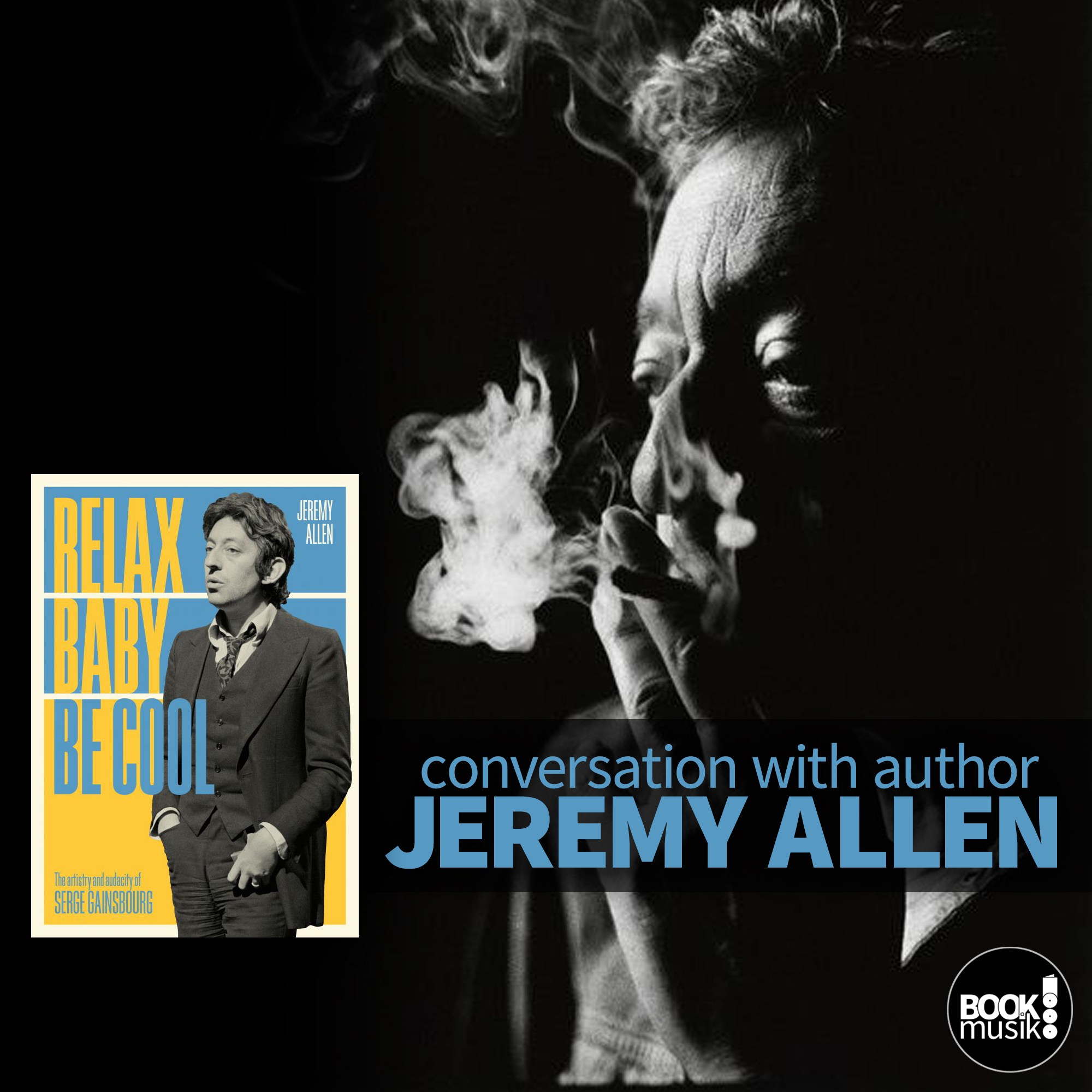
Book Musik 041 – Relax Baby Be Cool: the Artistry and Audacity of Serge Gainsbourg – discussion with author Jeremy Allen

Relax Baby Be Cool: the Artistry and Audacity of Serge Gainsbourg by Jeremy Allen - book cover

Tosh and Kimley are joined by author Jeremy Allen to discuss his new book Relax Baby Be Cool: the Artistry and Audacity of Serge Gainsbourg. When Gainsbourg died in 1991, the French mourned the loss of an icon on par with the deaths of Elvis Presley or John Lennon. But outside of France few noticed or knew much about him beyond perhaps his infamous duet with Jane Birkin, “Je t’aime… moi non plus.” Eventually the cult of Gainsbourg began to grow outside of France and he’s become a huge influence on musicians far and wide. This book explores the mythos of Gainsbourg and doesn’t shy away from his often provocative and controversial life.

Theme music: “Behind Our Efforts, Let There Be Found Our Efforts” by LG17


Wednesday, May 23, 2018

"The Despair of Monkeys and Other Trifles" a Memoir by Françoise Hardy; Translated by Jon E. Graham (Feral House)

ISBN: 978-1-62731-060-4
Françoise Hardy, along with Serge Gainsbourg, France Gall, and of course her husband, Jacques Dutronc is one of the great architects of the French pop sound, sometimes known as Yé-Yé.   For an American, the French pop/rock world is almost like living in Superman's Bizarro, where everything is slightly different, or just a tad weird.  The French are very formal in the recording well, and there is also a deep respect for poetry, which comes through the lyrics.  Especially someone like a genius such as Gainsbourg.  "The Despair of Monkeys and Other Trifles" is a fascinating memoir, for one, we don't get that much of an insight into that world if we don't speak in French.  So, a book like this is essential to one who loves French 1960s pop music.  

Hardy's life is not unusual, but still a troubling family background.  Her mother was cold, and her sister was insane.  And her long-term relationship with Jacques Dutronc is both a head-scratcher and kind of awesome, in that they both respect their roles in the relationship - although it took Hardy a long time to accept certain aspects of her husband's mental and physical state.   In a cliché saying, it sounds so French!   In her manner, Hardy is very thorough on her stance in life, which is a mixture of sophistication and a believer of astrology, which she has written books on that subject matter, as well as a column in a publication.   I'm also delighted that she knew Stockhausen and appreciated his music and other modern experimental composers of that era, even at the height of her fame in the 1960s.  

Indeed an iconic beauty, but I'm not surprised of her unease with her physical appearance or her feelings of stage fright.  For me, the way she sings there is a hesitation like she wants to grant the listener an invitation into their lives.  Which I think is one of her big appeals as a singing artist and songwriter.   There's a hesitation in her manner that is very seductive.  Still, she was then, and I suspect still, a major player in French pop music world.  Reading the book, you come upon every significant French star - both on artists she worked or ran around with.   So the reader gets a nice snapshot of the scene at the time.  The French entertainment world was/is a small one, so I suspect it's difficult to avoid anyone of importance.  For example, even my beloved Louis Furey is mention here and there in the book, and he's obscure like a ghost in the English speaking world. 

If there is a weakness in the book, it may be within the English translation of Hardy's prose in French.  Reading the book, I feel like I'm reading a translation which usually means there is something wrong with the style of the translator.  Or it may be just Hardy's writing itself.  Still, if you are a fan of Hardy's music, this book is a must-read.  A few years ago I published Serge Gainsbourg's biography by Gilles Verlant, and this book is an excellent companion piece, due to the coverage of the French pop music world, which is a mystery to most French non-speaking people. 

Friday, December 27, 2013

"Jane & Serge" by Andrew Birkin (Taschen Books)


The book unfolds in front of a reader/looker slowly like water pouring into sand.  At first the photographs by Jane Birkin's brother Andrew, who by the way is a Peter Pan expert and an interesting scriptwriter on top of that, are extremely intimate.  It is sort of like going to a stranger's house and looking at their photo album, and then all of sudden you recognize a famous face in the background.   There is something lovely and sincere about these images, but it becomes more clearer when you read the little booklet that comes with the photo album. 

 Andrew Birkin writes a very moving narrative that goes with the images in the book.  Each photograph is annotated with a commentary of some sort that is separate from the actual book of photos.  But what makes this a really special deal is Andrew's essay about his feelings for his sister and Serge Gainsbourg himself.  He loved him.  And he loves his sister and the children as well.  But the little booklet adds a context to the picturesque narrative - and like all family albums there is sense of sadness or that life won't be like this forever.   Some of the most beautiful images are of Kate, the daughter of Jane and her first husband John Barry.   The sad irony is that Kate passed away after the completion of this book.  Nevertheless, along with my production through TamTam Books (Gilles Verlant's fantastic bio on Serge "Gainsbourg") and the recent 33 1/3 study on "Melody Nelson" one gets a fantastic picture of life as lived by Jane and Serge. 

Saturday, November 30, 2013

"Yé-Yé Girls Of '60's French Pop" by Jean-Emmanuel Deluxe

Feral House ISBN 978-1-936239-71-9

The mysterious and always foreign world of the French Yé-Yé  music scene.  Without a doubt the book I published "Gainsbourg the Biography" by Gilles Verlant is the best book in English regarding not only the Yé-Yé movement, but also the entire French music world.  The second book to get (in English) is Jean-Emmanuel Deluxe's "Yé-Yé Girls Of 60's French Pop."  This is a very good guide to the singers, the record labels, and the artists/songwriters that wrote the songs for this particular market.  It is basically teenage music, but mostly written by older men, for instance Serge Gainsbourg.  But beyond that it is a fascinating sub-culture to fish in, because the music, overall, is a the very least super interesting, and at its best- excellent records.

There are those who are the queens of their field - France Gall, Françoise Hardy, and Sylvie Vartan and then there are various (actually many many ) one-hit wonders, who also made great records as well.  In France, the arranger as well as the songwriter are part of the magic that makes a great record. Usually I check out who the arranger is, and then my money quickly goes to that release, especially if it is someone like Jean-Claude Vannier, who did a lot of classic recordings with Gainsbourg.  His touch of genius always shows up no matter who the artist or singer is - so it is very much like following your favorite record producer - or am I the only one who buys records due to the production credits?

Deluxe's book, which is also well-illustrated with both ads from the '60's as well as the original  record covers, pretty much covers the basics as well as the odd releases that came out of this scene.  So for sure its a good guide to have on your side of the table as one explores YouTube footage or online shops.  He also covers current music figures like April March, who is fantastic by the way, and others who were influenced by the 60's scene.  I think he could avoid a lot of the bands/artists, and just focus on the 60's artists, but that is a very small criticism.  This book is designed for the beginner who is looking for hardcore information or names to get their listening habits in order.   So yeah I highly recommend this book as a beginner's guide and if you want to get deeper into the subject do get the Verlant Gainsbourg biography.

Victoire Scott - Une Fleur Dans Le Coeur


Reading the book "Yé-Yé Girls of 60's French Pop Music" by Jean-Emmanuel Deluxe and he comes up with some obscure artists from the era of the Yé-Yé.  Victorire Scott is even obscure in her country!  Yet, a very interesting record.

Saturday, October 19, 2013

33 1/3 "Histoire de Melody Nelson" by Darran Anderson


Darran Anderson's little study on one of the great albums that came out of Europe, "Histoire de Melody Nelson" is a superb study on Serge Gainsbourg and his masterpiece.   First of all I am touched that both titles ("Gainsbourg" by Gilles Verlant & Serge Gainsbourg's short novel "Evguenie Sokolov) that i published are in the bibliography.  So with the music and the books he's coming from a good place!

Anderson's book is very brief, but there's no wasted words.  He has a deep understanding of Gainsbourg's work, and not only does he talk about the Melody Nelson album, but it is also a brief biography on the great artist.   As in the Verlant biography, it is moving as well as terrifying to read about Gainsbourg's childhood running away from the Nazis.  Over time I have read tales dealing with the Occupation, but the Gainsbourg narration is one that really makes me emotionally aware how horrible those times were.  Almost unthinkable, yet it is these surroundings that probably inspired the greatness in Gainsbourg's songs and his very own iconic stance against authority.  

The book also captures the flavor of Gainsbourg's love for literature and how that inspired him as well.  Baudelaire, Jarry, Rimbaud, and the lasting influence of Boris Vian played a big role in how Gainsbourg looked at life and art.   Anderson is a wonderful writer, and his smart, intelligent take on Gainsbourg is right on the button.    Essential read for anyone who even has the slightest interest in the world of Serge, but also insightful in how bad things (occupation) can charge a shy figure into a warrior of sorts.   This book along with Gilles Verlant (The granddad of Serge bios), Sylvie Simmons' English bio and Gainsbourg's "Evguenie Sokolov"  we now have a great representation of the world of Gainsbourg in print.  


Tuesday, September 24, 2013

Gilles Verlant (June 11, 1957 - September 20, 2013)


Gilles Verlant and his subject matter Serge Gainsbourg


I would like to think that Gilles Verlant was my best friend, but the fact is I only met him face-to-face maybe half-a-dozen times in a short period of time.  The first time I met him was in Paris January 2012.  I and Paul Knobloch, the translator of Gilles’ magnificent biography on Serge Gainsbourg, was putting the final touches of this project which took us a long time to complete.  There were health issues involved on the American side, and just basic life stuff that delayed this book for a year or so. Also it was a major undertaking for the press due to the size of the book moreover being so detailed in information regarding the French pop music and its culture.  I needed to finish everything in 2012 due to production and distribution deadlines.   I was nervous at the thought of meeting the author of “Gainsbourg” because I felt so close to the book, that I almost forgot that there was a living author behind it.  I was so used to working with Paul mostly on the Boris Vian titles I publish, that I was totally not aware of working with a living author - until he wrote to me.  A very wonderful charming e-mail letting us know that’s he’s around to help, and that was a great help to our production of this book.   Over various e-mails to Paul, Gilles was very helpful and a great supporter of getting this “Gainsbourg” published in English.

So when I finally met him at a Paris restaurant, I was anxious.  On top of that he was late and i didn’t have a cell phone on me for this trip.  But I waited, and I dared not to move from our agreed spot to meet.  From a distance I saw a gentleman walking towards me and just by his walk there was a certain amount of character - I thought to myself “that has to be Gilles!”  It was and he was perfectly charming about being late and then for the next three hours over a meal we talked about Gainsbourg and his life.  I remember that I had so many endless questions to ask him about Serge, but not only that I was deeply curious about Gilles life as well. 

 From the very beginning he brought up the fact that he has two sons, and this I gather right away was a very important fact to him.  I know nothing about his parents but to him family meant his two sons.  Gilles appeared to be young, so I was kind of surprised to learn his two sons were around 19 to 21 years old because Gilles seemed ageless to me.  I think people who love rock n’ roll are ageless in a sense.  They are dealing with a passion that they picked up when they were young, and if it stays with you, it becomes an appearance of youth.  Gilles and I were from the same generation, so we shared that, but also a love of the pop music world and all the off-shoots of it.

Reading the “Gainsbourg” biography I was so impressed that Gilles met every leading figure in the French entertainment world.  Serge Gainsbourg is not only a pop artist, but also an entrance to the complex and wonderful world of the French pop world.  On one level, Gilles served as a tour guide to that world, where non-speaking French language people have an inside view of that fascinating planet known as the French entertainment world.  Gilles really conveys the importance of Gainsbourg, but also gives the bigger picture of what is French pop music as well as its cinema world.  So I was impressed that this man across the table from me interviewed almost every major iconic French star for his book.  As an American I couldn’t imagine being in the same room with these people, yet Gilles managed to talk to them and I just wanted to know what Juliette Gréco was like in person - but I was too shy to ask such a fan-type question. 

That summer he came to Los Angeles to promote the newly published edition of “Gainsbourg” as well as taking an old-fashioned tourist trip with his two sons.  It appeared to me that this journey was very important to Gilles.  One, because his book is being published in the States, but two, and even more important to him, he was with his sons.  Gilles strikes me as someone who likes U.S. culture a lot.  In that sense he reminds me of Jean-Pierre Melville, the great French filmmaker, who had an obsession with U.S. pop culture.   The fact he even took the name “Melville” as a nod to the great American author, that somewhat represented America to the iconic film artist.   With a short time it seemed Gilles and his sons went to every major tourist spot in Los Angeles as well as San Francisco.  The last time I saw him he was a shade of red, due to the sun from the desert. 

I think what really impressed him was doing an event for the book at City Lights Bookstore in San Francisco.  Gilles couldn’t get over the fact that he was part of the City Lights world due to it being the most iconic American bookstore in the country.  It was like the filmmaker Melville actually met the writer Melville!  For both events, one at the D.A.P. space in Los Angeles and the other at City Lights was a total success.  The memory of it now makes me happy, because god anything can go wrong in the book world.  But alas, it was a series of perfect moments with the perfect guy. 

A couple of days ago I heard about Gilles’ death,either from a heart attack or falling down a staircase, which at  this moment, seems unbelievable.  For one, he was such a happy figure in my mind.  He really enjoyed life as it was happening.  Serge Gainsbourg had the perfect biographer, and Oscar and Victor, his two sons, I think had a great Dad.

Paul Knobloch, Tosh Berman & Gilles Verlant

Tuesday, December 11, 2012

Juan Rodriguez's review of "Gainsbourg the Biography" by Gilles Verlant


Serge Gainsbourg’s place in French music was thoroughly investigated by Gilles Verlant, whose biography of the singer is now available in an English translation. (Photo: Les Francofolies de Montréal)

Read more: http://www.montrealgazette.com/entertainment/music/Juan+Rodriguez+Serge+Gainsbourg+genius+lost/7677345/story.html
By Juan Rodriguez, special to The Gazette

Serge Gainsbourg was short, had elephantine ears, a large nose, bug eyes, a foul mouth, and a motto: “For me, provocation is oxygen.” He smoked like a chimney. He was also as successful a skirt-chaser (Brigitte Bardot, Catherine Deneuve, France Gall and Jane Birkin were among his most well-known conquests) as he was a brilliant songwriter (a majority of his interpreters were women), master of the double entendre.

He was loaded with anti-charisma — his first words to Whitney Houston on a TV show were “I want to f--- you” — yet he was a perverse charmer. “Women adore misogynists,” he claimed; one of his preferred pickup lines was “Mind if I sit down, you little tart?” French president François Mitterrand characterized him as “our Baudelaire, our Apollinaire,” but his various musical periods also qualified him as the Picasso of pop. (He stole liberally from Chopin.)

Apart from the admirable but hardly complete A Fistful of Gitanes, by Sylvie Simmons (author of the recent excellent Leonard Cohen biography I’m Your Man), there’s not much in English on the great iconoclast of French pop. Now comes the English translation of Serge Gainsbourg by Gilles Verlant (under the title Gainsbourg: The Biography, from Tam Tam Books), the French journalist who spent more time interviewing Gainsbourg than any other.
The depth of his investigation into the agent provocateur’s place in French music is abundant throughout this hefty 575-page tome, originally published in 2000. Without indulging into too much armchair psychology, we come away with plenty of raison d’être for the man who was forced to wear a yellow Jewish star as an adolescent during the Nazi occupation. He boomeranged the anti-Semitism of those times with perverse irony on the 1975 album Rock Around the Bunker.

He was born Lucien Ginsburg to parents who fled the Russian Revolution and anti-Semitism; his father, Joseph, was a classical pianist who played nightclub gigs to get by; his mother, Olia, was a mezzo-soprano.

The household was cultured (attuned to André Breton, Man Ray et al), something overlooked in Gainsbourg’s penchant for scandal. At the beginning of his career, he suffered from stage fright and was discouraged because of his apparent “ugliness.” He was hardly in the league of Jacques Brel, Charles Aznavour, Georges Brassens or Yves Montand as a romantic hero, yet his power to shock — in either a disquieting sense or with inimitable irreverence (setting La Marseillaise to a stoned reggae beat) — set him apart, and was somehow more profound than his more genteel contemporaries. When some suggested that his biggest international hit, Je t’aime ... moi non plus, was simply a tape of Gainsbourg and Birkin engaged in sex, he quipped: “Thank goodness it wasn’t, otherwise I hope it would have been a long-player.”

Despite being littered with typos, the book is a page-turner. Although translator Paul Knobloch has drawn some heat for supposedly taking liberties, his adaptation of Gainsbourg’s lyrics is pure genius; most of the translations rhyme — an extraordinarily difficult creative act.

Alongside Simmons’s tome on Cohen, The One: The Life and Music of James Brown by R.J. Smith, and Gustav Mahler by Jens Malte Fischer, this is among the very best musical biographies I’ve read this year.


Read more: http://www.montrealgazette.com/entertainment/music/Juan+Rodriguez+Serge+Gainsbourg+genius+lost/7677345/story.html

Sunday, November 18, 2012

"Belles Chansons" by Antoine (Vogue Records, France, Vinyl 1967)


Antonine, to my ears is the French Donovan.  Both were making music around the same time, and like the Scottish pop/folk singer, there is a tinge of quietness but with a great deal of spunk and style.  Very tastefully arranged, Antonine draws me into his world, which seems reflective but youthful.  There is even a version of "Hey Joe" (Jeremie et L'existence de dieu) that is up there with The Leaves/Love.   The album has a bigger production on the first side -with baroque like string arrangements with a tad of garage rock, and the flip side is very much acoustic guitar and voice, and maybe a stand-up bass.  Very 1967 like, quiet, and really fits the mood for those who are into the Psych-folk thing.  But I sense that Antonine has a bite, and this is a very cool album.  In other words I love it.

Thursday, December 20, 2007

My Favorite Music For the year 2007

It is that great time of the year when we all make the best of 2007 list for films and music. Which in theory is great, but honestly I don’t like any of the new stuff that much. I could list David Lynch’s “Inland Empire” as one of the best films, but in reality it was THE ONLY NEW FILM that I thought was interesting. So I am going to do a two-part thing. I am going to list my favorite albums this year…. That was actually recorded years ago, except for a couple of exceptions. This is music that was played in my studio while working away on projects, etc. I will do films tomorrow or the next day

Music:


Les Rita Mitsouko “Variéty”


Idil Biret “Chopin: Complete Piano Music (Etudes)


Andre Hodeir “L’écume des jours” Soundtrack to Boris Vian’s “Foam of the Daze”


Bonzo Dog Doo-Dah Band “The History of the Bonzos”


V.A. “Le Meilleure De Boris Vian”


Chantal Goya “Les Ann+Es 60”


Charlotte Gainsbourg “5:55”


Cream “The Very Best of Cream”


Dave Dee, Dozy, Beaky, Mick & Tich “The Legend Of Dave Dee, Dozy, Beaky, Mick & Tich”


Dirk Bogarde “Lyrics for Lovers”


Electric Light Orchestra “No Answer” (with Roy Wood)


Ennio Morricone/Gruppo Di Improvvisazione Nuova Consonanza “nova musicha n.9; Musica su Schemi”


Graham Gouldman “The Graham Gouldman Thing”


Jack Nitzsche “Chopin '66”


Jacques Dutronc “Madame l'Existence”


Juliette Greco “Si Tu T'imagines”


Michel Legrand “Le cinéma de Michel Legrand (Nouvelle Vague)”


Scott Walker “And Who Shall Go to the Ball? And What Shall Go to the Ball? – EP”


Sparks “Hello Young Lovers”


Sigue Sigue Sputnik “21st Century Boys”


Thurston Moore “Trees Outside The Academy”

...And not in any order mind you!

Friday, October 5, 2007

TamTam Books' Salutes Les Rita Mitsouko


For over 15 years I have been a huge fan of Les Rita Mitsouko. It's kind of lonely being a fan of this band here in Los Angeles, but nevertheless locations don't exist anymore thanks to the Internet.


"Marcia Baila"
This is the first Les Rita Mitsouko song I have ever heard. My friend Eric invited me to his studio and he was playing this song as I walked in. I was instantly hooked. Oh by the way, clothing by Jean Paul Gaultier.


"Le Petit Train"

Perhaps the greatest music video of all time. Les Rita Mitsouko Bollywood style. I love the dancing and what a fantastic tune.


"Y'a d'la haine"

Catherine Ringer gets attacked and Fred dances. It's beautiful.


"C'est Comme ça"

Nothing on TV as good as this.


"Singing in the Shower"

Sparks are truly one of the greats, and this is footage I have never seen before. Some European TV show?


"Hip Kit"

Like an old French film clip, Sparks and Les Rita Mitsouko do another classic.


"A Conversation between Catherine Ringer and Serge Gainsbourg"