Showing posts with label Guy Debord. Show all posts

Monday, February 6, 2017

Theodor Adorno - "Minima Moralia: Reflections From Damaged Life" (Verso)

ISBN: 978-1-84467-051-2 Verso Books

"Minima Moralia" is my first introduction to the writing and brain of Theodor Adorno. I, of course, heard of the Frankfurt School, but never read works by its writers/thinkers - except for Walter Benjamin, who I adore. And technically he knew these guys, but wasn't a "member." This book is the ultimate bathtub book. It took me at least ten bath sessions, and a few long bus rides till I finished this book.

153 segments stand alone as miniature essays on subject matters that deal with the political system, aesthetics, literature, music, and Hitler. Since he wrote this book during the war years and as an exile in California, one gets a very precise snapshot of what it's like for an intellectual to witness such a devasting loss. The end of civilization, or the entrance of hell. "Minima Moralia" would be a proper companion piece to Guy Debord's "Society of the Spectacle." Both writers are very different, but the format of the writing is similar. The prose is very dense, and often I had to re-read passages. There are countless cultural references in Adorno's text -from classical works to pop culture of Germany/U.S.A/Europe of the time he wrote this work. The book analyzes the system that made things go wrong but doesn't have an answer to the problem. What comes through is an intelligent writer who is bitter, angry and very critical of the world as it lays out in front of him.

Monday, April 25, 2016

"In The Café of Lost Youth" by Patrick Modiano - Translated by Chris Clarke (NYRB)

ISBN 978-1-59017-953-6 NYRB

"In The Café of Lost Youth" by Patrick Modiano / Translated by Chris Clarke (NYRB)


As much as possible, I try to read every book - fiction and non-fiction on the city of Paris, especially if it took place in the 1950s.  Of my interest, the post-war years are the most interesting to me.  Great films, wonderful music and really interesting figures emerge from Paris during that time.  I suspect that Patrick Modiano feels the same way about Paris, because "In The Café of Lost Youth" is very much a love letter (or love novel) to Paris - especially the nighttime of Paris.  Where the characters wander around various neighborhoods and cafés and occasionally listen to lectures.  I do not even know for sure, but I suspect that the novel is based on Ed van der Elsken's book of photos "Love on the Left Bank" that tells a tale of a girl who wanders into the world of the Letterists/Situationists. There is likewise a character that is based on Guy Debord, but not overly him, but an "ideal" version of Debord. 

I like the novel for all the above reasons, but it is not as good as Michèle Bernstein's novel "All The King's Horses" or "The Night."   She was married to Debord, and her fiction can be read as 'maybe' a memoir.  Nevertheless, Modiano is sort of the after-effect of such literature by Bernstein.  His, is a very romantic narrative - and there are at least four running narratives on the same girl, "Lluki" who is both a wanderer as well as a bohemian adventurer in the night life of Paris.  If nothing else, it makes one wish to purchase an one-way ticket to Paris. 

Thursday, April 7, 2016

"Off-Screen Cinema: Isidore Isou and the Letterist Avant-Garde" by Kaira M. Cabañas

978-0-226-17459-4 University of Chicago Press

"Off-Screen Cinema: Isidore Isou and the Letterist Avant-Garde" by Kaira M. Cabanas (University of Chicago Press)

After going to a series of films in various theaters lately, I have now come to the conclusion that the cinema is truly dead.  It is like time stopped about twenty-years ago and nothing has changed.  For inspiration, I have always looked back at an age that seemed to embrace the new.  I have become fascinated by the Letterist movement due to their interest in art, cinema and literature.  In fact, their work usually consists of all three mediums in the same world, or even spot.  Over-all, they have challenged the idea of an audience watching a film, and the interaction between the viewer and what is projected on the screen.   I purchased a film "Traité de bave et d'éternite' (on DVD) by Isidore Isou.  Which is sort of ironic, because I'm sure the film works better in a theater environment than say my living room with two speakers.  Nevertheless, I imagine myself in the theater sometime in the post-war years in Paris, and being confronted by this work.  In many ways, it is a city film - being Paris. Makes it interesting just due to the character of the urban dream of that time.   Kaira M. Cabanas' book length study on the films that were made by the Lettersets - is much needed.  Besides Isou, there were Guy Debord, Gil J. Wolman, Maurice Lemaître, and François Dufrêne.  Due to the rarity of these films, I haven't seen all of them.  So, of course, the book raises one's curiosity - but Cabanas' take on these works, just makes it more interesting.  The illustrations that are in the book are superb, and this is clearly a must-have if one is interested in avant-garde cinema, but also the culture of the Letterists which eventually turned into the Situationists - and beyond that to the world of Yves Klein and Marcel Broodthaers.  There is also a touching set of letters from Stan Brakage to both Isou and Lemaître.   Superb book. 

Isidore Isou in his film Traité de have et d'éternité

- Tosh Berman


Sunday, December 28, 2014

December 28, 2014


December 28, 2014

Everything I do have a beginning, a middle, and then an end.  Life doesn’t often naturally follow that pattern in life, but alas, the role of a publisher can frame the world in a certain light, and therefore that’s TamTam Books.  I don’t want to last forever, but the moments I’m here, I want to be the best that I can be.  Everything else is nothing more than a distraction to me.  Some think it is a matter of luck, but I feel that luck have nothing to do with it.  I think luck is an invention of those in power, who insist that everyone gets a fair chance in grabbing the big award that is only inches from their grasp.   “Like a modern ‘wheel of fortune’ the message is ‘all is luck; some are rich, some are poor, that is the way the world is … it could be you! ”

When we’re down, it is good to believe in shit, because that is the one thing we have in common.   The president of the United States shit, I shit, you shit, even birds in the sky shit.  At least three times in my life I had birds shit on me from a distance.  Is it luck that I’m shitted on?  “There is nothing more natural than to consider everything as starting from oneself, chosen as the center of the world; one finds oneself thus capable of condemning the world without even wanting to hear its deceitful chatter.” Therefore to make the chatter louder, I began to publish.


The author Robert Greene brought me the idea of publishing Guy Debord’s “Considerations on the Assassination of Gérard Lebovici.” The book is fascinating because it is both a critique of the spectacle as well as Debord’s defense to his intimate friend Lebovici, who was also his publisher and financial backer for his films.   As I read this book, it seemed that one of the key titles for Lebovici’s press, was Jacques Mesrine’s “The Death Instinct.” Like the Boris Vian titles, I needed to publish all the main works from these authors.  To do just one book would be pointless.  I thought of my press as a structure or a building.

The foundation or basement will be Boris Vian’s “I Spit on Your Graves” and “Foam of the Daze.” The first floor had to be Debord’s “Considerations…. And Mesrine’s “The Death Instinct.” One without the other would have been incomplete.   In this house of TamTam Books, then there was a need for Vian to have separate rooms for “Autumn in Peking,”  “Red Grass,” and then a special wing of the building to go to Vian’s alter-identity Vernon Sullivan’s “To Hell With The Ugly,” and “The Dead All Have The Same Skin.”   To give focus on the world of Vian, I had to co-edit a book “Boris Vian’s Manual of Saint Germain des Prés”  And if you are going to mention Vian, then you have to add Serge Gainsbourg to the mix, which means publishing his short novel “Evguenie Sokolov,” as well as the magnificent biography on Gainsbourg by Gilles Verlant.   The attic is Debord’s book as well as Mesrine’s - and there we have the perfect structure that is TamTam Books.  For spice and color, I added the selected lyrics by Sparks, as well as an art book by Lun*na Menoh.

Now that I have my house, I realized that it is built on flammable paper, and can easily be burned down.   So what I left here is a series of thoughts, images, narrations, and a pathway for a future traveler, who may want to connect the dots or string that are attached to Debord to Vian to Gainsbourg to Mesrine.   I went full-circle, and therefore, is there a need for me to publish again?  “In societies where modern conditions of production prevail, all of life presents itself as an immense accumulation of spectacles.  Everything that was directly lived has moved away into a representation.”


As I merge my publishing into my writing, I’m slowly erasing the line between publishing and writing. The one thing that will be consistent in my make-up, is to read.  Often I felt like a magician in front of an audience and I’m just showing parlour tricks-of-the-trade.  I give you illusions, because you have a need for them.   Supply and demand, and I be damned if I fail in supplying you the illusion you need.  “The passions have been sufficiently interpreted; the point now is to discover new ones.” As a fellow traveler, I will sniff out what culture has to offer, and try to re-package it into another item or at the very least, a shiny new toy.  In other words, “nobody kills me until I say so. ”


Thursday, November 6, 2014

TamTam Books List on D.A.P.


TAMTAM BOOKS ACTIVE BACKLIST TITLES

Lun*na Menoh: A Ring Around The Collar
TAMTAM BOOKS
Hbk, 8.5 x 11 in. / 48 pgs / 40 color / flexi disc. | 10/31/2014 | In stock
ISBN 9780985272418 | $59.95
The Death Instinct
The Death Instinct
TAMTAM BOOKS
Pbk, 6 x 9 in. / 325 pgs. | 10/31/2014 | In stock
ISBN 9780966234688 | $16.95
Red Grass
Red Grass
TAMTAM BOOKS
Pbk, 5.75 x 8.5 in. / 230 pgs. | 11/30/2013 | In stock
ISBN 9780966234695 | $15.95
In The Words of Sparks...Selected Lyrics
TAMTAM BOOKS
Hbk, 4.25 x 6.75 in. / 200 pgs. | 10/31/2013 | In stock
ISBN 9780985272401 | $24.95
I Spit On Your Graves
TAMTAM BOOKS
Pbk, 5.75 x 8.5 in. / 177 pgs. | 10/31/2013 | In stock
ISBN 9780966234602 | $17.00
Evguenie Sokolov
Evguenie Sokolov
TAMTAM BOOKS
Pbk, 7 x 5 in. / 137 pgs. | 2/29/2012 | In stock
ISBN 9780966234619 | $17.00
Foam of the Daze
Foam of the Daze
TAMTAM BOOKS
Pbk, 8.5 x 5.5 in. / 261 pgs. | 3/31/2012 | Awaiting stock
ISBN 9780966234633 | $18.00
Autumn in Peking
Autumn in Peking
TAMTAM BOOKS
Pbk, 8.75 x 5.5 in. / 284 pgs. | 2/29/2012 | In stock
ISBN 9780966234640 | $18.00
The Dead All Have The Same Skin
TAMTAM BOOKS
Pbk, 8.5 x 5.70 in. / 137 pgs / illustrated throughout. | 2/29/2012 | In stock
ISBN 9780966234657 | $17.00
To Hell with the Ugly
TAMTAM BOOKS
Pbk, 8.5 x 5.75 in. / 200 pgs / illustrated throughout. | 2/29/2012 | In stock
ISBN 9780966234664 | $15.95
Gainsbourg: The Biography
TAMTAM BOOKS
Pbk, 8.5 x 5.5 in. / 400 pgs. | 7/31/2012 | In stock
ISBN 9780966234671 | $24.95

Monday, October 6, 2014

TamTam Books Title List on D.A.P. and Throughout the World


Lun*na Menoh: A Ring Around The Collar

Published by TamTam Books
Introduction by Leslie Dick.

For 14 years, Los Angeles–based artist, fashion designer and musician Lun*na Menoh has been exploring the many unexpected possibilities of the dirty shirt collar, producing paintings, sculptures, music, DVDs, performance art and fashion shows inspired by this lowly, ubiquitous aspect of clothing. The collar is a fashion boundary--the dividing line between what is hidden by clothing and the body that emerges from the cloth--and the stains commonly found there often confound sartorial panache, a fact which Menoh takes as the mischievous starting point for her work. Lun*na Menoh: A Ring Around the Collardocuments the paintings included in this series, as well as Menoh’s performance art and fashion shows. Included with this book is a flexi-disc with two songs by the artist’s band, Les Sewing Sisters, and an introduction by acclaimed author Leslie Dick.


The Death Instinct

Published by TamTam Books
By Jacques Mesrine. Introduction by Robert Greene. Translation by Robert Greene, Catherine Texier.

France's Public Enemy Number One from the late 1960s to the end of the 1970s--when he was killed by police in a sensational traffic shootout--Jacques Mesrine (1936–1979) is the best-known criminal in French history. Mesrine was notorious both for his violent exploits and for the media attention he attracted, and he remains very much a public media figure in France and Europe. In 2008 there were two feature-length films based on his life, one of them starring Vincent Cassel in the lead role. Mesrine wrote The Death Instinctwhile serving time in the high-security prison La Santé; the manuscript was smuggled out of the prison and was later published by Guy Debord's publisher Gérard Lebovici (who briefly adopted Mesrine's daughter, Sabrina, before being assassinated, a few years after Mesrine). The Death Instinct deals with the early years of Mesrine's criminal life, including a horrifically graphic description of a murder he committed early on in his career and a highly detailed account of the workings of the French criminal underworld--making this book perhaps one of the most intriguing and detailed anthropological studies of a criminal culture ever written.


Red Grass

Published by TamTam Books
By Boris Vian. Introduction by Marc Lapprand. Translation by Paul Knobloch.

Boris Vian (1920–1959) was a magnificent jack-of-all-trades--actor, jazz critic, engineer, musician, playwright, songwriter, translator--not to mention the leading social light of the Saint-Germain-des-Prés scene. His third major novel, Red Grass is a provocative narrative about an engineer, Wolf, who invents a bizarre machine that allows him to revisit his past and erase inhibiting memories. A frothing admixture of Breton, Freud, Carroll, Hammett, Kafka and Wells, Red Grass is one of Vian’s finest and most enduring works, a satire on psychoanalysis--which Vian wholly and vigorously disapproved of--that inflects science fiction with dark absurdity and the author’s great wit. Much in the novel can be regarded as autobiography, as our hero attempts to liberate himself from past traumatic events in the arenas of religion, social life and--of course--sex. Red Grass is translated by Vian scholar Paul Knobloch.


In The Words of Sparks...Selected Lyrics

Published by TamTam Books
Edited by Ron Mael, Russell Mael. Introduction by Morrissey.

Sparks--the long-running duo of Ron and Russell Mael--are among the most respected songwriters of their generation, their songs ranking alongside those of Ray Davies (The Kinks having been a formative influence), George Gershwin, Cole Porter and Stephen Sondheim. Formed in Los Angeles in 1971, Sparks have issued over 20 albums and scored chart hits with songs such as “This Town Ain’t Big Enough for Both of Us,” “Cool Places” and “Never Turn Your Back on Mother Earth.” While their musical style has changed dramatically over the course of 40 years--embracing the British Invasion sound of the 60s, glam rock, disco (they teamed up with Giorgio Moroder for 1979’s “No. 1 in Heaven”) and even techno--their work has consistently stretched the boundaries of pop music and the song form. Sparks continue to break new ground: they are currently working on a project with filmmaker Guy Maddin and are soon to embark on a world tour. Now, for the first time, the Mael brothers have chosen their favorite Sparks lyrics (to some 75 songs), editing and correcting them for presentation in In the Words of Sparks. As James Greer--novelist and former member of Guided by Voices--comments, “Sparks-level wordplay is a gift, and more than that, an inspiration.” This book also includes a substantial introduction by fellow Los Angeles resident and longtime fan, Morrissey.

The Mael brothers (Ron and Russell) select their favorite Sparks lyrics from 75 songs.


I Spit On Your Graves

Published by TamTam Books
By Boris Vian.

Written under Vian’s famous “Vernon Sullivan” pseudonym, I Spit on Your Gravestells the story of a “white negro” who avenges his murdered brother with a series of killings in a small town in the deep south. A bestseller in France, the book was notoriously used as a model for a copycat killing.

"Nobody knew me at Buckton. That's why Clem picked the place; besides, even if I hadn't had a flat, I didn't have enough gas to go any farther north. Just about a gallon. I had a dollar, and Clem's letter, and that's all. There wasn't a thing worth a damn in my valise, so let's not mention it. Hold on: I did have in the bag the kid's little revolver, a miserable, cheap little .22 caliber pea-shooter. It was still in his pocket when the sheriff came to tell us to take the body away to bury it. I've got to say that I counted on Clem's letter more than on everything else. It ought to work, it just had to work. I looked at my hands on the steering wheel, at my fingers, my nails. Nobody would find anything wrong there. No risk on that score. Maybe I'd get away with it."
—Excerpted from I Spit On Your Graves.


Evguenie Sokolov

Published by TamTam Books
By Serge Gainsbourg. Translated by John Weightman, Doreen Weightman.

Serge Gainsbourg's sole foray into fiction, Evguenie Sokolov describes an artist who uses his intestinal gases as the medium for his scandalous artwork. What once was a smelly and noisy problem in his social and sex life becomes a recipe for success in the early 1980s art world.

"So, as I said to myself during the dark hours of the night while trying in vain to get to sleep, the pestilential exhalations prophetic of my corporeal death were to serve the purpose of channeling and transcending that which was more pure, most enduring and most despairingly ironical in the inner depths of my creative mind, and after all the years devoted to the technique of painting and all the day spent releasing my gases in front of museum walls radiant with the genius of the great masters, these jagged, fragile and torturous lines had now rid me forever of my inhibitions."
Excerpted from Evguenie Sokolov.


Foam of the Daze

L'ecume des jours

Published by TamTam Books
By Boris Vian. Translated by Brian Harper.

Raymond Queneau called it the “most poignant love story of our time,” and Julio Cortázar said of its author: “I can’t think of another writer who can move me as surreptitiously as Vian does.” Boris Vian (1920–1959) was a songwriter, trumpet-player, poet, playwright and pataphysician, but is best remembered for his 1947 novel, Foam of the Daze, a jazz-fueled science-fiction romance that mingles bittersweet and surrealist absurdity with a melancholic meditation on the frailty of life. It tells the tale of Colin, a wealthy young dandy, and Chloe, his newly wedded wife who develops a terrible illness: a water lily in her lung. The supporting cast includes Chick, an obsessive collector of Jean-Sol Partre memorabilia; Colin’s libertine manservant Nicolas, a Jeeves for the jazz-age; the philosopher Jean-Sol Partre himself, Vian’s rib-poking tribute to his friend Jean-Paul Sartre and the pianocktail: a cocktail-mixing piano whose individual notes are tuned to liqueurs that mix incredible cocktails. Michel Gondry’s film adaptation of the novel, to star Audrey Tautou, will begin production in 2012.

Colin finished dressing. Getting out of his bath, he had wrapped himself in an ample towel of fine fabric from which only his legs and torso were exposed. He took the vaporizer from the glass shelf and sprayed the perfumed liquid oil in his light-colored hair. His amber comb divided the silky mass into long orange strands identical to the furrows that a happy laborer traces with a fork in apricot jam. Colin put down his comb and, arming himself with a nail clipper, beveled the corners of his shaded eyelids to give mystery to his gaze. He had to repeat this often because they grew back quickly. He turned on the little light of the magnifying mirror and approached it to verify the state of his epidermis. Several blackheads were sticking out around the sides of his nose. Seeing themselves so ugly in the magnifying mirror, they quickly went back under the skin and, satisfied, Colin turned off the lamp. He took off the towel that girded his loins and passed one of the corners between his toes to absorb the last traces of moisture."
Excerpted from Foam of the Daze.


Autumn in Peking

Published by TamTam Books
By Boris Vian. Introduction by Marc Lapprand. Translated Paul Knobloch.

Autumn in Peking takes place in an imaginary desert called Exopotamie, where a train station and a railway line are under construction. Homes are destroyed to lay the lines, which turn out to lead nowhere. In part a satire on the reconstruction of postwar Paris, Vian’s novel also conjures a darker version of Alice in Wonderland.

"As he swept the remains into a sewage ditch, the city sanitation worker noticed the peculiar green color of the lungs of the little dog that had been crushed by Agathe Marion who, as usual, was driving recklessly. Soon after, the sewer began vomiting things up and traffic had to be rerouted for several days."
—Excerpted from Autumn in Peking


The Dead All Have The Same Skin

Published by TamTam Books
By Boris Vian. Introduction by Marc Lapprand. Translated by Paul Knobloch.

Vian’s second noir novel under the Vernon Sullivan pseudonym is a brutal tale of racism in postwar New York City, as protagonist Daniel Parker is blackmailed by a long lost brother. Also included is the short story “Dogs, Desire and Death,” and Vian’s account of the controversies surrounding his previous novel I Spit on your Graves.

"We didn't have many customers this evening, and the band was playing a bit sluggishly, as is always the case eon nights like these. It was all the same to me. The fewer people the better. Having to toss out half a dozen guys a night, in a more or less orderly fashion to boot, well, in the long run it can end up being a real drag. In the beginning I liked it."
—Excerpted from The Dead All Have The Same Skin.


To Hell with the Ugly

Et on Tuera Tous Les Affreux

Published by TamTam Books
By Boris Vian. Translated and Introduction by Paul Knobloch. Drawings by Jessica Minckley.

First published in French in 1948, To Hell with the Ugly saw Boris Vian's noir-novelist pseudonym Vernon Sullivan take on Vian's own burlesque pop sensibilities. An erotic crime novel with science fiction tendencies, Sullivan's third outing is described by its translator as "a pornographic Hardy Boys novel set on the Island of Dr. Moreau to a be-bop soundtrack." To Hell with the Uglyrecounts the tale of Rock Bailey, a dashing 19-year-old lad determined to hold onto his virginity amidst the postwar jazz-club nightlife of Los Angeles-a resolution challenged by the machinations of the demented Doctor Markus Schutz, who has decided to breed beautiful human beings and found a colony in which ugliness is a genetic crime. Vian's brutal depictions of American race relations in his previous Sullivan novels here give way to a frenetic fantasy of eugenics and uniformity-a parodic anticipation of the cosmetic surgery that was to rule Hollywood over the coming decades, as well as a comic-book reflection on Nazi Germany's visions of a master race. With the novel's breathless domino tumble of fist fights, car chases, kidnappings, and murders, Vian here set out to out-Hollywood Hollywood, serving up a narrative cocktail of Raymond Chandler, H.G.Wells, Brave New World and Barbarella.

"Taking a smack on the head is nothing. Even being drugged twice during the course of the same evening is something a guy can live with. But stepping outside for a bit of fresh air and then all of a sudden coming to in your birthday suit in a room with a naked woman, well I'd say that's when things started to get weird. As for what happened next…"
—Excerpted from To Hell with the Ugly.


Gainsbourg: The Biography

Published by TamTam Books
By Gilles Verlant. Translated by Paul Knobloch.

When Serge Gainsbourg died in 1991, France went into mourning: François Mitterand himself proclaimed him “our Baudelaire, our Apollinaire.” Gainsbourg redefined French pop, from his beginnings as cynical chansonnier and mambo-influenced jazz artist to the ironic “yé-yé” beat and lush orchestration of his 1960s work to his launching of French reggae in the 1970s to the electric funk and disco of his last albums. But mourned as much as his music was Gainsbourg the man: the self-proclaimed ugly lover of such beauties as Brigitte Bardot and Jane Birkin, the iconic provocateur whose heavy-breathing “Je t’aime moi non plus” was banned from airwaves throughout Europe and whose reggae version of the “Marseillais” earned him death threats from the right, and the dirty-old-boy wordsmith who could slip double-entendres about oral sex into the lyrics of a teenybopper ditty and make a crude sexual proposition to Whitney Houston on live television.
Gilles Verlant’s biography of Gainsbourg is the best and most authoritative in any language. Drawing from numerous interviews and their own friendship, Verlant provides a fascinating look at the inner workings of 1950s–1990s French pop culture and the conflicted and driven songwriter, actor, director and author that emerged from it: the young boy wearing a yellow star during the German Occupation; the young art student trying to woo Tolstoy’s granddaughter; the musical collaborator of Petula Clark, Juliette Greco and Sly and Robbie; the seasoned composer of the Lolita of pop albums, Histoire de Melody Nelson; the cultural icon who transformed scandal and song into a new form of delirium.

"Now it's impossible to understand what will follow – namely the mad passion that will unite Bardot and Gainsbourg for no more than a few weeks but which will have serious repercussions for the both of them – without taking into consideration the reckless Don Juanism of this woman, who at the age of 33 is at the height of her beauty. Our anonymous contributor continues: 'She dealt with her conquests like a praying mantis: Serge, like me and like all the others, was zombified by Bardot. That woman had a supreme talent for grinding men into rubble. Serge was a totally atypical lover for her. He had the authenticity of a real artist, he hated money, and he led his life with a sort of heedless existentialist ethic. He was the exact opposite of the clean-cut types she had been with. I am convinced that Serge fascinated her much more than her other lovers. He brought her into a world of intelligence and talent, which no one had ever exposed her to before. Little did it matter that he had a face like a gargoyle from Nôtre-Dame. What's more, he brought a whole new world to her, served up on a silver platter, which is just what she needed at the time. Thanks to Serge she was hip again.'"

-Excerpted from Gainsbourg: The Biography


Tuesday, August 5, 2014

August 5, 2014


August 5, 2014

 It’s funny how things turn out, when you really don’t plan anything, but then everything you want to do becomes crystal clear.  I never wanted to be a publisher till I discovered Boris Vian through my wife Lun*na, and in all  of odd places, in Japan.  At the time, I was writing short fiction pieces, and Lun*na mentioned to me that my work reminds her of Vian’s short stories.  At that moment, I sort of heard about Vian, but more in a jazz music placement than say in literature.  In other words, I didn’t know of him.  Once I came back to Los Angeles, I immediately went to the Downtown Library to see if I can find anything on Vian and his novels.  The book they had there, and it was a part of their permanent collection (meaning I couldn’t check the book out) was “I Spit on Your Grave.” It was a mass-market paperback, published by a company that no longer existed.   I made a photo-copy of the novel and took it home to read.  By the time I finished the book, I knew that I must re-publish this work.   I located the French owners of the novel, and secured the English language rights.  As I signed the contract they asked if I would want the English language edition of the book that they have on file.   I said sure, and it seems that the version that they have was translated by Vian and an American army buddy at the time.  I didn’t really think of it, because I thought the American mass-market edition would be exactly the same.  That, as usual, was a totally wrong presumption on my part.  The American copy was edited of course, and Vian’s manuscript was a tad much rougher in spots.  The purist that I’m, I decided to publish Vian’s manuscript.
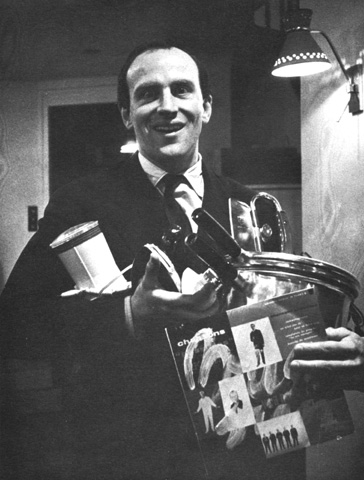


Now that I discovered this Vian (Vernon Sullivan) novel, I decided I needed to publish an English edition of his masterpiece “Lécume des jours.   Once I made that decision, then I knew I had to publish all of Vian’s major novels. Both under his name and the books he wrote under Vernon Sullivan.   The way I looked at I just wanted to build a structure that was Boris Vian.   The foundation would be “I Spit on Your Graves, ” which is probably his most scandalous and famous book, and L’écume des jours.   Then I would add the additional Vian titles on top of the solid foundation.  With that in mind, I discovered Serge Gainsbourg while doing research on Vian.   Vian was a big supporter of Gainsbourg and his music, during the 1950s, so I felt I had to add him to the TamTam Books’ family.   Therefore I published Gainsbourg’s only work of fiction, “Evguénie Sokolov” as well as the magnificent biography on Gainsbourg by Gilles Verlant.


The other important figure for me is Guy Debord.  The writer Robert Greene (“48 Laws of Power”) turned me on to Debord’s “Considerations on the Assassination of Gérard Lebovici, ” which is an incredible book and a tad unusual one from Debord. In that book, he defends himself and his good friend Lebovici, who was a financial backer of Guy’s writings and films, as well as a publisher.  Robert did a superb translation of the book, with a fantastic introduction, and one of the things that came to my attention is the narrative of Lebovici publishing the French gangster Jacques Mesrine’s memoir “The Death Instinct. ”


So now that I have completed the circle in a sense with Boris Vian and his world (of sorts), I decided to focus on my own writing and explore within my own world.  But alas, TamTam Books is really all about me.  In one sense, all twelve titles that I have published is very much a memoir, in that I lived with all of these books (including Lun*na’s upcoming “A Ring Around The Collar” and Sparks’ “In The Words of Sparks… Selected Lyrics), that when I look at them, I see myself in every book that I published.  In other words, this is my life:

- I Spit on Your Graves by Boris Vian (Vernon Sullivan)
- Foam of the Daze by Boris Vian
- Autumn in Peking by Boris Vian
- The Dead All Have The Same Skin by Boris Vian (Vernon Sullivan)
- To Hell With The Ugly by Boris Vian (Vernon Sullivan)
- Red Grass by Boris Vian
- Evguénie Sokolov by Serge Gainsbourg
- Considerations on the Assassination of Gérard Lebovici by Guy Debord
- Gainsbourg the Biography by Gilles Verlant
- In The Words of Sparks… Selected Lyrics by Ron Mael and Russell Mael (Sparks) with Introduction by Morrissey
-A Ring Around The Collar by Lun*na Menoh
- The Death Instinct by Jacques Mesrine