Showing posts with label Manhattan. Show all posts

Monday, May 24, 2021

Wallace Berman in Manhattan in September 2021


We'll take Manhattan again. Wallace Berman exhibition in NYC this coming September. More details later. Self-portrait of Wallace up above.

Monday, April 5, 2021

The Free Spirits - "Out of Sight and Sound" 1967, Vinyl (ABC Records)


I purchased this used album due to the front cover's groovy aspect and even more so to its title, "Out of Sight and Sound." The Free Spirits are basically a jazz band. Two guitars, electric bass, drums, vocals, and Saxophone/flute. To me, the album yells out mid-60s Manhattan, and I see The Free Spirits fitting in into the world of The Fugs and The Velvet Underground. Over anything else, I'm intrigued when jazz-heads do rock. The known musicians on this album are the guitarist Larry Coryell and sax player Jim Pepper, who, by the way, is excellent on this record. 

"Out of Sight and Sound" was produced by Bob Thiele and engineered by the great Rudy Van Gelder at his tremendous and legendary studio in Englewoods Cliffs in New Jersey. The Free Spirits do twelve songs, I presume, in the hopes of getting a hit of some sort. Live, they stretch out like a jazz band, so the tension between the jazz mentality and pop is at its contrasting postures. 

The album is not by any means a masterpiece but a great work of curiosity. For those who love The Lovin' Spoonful, The Velvets, and The Fugs, I think this record needs to be placed in that post-hippie but right before the music world became totally dull. Coryell, the music director of this band, became a significant jazz guitarist in the jazz world. Here he put his talents to the rock n' roll medium and tried to stretch it to something new at the time. I love 1967. 

Wednesday, November 19, 2014

November 19, 2014


November 19, 2014

I served as an assistant to the photographer Louise Dahl-Wolfe, and I don’t think I ever held a conversation with her beyond her telling me to get a certain hat from the wardrobe department or to bring her coffee or water.  When she is shooting in a studio, there is a certain amount of calm that she demands on the set.  They say when you work with someone, that is when you know them best.  But in this case, I think that is not true.   Louise was always a mystery to me, and when I see the finished project by her, she still remains a figure that comes and goes in my life.   When I’m not doing anything on the set, she expects me to be quiet.  I pretty much stand behind her, handling the extra film and delivering the drinks. I just have to read her body language, because verbally she doesn’t talk to me.   She is usually looking in the lens of her camera, and Louise would dart out her hand towards my direction, meaning I should hand over the film to her.   My other responsibility is to deliver the models for the shoot.  I would have to pick them up, and then drive them to the studio, which was located on West 34th Street. 


I have always been fascinated with fashion photography, not because of the clothes or even the models, but more in the juxtaposition of these figures in the landscape.  It doesn’t have to be a real world, but one that ‘hints’ that there maybe another dimension out there - somewhere.   Even if the shoot is a real and iconic location, it is still transformed into something else.   It’s magic, and working with Louise I still don’t know how she does it.  I think because I see an image for what it is, but she sees it as an entrance way to a better world or where one can pinpoint their desires.  On one level, it exists to sell the merchandise, but I truly do believe that it is more than that. 


The one person I remember picking up for a shoot was the actor Clifton Webb.  I had to go to his hotel, the Algonquin, and I waited for him at the bar.   He came upon me, and he was in a bad mood.  I felt I knew him, because I’m a fan of his work.  I imagined him being prissy, and I wasn’t disappointed in the ‘real’ Clifton.  He got in the back seat of the car, and didn’t say a word.  When I brought him up to the third floor of the studio, he immediately sat down and waited for Louise to provide him with some direction.   The thing is Louise told me what she wanted Clifton to do, and then I would tell him.   I always hated to be the middle person when two people were working together.   Sometimes she would have me instruct the models, after telling me in great detail what needs to be done.   Communication is a tricky thing, because the way one reads information from the other, can be totally subjective.   Louise would often get mad at me, because she felt I didn’t relay the correct comments to the model or at this specific case, to Clifton. 


The thing is with Louise and her work, I feel what she conveys in her photographs is nothing specific, but more of a mood.  Her use of color is revolutionary and this is something only Louise can do - so I’m hopeless in that situation where I try to convey her ideas and skills into something concrete.  As you can gather, I didn’t last long in this occupation.   I never do.  Everything I touch, or do, has the desperation of failure attached to it.  When I see Louise’s photographs, it reminds me of a world that I very much wanted to be part of - but alas, I can’t. My other big attraction at that time was watching the Dick Cavett Show.  He always had great guests on, and to me it was always the best of Manhattan.  Of course filtered through Hollywood, but still, it was an indication of sophistication - and again, just my mere moments of touching such a world - but never grasping it to hold forever.   Oh damn…

Wednesday, June 11, 2014

June 11, 2014


June 11, 2014

In the late 1970s, I was living in Manhattan, and pretty avoiding the music scene that was taking place in the East Village and the Bowery.  I craved music that would gently caress my broken soul, and that was seeing and hearing Hazel Scott at the Milford Hotel Plaza on 8th Avenue, not far from Times Square.  At the time, I only had one vinyl album, and one portable turntable, and basically that was that, if you wanted to include several stripped t-shirts and one winter coat, with a pair of blue jeans and boots.  One can say my finances were non-existent. Yet I knew the doorman at the hotel, and he always got me in to see the Scott trio.


The one album I owned was Hazel Scott’s “Relaxed Piano Moods” with the backing of Charles Mingus on bass and Max Roach on drums.  I often lay on the floor by the turntable and its small speakers, and let her music soak into my ear drums, and throughout my body.  I was likewise staying at the Milford, due to a small inheritance that I was living on.  I was fascinated with the idea of not working, and finding out what will happen once the money dried up.  At the time, I was curious to know if eventually what my behavior would be like if I die from the elements, or the lack of food.  The idea of that being the case with me in the middle of Manhattan had a great appeal for me.


I spent most of my daylight hours at the New York Central library reading New York poets.  Frank O’Hara had a huge appeal for me, because it’s a life I know I won’t ever have.   I guess I could if I agreed to get a job, and basically spent my hard earned dole on food, books, and music  - but I was struck by the idea of doing nothing, and walking to the library to read books and then come back to the hotel to listen to the album, and then seeing that artist play later that night.   Now come to think of it, life was really perfect.


At the time, I avoided all social contacts, and in fact, besides the doorman to the hotel, and a waiter or waitress here or there, I didn’t really talk to people.  The inner-dialogue I had with myself, gave me food and I really didn’t have anything to say to others.  In my hotel room, I decorated the walls with images by Julia Margaret Cameron, because I love the idea that she only focused on the world around her, and nothing else.   I stole a lot of the images from photo magazines that were placed in the collection at the library.  I did the famous loud cough as I tore a page one at a time.  The only images I had in my room were the album cover and various portraits by Cameron.

When I was living in Los Angeles, I was a fan of Shelley Manne, and I sort of had this fantasy that I could be Peter Gunn, going to “Mothers” night club to see my non-existent, but fantasy girlfriend sing a number or two.  It was at Manne’s jazz club where I first saw Hazel Scott. I don’t want to say I followed her to New York, because that sounds sort of creepy.  But truth to be told, it was her and my love for Manhattan culture, which clearly was another fantasy on my part.  Till then, the only thing I knew about Manhattan was through books and old episodes of “Naked City” TV series.   Once I came to the big apple, I was surprised that my dream location was exactly the same as reality.  Or maybe I just make fantasy into reality.

Sunday, May 25, 2014

May 25, 2014


May 25, 2014

As a child, Marie Menken filmed me on an almost consistent basis.  I’m not sure what happened to the film footage, but I have heard rumors that the Andy Warhol Foundation got hold of the footage and was doing a preservation job on it but you know, who knows.  No one tells me anything.   Some people own their history. I’m one of those chaps that don’t own a thing, including my history.  Shit, I’m lucky that I have a roof over my head, you know what I mean?  All I know, ever since I was a kid, I wanted to be a part of the book biz or movie world in Manhattan.  As a child I used to watch “What’s My Line” and I was impressed by a member of the panel, who to me at the time appeared to be sophisticated, witty, and charming.  Three things that I ain’t had at that time.  But if I drew from a master, well…. Bennett Cerf was a genuine deal.


The fact he was born in Manhattan, and went to school in Manhattan, and got a job in Manhattan as well as co-founder of Random House publishing, of course, located in Manhattan, makes me a huge fan of Manhattan.  But only on the streets that are numbered.  I try to avoid lower Manhattan if it was the Red Death plague.  In my mind, Manhattan stands for order, organization, and the good tasting martini.  Lower Manhattan I feel is a trap of some sort. Once you’re down there, you are totally confused with the streets with names, and I do have a pet peeve against streets that actually have names.


I first went to Manhattan to be an actor.  I was 16 or 17, and in my mind that was the right time to get serious about entering the world of stardom.  The only job I could find, and it wasn’t really a job because I had to volunteer my services, was to work with Marie.  Since I was a film nut, I used to go to the Musuem of Modern Art’s film program, and I became totally obsessed with the silent movie actress Marie Doro.   She has 18 films to her credit, and of the those 18, only one fully exists.   The others only exist in parts or are totally gone missing.  Marie Menken was a fan as well.  We’re both drawn towards artists who are lost causes.   The only Hollywood actor we admired was Steve Cochran, mostly due to the fact that he died on his yacht, with three female “assistants, ” who didn’t know how to pilot the boat back to shore.  So with his dead body (from a heart attack), the boat was floating off the coast of Guatermala for ten days.  Eventually the boat drifted to the shore in Port Champerico.


Marie thought this would be a suitable subject for a film, so I went up to her studio, to start shooting the film.  What’s unusual about this film was that it was shot in her studio as well as on the roof-top of her building.  I was way too young to play Steve Cochran (who died when he was forty-eight), but the illusion of youth was very much the theme of her work at the time.   She built a fake boat on her roof, and occasionally her husband Willard Maas, would throw buckets of water in front of the hand-made set to make it ‘sort’ of look like we were in a body of water or ocean.  I didn’t understand it at the time, but Marie was more interested in capturing a ‘feeling’ than a narrative about Steve, the three assistants, and his yacht.  It was the first time in my life when I realize that the narrative is not the deal, but the adventure or journey is the “it.”

I was shocked to know the social circle that she hung out with.  For instance she knew my idol Bennett Cerf, and she was kind enough to recommend my services to Bennett.  At the time, I had no real work skills, but I told Cerf I just wanted to learn about the publishing business as well as Manhattan life, as long as I can avoid the lower half of the island.  He said “absolutely,” and my main job was basically to make sure all the pencils were sharpened.  It was a massive job, because there are a lot of pencils in the Random House building.   Within three months, not only did I know a bit about the publishing world, but I became an expert on the pencil.  The pencil was the weapon or tool of choice in the world of Random House.  For one, it never ages like ink, and two, you can erase your work with an eraser.   A remarkable invention if I may say so!

Well, as I said earlier, history doesn’t owe me anything.  I eventually had to come back to Los Angeles, and get a job at a bookstore,where oddly enough, they had a huge supply of pencils for use in work.   I took care of that department, and mostly took care of the books regarding film history.   But I won’t lie to you, that I get a frog in my throat whenever I come upon a book published by Random House.  Especially the one on Marie Menken, where of course, my name does not appear in the text or in the back of the book, known as the index.  I feel like I don’t exist.  But then again, what is an existence, exactly?

Saturday, May 10, 2014

May 10, 2014


May 10, 2014

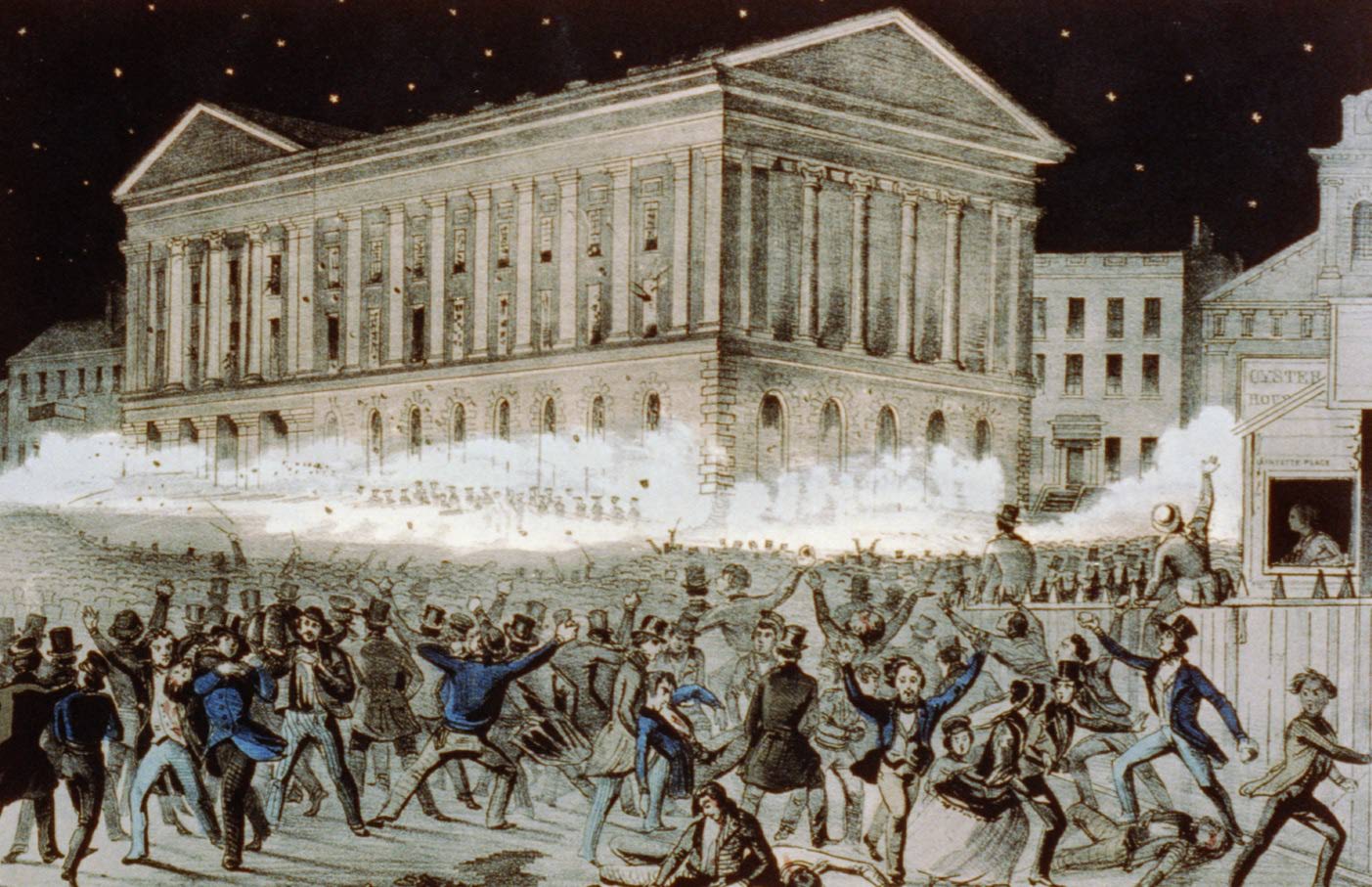
In theory, I don’t care for rioting, unless it was just for aesthetic reasons.  The Astor Place Riot that took place in 1849, started when two famous Shakespearean actors argued who was best to play in the Bard’s plays.  American actor Edwin Forrest (1806-1872 and the British actor William Macready (1793-1873) had a running feud, and both were extremely well-known actors in Shakespeare’s theater. Due to this feud, 120 were injured, and at least 25 were killed in this riot. This was the first time that in an American riot where a state militia was called in, and they actually shot into a crowd.


In the mid-nineteenth century, it was the British who dominated the American theater, and Edwin Forrest was one of the first American actors to do major roles in Shakespeare’s plays.  Eventually, what was a difference of opinion regarding to input one’s culture into another, became a huge subject matter for Americans.  Over time, the American theater scene started to resent the Briitsh influence over their own national theater.   Over time, British actors who were touring in America had it rough with the American audience.  Shakespeare in America went through every class in America during the nineteenth century.  It seemed that the great populace was super aware of his work, and often various groupings would recite his work to each other, as well as his work being very much part of the pop culture of that time.


Macready and Forrest were once friends, but became enemies when the argument reached a feverish pitch in the American and British media.  Forrest challenged Macready directly, by following his tour in America and doing the same plays, to show the audience who is a better actor in Shakespeare's plays.   When Forrest went to London, to see Macready play “Hamlet, ’ he hissed at the British actor from his seat in the audience.  Macready commented that Forrest 'lacked taste."   When Macready came to America for another tour, he faced hostility from the audience.   There was even a report that someone in the audience threw the carcass of half a dead sheep on the stage, while he performed on stage.   Around the same time, Forrest proceeds with a divorce against his British wife for immoral conduct, but the verdict came down against Forrest on the same day that Macready came to New York City.


What is set-up here is a major difference between the British and American sensibility, especially in New York City.  Forrest was quite popular with the gangs of New York, where he performed Shakespeare at the near-by Bowery Theater, which catered to a working-class audience.   The Astor Place Opera House was built for the upper-class who didn't want to associate themselves with the lower or middle-class theater audience.   Shakespeare appealed to both classes, but Forrest gave it an "American" spin, while Macready did of course, a more British subdued style.   Either by chance or design, on the same night and the same play, "Macbeth," Macready had his performance at the Astor Place Opera House, and Forrest did his "Macbeth" at the Bowery Theater, a couple of miles away.    During Macready's performance, a group of fans of Forrest, purchased tickets to the upper balcony of the theater and threw rotten fruit towards the stage while he performed.   Meanwhile at the Bowery, when Forrest recited Macbeth's line "What rhubarb, senna or what purgative drug will scour these English hence,?" the crowd stood up and roared their approval.

When Macready appeared for his next appearance at the opera house, the riot exploded.  There were at least 10,000 people outside the theater.    About 21 to 31 rioters were killed and approximately 48 were wounded.   At least 70 policemen were injured as well.  Nevertheless, during the rioting, even as people were trying to burn down the theater, Macready did his full performance and then disguising himself, left and escaped from the crowd.  The most interesting observation I have read about the riot is that Sigmund Freud commented that the theater goers "rioted over whether "Hamlet" should be a feminine or masculine character."  At this point and time, history hasn't told us yet, regarding that burning question.

Sunday, January 5, 2014

January 5, 2014


January 5, 2014

I read on Facebook that it was going to snow in NYC and I never ever been in the snow before.   I booked a red-eye on JetBlue to make sure that I arrive at the height of the snow storm.  Luckily I had no trouble with the flight into JFK.  The great thing is when I went to the taxi stand, that was the moment where I experienced my first time under a snow flake.  Except it wasn't one flake but a super lot.

   I had the taxi driver take me to the Jefferson Station in Bushwick, Brooklyn.  i wanted to go somewhere that was totally industrial, yet in the snow.  It took awhile and cost around $70 to get there, but once there after I paid the driver, I jumped out of the taxi, and experienced my first time walking in the snow.  It was odd because due to the heavy snow, I couldn't see where the curb off the street was.  I kept stepping on a pile of snow where it seemed that there was no ground underneath the white stuff.  I imagine to find an international market that was open that early in the morning. I bought an apple muffin and a large cup of hot coffee.

 I sat as close as I can to the door, so when it opens I can feel the freezing temperature  come in.  Strange enough when I am in Los Angeles, and its cold, I really feel it.  Here when it is around 17 degrees, the cold almost becomes abstract.  I hung out there with my large coffee being kind of scared because I thought there was a good change I would die on this trip.

   Around 10:am I got up and headed towards back to the Jefferson St station.  It was really difficult for me to walk on the snow for some reason.  Plus the fact that I never experienced the sensation of the snow hitting my face.  I really didn't like that feeling.  I made it to the station, and I was extra careful not to go face down the stairs.  My sixth sense told me that the stairs could be slippery.  I bought a MTA card and used it with no problem.  The L Line took me to Union Square Manhattan.  That is where I got off and I walked down Broadway to the Strand Bookstore.

 I went in, and I was so thankful to be in a warm store.  Almost too warm, but nevertheless I felt that since I made it here, there is a good chance I won't die on this trip.  I looked around for a book to read on my way back home later that day.  I found a hardcopy of "The Boy Detective: A New York Childhood" by Roger Rosenblatt.  I never heard of this book, but it seems to be about a writer who pretended to be a boy detective among other things, and  it covers two subject matters of my interest.  Childhood and detective fiction.  Also, even though it was a hardcover book, the size was perfect for a plane trip.

  I bought it, refused the bag, and stuff it into my coat pocket.  I found a taxi around the Strand area and went back to JFK.  Luckily there was no cancellation of the plane trip going back to Los Angeles.


Thursday, September 12, 2013

"The Collected Writings Of Joe Brainard" by Joe Brainard


Joe Brainard may be my favorite writer.  As I was reading "The Collected Writings of Joe Brainard" I didn't want the book to end, and its over 500 pages.  What strikes me the most brilliant aspect of Brainard is that he's not overly writer-like, but just naturally breathes as a writer.  He is mostly famous for his "I Remember" which is an unique form of memoir writing, that to this day is taught by writing teachers.  It is an effective way to open up the writing process, but in the hands (and mind) of Brainard, it's a work of genius.

The beauty of his work, including his artwork, which he's equally known for as well, is how simple he describes a piece of literature, art, or just commenting on day-to-day journals.  But that 'simple' is quite complex and there is something very organic in the way he processes his subject matters to the readers or viewers.   He is sometimes beyond zen, for instance "Short Story"

"Ten years ago I left home to go to the city and strike it big.  But the only thing that was striking was the clock as it quickly ticked away my life."

Or his little prose piece "Ron Padgett"

"Ron Padgett is a poet.  He always has been a poet and he always will be a poet.  I don't know how a poet becomes a poet.  And I don't think anyone else does either. It is something deep and mysterious inside of a person that cannot be explained.  It is something that no one understands.  it is something that no one will ever understand.  I asked Ron Padgett once how it came about that he was a poet, and he said, "I don't know.  It is something deep and mysterious inside of me that cannot be explained.""

Brainard is one of the great critics as well as a prose stylist.  He writes like a visual artist who is extremely talented in giving the reader a picture.  It's interesting that he never wrote a novel, because it seems that was one of his favorite literary formats.  But again, the narration is not the key, but the way he observes his world, and it is a fascinating world.  He was close the New York School Poets and the painters around that scene.  His observations are fresh and non-cliché, it is almost like looking at the world for the first time.  But looking at it with intelligence, great wit, and telling the tale in a very uncomplicated manner.

The Library of America should get a nice pat on the back for publishing this book, and also extra stars to Paul Auster for writing an interesting introduction, and most of all to the skills of fellow poet Ron Padgett for editing Joe's writings.  This book is a must for those who write, and for those interested in 1960's/1970's Manhattan art culture.  In other words, the book is a keeper, and I'll never loan it out.

Friday, March 12, 2010

Michael Sorkin's "Twenty Minutes in Manhattan"

Twenty Minutes in Manhattan Twenty Minutes in Manhattan by Michael Sorkin


My rating: 4 of 5 stars
If you look at my list of titles on Goodreads, you can see that I am interested in books that are in a specific place and time. In many ways I think I prefer that than to say 'character.' But then again I find cities and locations are very much character in the sense that the architectural or urban landscape is a narrative in itself and there lies the suspense and often tells how humans react to that environment.

Michael Sorkin, like a skilled surgeon, writes about his neighborhood in lower Manhattan. And what he sees is visual history slowly and surely disappearing as New York merges into another identity or large shopping mall. The human interaction is still in place, but can one imagine a time where that will also disappear like one's favorite little shop.

Sorkin is an architect, and it is basically the eyes of that occupation that he looks at his home. The first chapter on various staircases in Manhattan is fascinating and scary (due to my vertigo). But he also admires all the quirks and charm of a building that doesn't work perfectly. This is a very human take on a city that is changing but will always be fascinating as well.

View all my reviews >>