Showing posts with label William Shakespeare. Show all posts

Tuesday, May 20, 2014

May 20, 2014


May 20, 2014

As the world gets more complicated and cluttered with information, objects, and just plain things, I decided to go in the opposite direction and become more simple.  First things first are clothing.  I wish to draw attention to a minimal uniform where I don’t have to think about what I’m wearing on a regular basis.  I have decided on the classic white t-shirt and 501 straight legged Levi’s with a pair of black shoes from Red Wing.    For an additional color, perhaps a red and white stripped sweater or pull-over will do.   Since I do very little physical work, I can usually cut down to one pair of jeans, and maybe five days of white t-shirts in my inventory.  Five days of socks, usually stripped, but always a dark color like gray and black stripes.


As you most know by now, I don’t do work.  Well, let me put this in another way.  What I do is work, but not for money.  I lost my job about two years ago, and I’m having a hard time getting back on the gravy train of a regular salary.   What I have been doing is writing up to 140 stories, regarding mostly my life, as a man who is just trying to simplify his life.   Basically on an everyday basis, I put on my uniform, shave, and then go off to the Central Library to do my writing.  I stop when my hands start hurting, and then come home and try not to spend any money whatsoever, because due to my lack of “work. ” I have no more money left.


This causes significant amount of anxiety, but I’m on a suicide mission to finish writing 225 more stories and then I can relax and ….Well, you know whatever the end brings to my soul.  With respect to my clothing, I rarely go out for social visits or go to ceremonies.  For instance, I would never go to a wedding or a funeral, due to my lack of proper clothing for such affairs.  Also the blue jeans and t-shirt combination are a look that doesn’t offend anyone.  On certain bodies, it can look rather stylish, sadly I’m getting a tad fat.  But even that, it brings a sense of focus in my life.    Once I die, I wish to be dressed in my T-shirt and blue jeans, and then burned to the crisp, and eventually place my ashes in the Levi’s headquarters in San Francisco.   The thought of that offers me a sense of peace and happiness.  On the other hand, living is a total drag at times.

It is indeed hard for me to wake up and face an empty notebook page with my pen by its side.  I stare at the lined paper till something comes towards my chest.  At first I thought it was the first sign of a heart attack, but it is not!   The idea for a narrative is very physical. It is almost like a beautiful woman embracing you around the waist.  You can smell the essence of her skin and hair, and then bingo, you start writing.


Also you consistent readers, you know I am a publisher as well.  And within a couple of weeks, I’ll be doing a reading of Shakespeare’s Sonnets from the original edition that was published by Thomas Thorpe in 1609.   Some years ago I purchased a copy of this rare item at Mystery Pier Books, which cost me a fortune of course. But how could I resist as a publisher myself.  The thing that is interesting to me, is that Thorpe may have published the Sonnets without Sharkespeare’s approval.  In other words, he stole it.  This of course is only a theory, because as we all know, history is told through someone’s point-of-view, and who knows the extent to which that goes. Nevertheless, it doesn’t matter in the end, because Thomas Thorpe died in his early 60s and in a poorhouse on top of that.  Surely as a publisher I will be going down that same route as well.

However, before all of that, I will do a public reading of the Shakespeare Sonnets, dressed in my normal uniform, because I think that will bring out the words more.  The visual sensibility of being aware of one’s clothing even helps me when I’m writing with my pen and paper.

Saturday, May 10, 2014

May 10, 2014


May 10, 2014

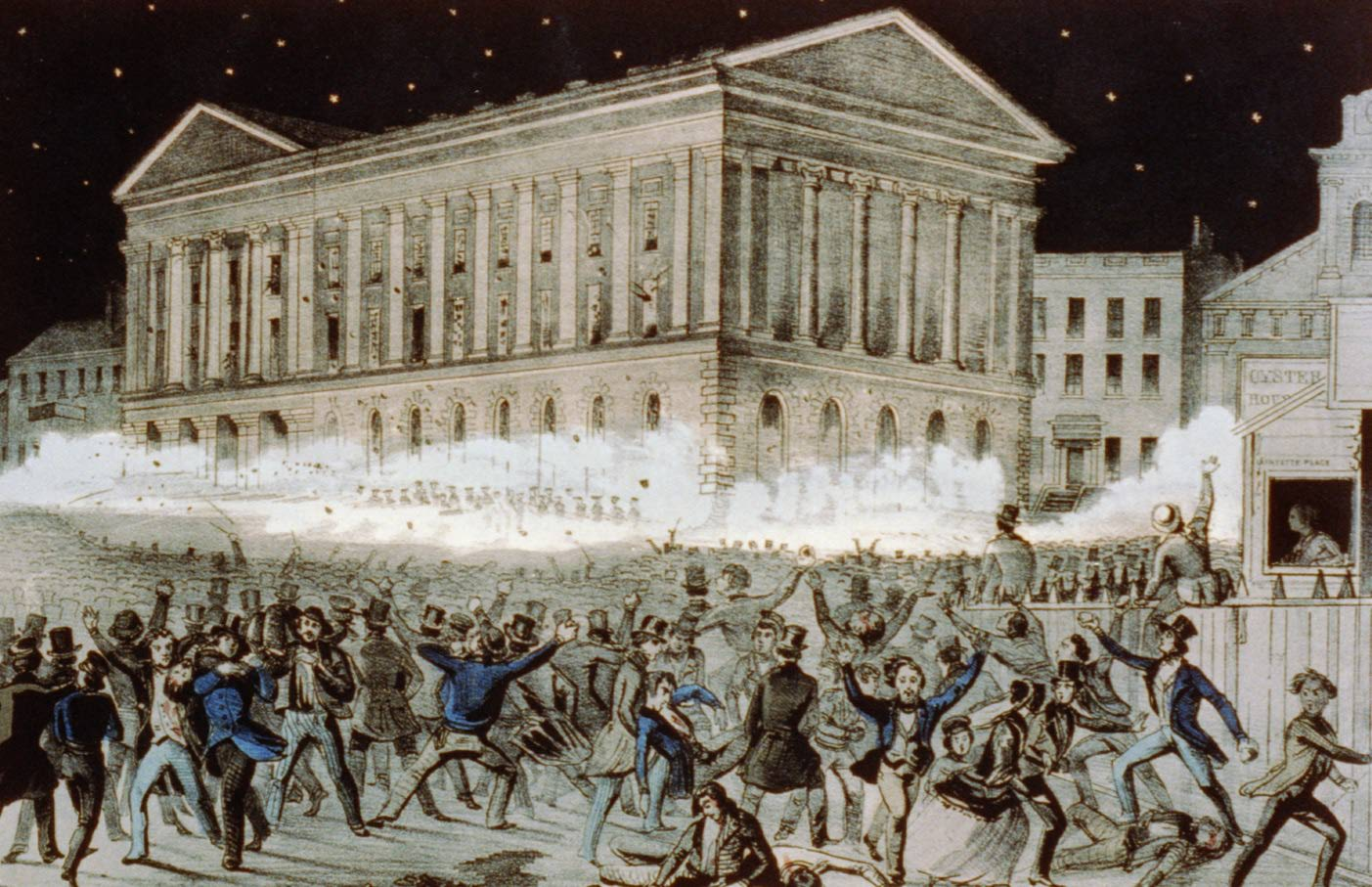
In theory, I don’t care for rioting, unless it was just for aesthetic reasons.  The Astor Place Riot that took place in 1849, started when two famous Shakespearean actors argued who was best to play in the Bard’s plays.  American actor Edwin Forrest (1806-1872 and the British actor William Macready (1793-1873) had a running feud, and both were extremely well-known actors in Shakespeare’s theater. Due to this feud, 120 were injured, and at least 25 were killed in this riot. This was the first time that in an American riot where a state militia was called in, and they actually shot into a crowd.


In the mid-nineteenth century, it was the British who dominated the American theater, and Edwin Forrest was one of the first American actors to do major roles in Shakespeare’s plays.  Eventually, what was a difference of opinion regarding to input one’s culture into another, became a huge subject matter for Americans.  Over time, the American theater scene started to resent the Briitsh influence over their own national theater.   Over time, British actors who were touring in America had it rough with the American audience.  Shakespeare in America went through every class in America during the nineteenth century.  It seemed that the great populace was super aware of his work, and often various groupings would recite his work to each other, as well as his work being very much part of the pop culture of that time.


Macready and Forrest were once friends, but became enemies when the argument reached a feverish pitch in the American and British media.  Forrest challenged Macready directly, by following his tour in America and doing the same plays, to show the audience who is a better actor in Shakespeare's plays.   When Forrest went to London, to see Macready play “Hamlet, ’ he hissed at the British actor from his seat in the audience.  Macready commented that Forrest 'lacked taste."   When Macready came to America for another tour, he faced hostility from the audience.   There was even a report that someone in the audience threw the carcass of half a dead sheep on the stage, while he performed on stage.   Around the same time, Forrest proceeds with a divorce against his British wife for immoral conduct, but the verdict came down against Forrest on the same day that Macready came to New York City.


What is set-up here is a major difference between the British and American sensibility, especially in New York City.  Forrest was quite popular with the gangs of New York, where he performed Shakespeare at the near-by Bowery Theater, which catered to a working-class audience.   The Astor Place Opera House was built for the upper-class who didn't want to associate themselves with the lower or middle-class theater audience.   Shakespeare appealed to both classes, but Forrest gave it an "American" spin, while Macready did of course, a more British subdued style.   Either by chance or design, on the same night and the same play, "Macbeth," Macready had his performance at the Astor Place Opera House, and Forrest did his "Macbeth" at the Bowery Theater, a couple of miles away.    During Macready's performance, a group of fans of Forrest, purchased tickets to the upper balcony of the theater and threw rotten fruit towards the stage while he performed.   Meanwhile at the Bowery, when Forrest recited Macbeth's line "What rhubarb, senna or what purgative drug will scour these English hence,?" the crowd stood up and roared their approval.

When Macready appeared for his next appearance at the opera house, the riot exploded.  There were at least 10,000 people outside the theater.    About 21 to 31 rioters were killed and approximately 48 were wounded.   At least 70 policemen were injured as well.  Nevertheless, during the rioting, even as people were trying to burn down the theater, Macready did his full performance and then disguising himself, left and escaped from the crowd.  The most interesting observation I have read about the riot is that Sigmund Freud commented that the theater goers "rioted over whether "Hamlet" should be a feminine or masculine character."  At this point and time, history hasn't told us yet, regarding that burning question.

Wednesday, April 23, 2014

April 23, 2014


April 23, 2014

As I learned from Johnny Hyde, never fall in love with your client.  They are many things that make a successful client, but one thing they are not, is an object of love from the agent’s point-of-view.   To be successful, you have to see your talent as an object, and know what that subject is worth the open or even closed market.   Johnny made the mistake in believing in his star client, when instead, he should have admired her from afar, like her fans.  He would gain a better understanding of her appeal and the needs of her fan base. 

What is it about guys who fall for their meal ticket?  They now come to you because they insist on vision and security of some sort.   If you cross that line, you become powerless in front of their eyes.  To be honest, it makes me sick to my stomach to see it happen to my type of guy in my type of occupation. Once I see an artist at work, it becomes a narrative right in front of me.  There is a beginning, a middle and of course an ending.  The thing is to be prepared for that crash in the third act, and make sure your client is comfortable when that time comes.  


I took my client to a nice bar for a intimate drink and to discuss business.  Roy Orbison’s “Only The Lonely” is playing softly on the jukebox, and I told her that we need to make some drastic, but positive, plans. There was a war photographer who freelances by the name of Lee.  She drinks like a fish and she had the guts to take a bath in Hitler’s tub right after the liberation of Munich.  I knew Lee for a long time, we were pals in Paris before the war, and at the time she was living and working together with another photographer, whose name doesn’t come to the front of my head at this moment.  But she did fashion, and she’s talented with the lens.  

I had a script with me that is based on Shakespeare’s “Richard the Third.” The movie was going to be original by updating the narrative to contemporary times.  Yet, keep the Shakespeare language intact.  I didn’t know if this would work or not, but my client did Shakespeare in her school, so I figure this would be a natural for her.   As I told her more about this project, she seemed to get less interested and was fidgety, and not drinking any of her drink as well.   She then asked if I would take her to an address in South Pasadena.  She just wanted to show me something there.   The address that she gave me was on 1071 South Orange Grove Avenue. 


When we arrived it was dark already, and it seemed to be a charming sleepy neighborhood in South Pasadena.  She indicated to me that there used to be a house here, not this one, but another one, that was destroyed by an explosion.  The house was the property of a scientist who worked for the Jet Propulsion Laboratory, and was known to be as an explosives expert.  He and his wife were getting ready to move to Mexico to work and live, but he accidentally dropped some chemicals, which in turn, caused an explosion and therefore his death.   Also both of them were under the tutelage of Aleister Crowley.  She mentioned this all to me, and just wanted to bring this story onto the big screen.   Me, being me, tried to link a Shakespeare theme or narration as she told me this very minimal but nevertheless interesting Mise-en-scĂ©ne.  At least that’s the way I looked at it.  We both sat in the car and stared at the property, not saying anything to each other.  I had the motor on, and over the radio we listened to Sergei Prokofiev’s “Romeo and Juliet, Op. 64., Suite No. 1, Op.64c: Monagues and Capulets.”