Showing posts with label Richard Stark. Show all posts

Thursday, December 31, 2020

"Maybe The People Would Be The Times" by Luc Sante (VCP)


I identify with Luc Sante's writings because we seem to share an interest in urban street history and its culture and music, films, French crime books & literature. He's a superb essayist with very sharp intelligence, and I love how he approaches his subject matters by making it personal.  Born in 1954,  he was born in Belgium and moved to the United States. His sensitivity is that he's very much aware that he lives in a duo-cultural existence. He's both an American and a European. Through his writing, I get the impression that he feels like an alien in a different world. Sante approaches to culture as buying a nice winter coat in the cold. The very essence of music, art, and literature is deadly important to him. 

"Maybe The People Would Be The Times" is a compilation of Luc's writings from the 21st-century. It includes essays on music, cultural history, writers (great article on Richard Stark), Punk Rock & Reggae, and life in Manhattan during the 1970s. The book's title came from an Arthur Lee song, "Maybe the People Would Be the Times or Between Clark and Hilldale," a classic tune from Love's "Forever Changes" album. I can tell that Sante wrote poetry due to his dense but straight forward prose, but not a wasted word in these essays. Reading some of the chapters in this book is like a physical presence in one's conscious. I can feel Georges Simenon, Patti Smith, Ricard Stark, and others in this volume as if they are sitting across from me. 

Saturday, December 9, 2017

"Ask The Parrot: A Parker Novel" by Richard Stark (The University of Chicago Press)

ISBN: 978-0-226-48565-2 University of Chicago Press

Richard Stark (Donald Westlake) should be studied at all writing schools. To write a Parker novel is more of a math problem than a series of moments inspired by passion. The ultimate anti-hero, Parker represents a professional who will do what he has to do, to survive or excel in his line of the profession - which is being a professional criminal. Parker is in a pickle, somewhere in the backwaters of a small community, avoiding an arrest, he teams up with a hermit of sorts, who is still sore about being fired from a horse racetrack. Parker, who is quick with psychological profiles on everyone he comes upon, he acts on not emotion, but intellect. Stark is just as great as a writer as Patricia Highsmith, another narrative writer who plots with the skill of a surgeon under tense conditions. Recommending the best Richard Stark "Parker" novel is pointless. All are equally readable and addictive.

Saturday, July 12, 2014

July 12, 2014


July 12, 2014

I have been writing poetry for my whole life. Yet it is difficult to describe the horrors and put that on paper.  I usually write with green ink, because for me, that color represents desire and hope.  But to be honest, it is futile to think that I can change the world with my writing, and whatever it’s green or black ink, it comes out white on white piece of paper, and barely readable. I’m intrigued by the art of the sentence, the way the lines break on a page with respect to poetry.  It is these little pleasures that keep me on the page and holding onto my pen. On the other hand, I don’t see much hope for the world outside my studio or writing space.


I have always been fascinated by a world that I wasn’t allowed to see.  As a small child I pretty much learned to read by devouring “Famous Monsters of Filmland” edited by Forrest J Ackerman, especially articles on Tod Browning.  As a ten-year old, I had a favorite filmmaker, yet I never saw any of his films.  I just loved the film stills I have seen in the magazine, such as “Dracula, ” and anything with Lon Chaney.  I was intrigued with Chaney due that he wore the most bizarre and scary make-up.  The photograph of him dressed up as the Phantom of the Opera, scared me, but everything he did with Tod Browning as his director, seemed impossible to see, especially when you are ten-years old, and this was all before VHS video or DVDs.  The one film that seemed taboo was Browning’s “Freaks.” Quite often, “Famous Monsters of Filmland” would have articles and images from this film, and it truly captured my imagination.   I couldn’t draw, but I could write, so I started writing poems devoted to the images I have observed in the magazine.  As a teenager I started to read French surrealist poetry, and I was struck with the image of filmic horror and the surrealist imagination, as being married, or perhaps connected to the hip, like the Dolly Sisters.


As a poet, I strived to be as cold as Richard Stark’s “Parker, ” in that I want to plan out the poem as a route on a map, or at the very least a destination from there to here.   To take everything that is out there and make it into my home, or at least in a position where I can control or contain a world that I can call my own.  Like my favorite poet, Max Jacob, I’m often at odds with the world, which in turn hates me.   Everything I have done in life has ended up as failures, on the other hand, I wear ‘failure’ as a badge of pride.  Like Thoreau, I’m interested in the idea of survival in the face of hostile elements, historical change, and the most important, natural decay.   I think this is exactly what I sense with respect to the figures and characters I saw in “Famous Monsters of Filmland.” To survive in a world that is hostile to the monster, the vampire, and best of all, the side-show circus freak, captured my imagination and my soul.


A lot of my childhood friends played with toys like G.I. Joe, and I think later they were in a position to join a culture that was open and friendly to them.  I, on the other hand, was on the side of the mad poets and monsters.  As a young adult, I became attracted to the work of Alain Cuny, a French actor who was likewise a close friend of Antonin Artaud. He appeared in numerous films made by Fellini, but the role that I am mostly impressed with is the character that he played in “Emmanuelle.” He played an older man named Mario who convinces Emmanuelle that monogamy will die out, and that lust will win out over guilt or reason.  He leads Emmanuelle to one sexual adventure after another, and like the characters in the monster magazine, I have found another hero.

The sad thing in life is that I just have notebook after notebook with writings in green ink, that is barely readable. Yet I continue, because as I said, the destination is just a direction, in which I don’t think will bring me to a conclusion.

Monday, December 20, 2010

Richard Stark's "Deadly Edge"

I am trying to review each Parker novel by Richard Stark as a separate entity, but alas, to me it is one big huge novel. Like Proust! One pretty much knows that each and every one of the Parker novels is a page-turner. I read a lot of his novels on the bus and almost consistently I miss my stop, due that my every sense is tied into the narrative. 
This one is slightly unusual, because the first part of the book is the heist of a rock n' roll show. Its 40 or so pages (which is a mega-section in Parker theme novel) of the actual robbery. But then afterwards someone is killing off the gang. And the violence in this novel is harsh and ugly. 
The beauty of the novel is how Parker reacts to the dangers he face. Which of course, is being totally professional and looking at the problem on a total technical level. "A" is killing each heist gang member, therefore I Parker must do this or not do this. And part of the fun is seeing a criminal mind against another criminal mind. Parker is not a sadist, but he is a cold blooded killer. His instinct is to survive. And this is in many ways a perfect crime novel.

Monday, December 6, 2010

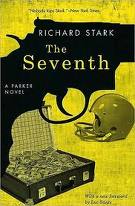
"The Seventh" by Richard Stark

In that neat style, "The Seventh" is not only No 7 in the Parker series, but also deals with 7 crooks sharing loot 7 ways and when someone outside the system screws up - how that seven becomes meaningless...well, till the end because nothing screws up for Parker on a permanent level. 

And that is the beauty of the Parker series. It reads like oatmeal every morning and you are always happy after the meal. It is sort of the perfect airplane read but without the guilt - because these books are superb. To review them as separate titles is almost pointless, because really, they're the same novel. Parker is a man with little emotion but highly professional. He is part of a group stealing something (and that something has really no importance) and the fun of the novels is watching how the heist falls apart. In other words the heist or crime always fail on the grand picture, although Parker sometimes wins in the end. 

So the novels are about how the failure happens, who screws up, who talks to the wrong person, and how they do their business. There are few surprises in the series which is why it is almost a trust-worthy no money back sure thing that you are getting your value out of these novels. 

So yeah, its almost genius like in how Donald Westlake (Richard Stark) writes these perfect narrations on an on-going basis. But alas, he does and we the reader are thankful in a world that is falling apart - at the very least we can expect another Parker novel that will again say "things are alright in the heist world."

Wednesday, December 1, 2010

Richard Stark's "The Sour Lemon Score"

a href="http://www.goodreads.com/book/show/7358545-the-sour-lemon-score" style="float: left; padding-right: 20px">The Sour Lemon Score: A Parker NovelThe Sour Lemon Score: A Parker Novel by Richard Stark
My rating: 5 of 5 stars

So far, reading a Richard Stark book is a meditative practice of being with an object that is a form of perfection.   Lean, not a word wasted, and right to the point, the main character Parker has a Zen like intensity to his mission in life - robbery.


He also has a distate for those who don't follow the plan which is to rob and then share the loot.  "The Sour Lemon Score"" is about a loser who kills numerous people for a small amount of money and you eventually Parker will get back at this double-dealing creep in no time.  Because Parker is like a shark.  He's totally focused on getting what he agreed to get in the first place.  We the readers are interested in seeing the weak criminal get his just awards - but Parker is really only interested in getting what is owed to him  - which is a small amount of the money that was robbed in a bank.


Parker is not crazy, nor does he have a great deal of passion, but what he sees himself as is a total professional.  He takes pride in his work, yet he doesn't really judge other people.  He is only concerned about his actions in the affair.  He's loyal to a point that he will do his part in the job, but it is almost indifference when someone in the gang screws up.  That is their affair.  But for him he agreed to do crime to get a certain X amount of dollars and he won't take less then that.  If he agrees to share the loot, that is only what he wants.


Yet the greed of his criminal(s)  leads to a major downfall to their world.  Yet Parker rises over the damage and sees himself as just a worker getting what he deserves or worked for.   "The Sour Lemon Score" is another act of perfection in a world that is not perfect.


View all my reviews