Sunday, June 20, 2010

Francis Ponge's' "Soap"

Soap (Meridian: Crossing Aesthetics) Soap by Francis Ponge


My rating: 5 of 5 stars
I have heard of Francis Ponge, but never read any of his books. Luckily i found this book at my favorite local used bookstore, and the subject matter interested me - Soap. Well, not soap in itself, but the fact that a writer wanted to write a book called "Soap."

And yes the book is about soap and washing your hands, it is also about writing. Or the nature of writing. If my eyes were covered (does that make sense while reading?) I for sure would think this is the work of Raymond Queneau, with respect to his "Exercises in Style." Both books have a strong visual picture, but its not the picture that is the subject matter, but how the tale or image is told.

So yeah, the book is about nothing, but really its about everything. Therefore its great!

View all my reviews >>

Saturday, June 19, 2010

Robert Mitchum

Mitchum - In His Own Words Mitchum - In His Own Words by Jerry Roberts


The late and for sure great Robert Mitchum. A man's man. A girl's version of what a man should be. And one of the great screen actors of all time. But saying that, he was also a very sensitive and quite aware of his world or his surroundings as well. It is truly a sin that he never wrote a memoir, because via this book, one can gather he has or had endless fascinating stories to tell.

His main biography, "Baby I don't Care" is a masterpiece of sorts. And this book is sort of a side-dish of the main biography. In fact its important to read this one as well if you read the other. So what we have here are a collection of Q&A's with Mitchum that deals with childhood, his various troubles with the local law, and of course, his film career. "Night of the Hunter" gets a big nod in the positive from the main man, and he also thought that "Cape Fear" should have been more nasty. Or was that "Night of the Hunter" should have been more nasty? Well, nevertheless a truly unique movie icon and one misses him now in our daily life.

View all my reviews >>

Sunday, June 13, 2010

Walker Evans

Walker Evans: Decade by Decade Walker Evans: Decade by Decade by James Crump


My rating: 5 of 5 stars
There is something so satisfying at looking at an artist's entire career in a book - and this one is a superb beauty. With Walker Evans, of course there are a lot of landscape images, but what impresses me the most are the portraits of various writers and fellow photographers. And the women in the book are beautiful. He really captures not the sexy, but more of the sensual aspect of their personalities.

View all my reviews >>

Saturday, June 12, 2010

Frank The Voice by James Kaplan

Frank: The Voice Frank: The Voice by James Kaplan


My rating: 4 of 5 stars
Along with Buster Keaton, Marcel Duchamp, Howard Hughes, Duke Ellington, Louise Brooks and Fritz Lang, I think Frank Sinatra is an icon of the 20th Century - or in many ways he is the 20th Century. Famous, but still a mystery, and a man who saw things differently then everyone else. James Kaplan, the biographer, sees him as a genius, and if that is true, then he is a man pretty much made up by his inner personality - which is insecurity, doubt, and pure instinct.

The plus side of the book is that it deals with Sinatra from birth to 1954. Professionally speaking, a bumpy ride to end all bumpy rides. He went from being an early teen star to the bottom of the heap, to the top again - but over time he became a great recorder of human emotion via his music.

So the book in ways reads like a fictional narrative where it starts off good, the middle part is despair, and the ending is hopeful for a better future. And all of this pretty much has a strong second character Ava Gardner, the muse, the wife, and demon for Mr. Sinatra. In many ways a perfect couple, in the Sinatra world, but in reality it must have been a total mixture of boredom, total despair, and pure blissfulness all in parts, but never put together like a perfect cocktail drink.

Although the book doesn't cover the entire 1950's, which I consider to be the golden age of Sinatra-life, due to making perhaps the first of a series of conceptual albums with a particular theme for capital Records. Those series of albums are without doubt landmark albums, and they are made to play all the way through from the first song to the last.

So yes, the book ends in 1954, my birth year, and also one can argue the beginning of commercial white Rock n' Roll with respect to Elvis hitting Sun Studios. This decade he would grow as an artist, and yet the doubt lurks in the murky background....

View all my reviews >>

John Zorn & Co. + Wallace Berman = Bliss

Sunday, May 23, 2010

"Return of the King" by Gillian G. Gaar

Return of the King: Elvis Presley's Great Comeback Return of the King: Elvis Presley's Great Comeback by Gillian G. Gaar


My rating: 3 of 5 stars
Elvis Presley = sadness. It is truly the most depressing story of an icon music legend. On one level one would think Elvis was just dumb, but also he was a man who had the moment and the time (1950's) and he was sort of the force that got us over to the 1960's. The concept of Elvis is genius, but the life that is Elvis is not genius, but rather pathetic or someone caught is a strange depressive state of mind and body.

"Return of the King" is a well written researched book that focuses on Elvis' comeback years that quickly turned into a march to death. The great bio on Elvis is the two volume set by Peter Guralnick, and all others are just a shadow to that particular biography. Saying that, this is a very good book, but it has been said before, so there is really nothing new regarding Elvis and his world.

But for sure, anything on Elvis, one has to talk about Memphis and its culture. The Southern (gothic) culture basically made Elvis, and you can sort of see his world via the images of the great Southern photographer William Egglestion. Roughly both men are in the same generation, but it is interesting to see how outside influences such as the Southern family and settings can make a person tick. The big picture of Elvis is not his sad life, but how is life is part of a bigger puzzle that is the 20th Century South.

Elvis is fascinating in so many ways. A man who wore pink pants and eye make-up in his teenage years, and who adopted black culture as well as country music to make a hybrid sound - or a Frankenstein monster in a sense. Gillian Gaar is good with the facts, but there is no real analysis with those facts. She interviews all the key players but none can penetrate the Elvis wall. And I think even Elvis couldn't penetrate that wall.

So yeah if you are a Elvis fanatic this is a good book. But it has all been said in the Guralnick bio - but then again, like a car accident repeated in front of your eyes again and again, its hard to look the other way.

Also I want to note that the publisher Jaw Bone is fantastic. They don't do poorly designed books, and "Return of the King" is a beautiful production. Great cover, thick pages, nice photos - the whole package is great.

View all my reviews >>

Dandies in Revolt

Saturday, May 22, 2010

Mick Jagger - Umano non Umano - 1969


The importance of the classic Mick Jagger.

Boris Vian Related Albums That I listened to Today


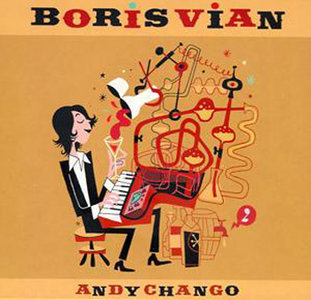
A album that I believed was put out in 2008 by Andy Chango "Boris Vian." I know very little of this music artist, except that he is from Buenos Aires and he has this record, which is really good. The cover itself is an A+. Pianococktail from "Foam of the Daze" (L'ecume des jours). Chango sings Vian songs in Spanish (at least I think it is) and it has a nice updated yet respectful stance towards the material. Highly recommended.


As Paris was burning to the beat of May 1968, Les Charlots put out an album of Vian songs called "Les Charlots chantent Boris Vian." Basically a comedy group in the line of maybe a French version of the Goons, or at the very least Monty Python. Now Vian is a funny guy, so its interesting that this group of comedians pretty much (music wise) do straight ahead versions of Vian's music. They stay pretty true to Vian's sense of fun. A curious album and I imagine kind of rare.


A cool album. Basically a mix of Vian's poetry and excerpts from his novel and then his songs. The album was recorded in 1964, and the singer Beatrice Moulin is really good. Very showbiz, and one wonders if this was a stage show of some sort. I can see it work as a theater piece. Here are the original album cover


And here's the back cover:


And for the strange, here's a prog-rock album done in the 70's that uses "Foam of the Daze" (L'ecume des jours) as a subject matter.


I know nothing of this band called Memoriance. By all sane standards I loathe prog music. But since they did a whole album based on "Foam of the Daze" I am ok with it. My critical stance weakens in the name of Vian's fans. Here's a taste of the album via YouTube:


Actually the album is pretty cool. Get it!

ANDY CHANGO RELACIONES PELIGROSAS Alfil

ANDY CHANGO BEBER Alfil

ANDY CHANGO | SNOB


I just got the album by Andy Chango called "Boris Vian." It's good!

Thursday, May 20, 2010

Manet and the Object of Painting Manet and the Object of Painting by Michel Foucault


My rating: 4 of 5 stars
Manet, to me, is sort of like wallpaper. I noticed it for a second and then moved on to the other room. But since reading this beautifully designed slim book by Michel Foucault, I now see him in a new light.

This is actually a lecture that Foucault did on Manet sometime in the early 1070's. Compared to his other writings, this is very much a book you can read on a good bus ride from Downtown L.A. to the beach. The thing I like about it is that Foucault is not an art reviewer or someone from that world. He's looking at the artwork from a totally different angle, which of course makes it an unique study on an artist's work.

Foucault focuses on maybe 10 paintings by Monet and comments on the space and lighting in the paintings. Reading the text I start noticing rather eccentric aspects of Monet's work that I didn't observed in the first place.

Foucault's observations are very focused, but done in a way where the reader or perhaps if you were in the audience at the time, start making your own connections to the work on hand. For me this makes excellent art criticism.

View all my reviews >>