Showing posts with label Bruce Conner. Show all posts

Friday, July 8, 2022

Lyrical Cool: Tribute to Shirley Berman


 Lyrical Cool - Tribute to Shirley Berman


Opening Saturday, July 9th, 2022 5 - 7pm
Exhibition on view through September 10, 2022

“Shirley’s Left Bank extreme kohl eye shadow and lyrical cool defined and challenged any suburban tendency to be nice or safe.” – David Meltzer

In the Spring of 1951, Shirley Morand famously entered the annals of American art history. Standing in line at the art house Coronet Theater to see Jean Cocteau’s surrealist classic The Blood of a Poet, she was approached by then-unknown artist Wallace Berman. Their chance encounter would put the couple at the forefront of the counterculture movement, with Wallace as the hipster-mystic artist and Shirley as the soft-spoken, steadfast first lady of California cool.

Like Gertrude Stein and Alice B. Toklas before them, the Bermans cultivated a social sphere unbeholden to the commercial art world. With friends like Dennis Hopper, George Herms, and Bruce Conner, the couple acted as a locus of the West Cost film, dance, and literature scenes. Shirley’s presence helped to facilitate these environments, allowing the opportunity for creative collaboration.

Not a practicing artist herself, Shirley occupied the dual roles of observer and subject, at once a center of the orbit and a cause of its fascination. With her elfin beauty and preternatural poise, Shirley Berman embodied a type of ethereal femininity that encompassed the evolution of postwar American womanhood. As captured by the likes of Charles Brittin, Patricia Jordan, and Edmund Teske, Shirley conveys glamorous, yet unpretentious sophistication, whether superimposed onto double exposure of ruinous landscapes or floating supine on water like an Egyptian goddess.

Kohn Gallery’s “Lyrical Cool: A Tribute to Shirley Berman,” celebrates the unique legacy of this inspirational but lesser-known woman, who passed away in early 2022 at the age of 88. Curated by Karl Puchlik, the exhibition will present never-before-shown portraits of Berman, as well as original works drawn from her private collection, including Wallace Berman, Charles Brittin, Bruce Conner, George Herms, Lun*na Menoh, Dean Stockwell, Edmund Teske, and others. An accompanying catalog will feature an extended interview with Berman by Claudia Bohn-Spector, illuminating the underappreciated role of women in the Beat Generation as well as an essay by Bohn-Spector and Tosh Berman, son of Shirley and Wallace Berman.

Saturday, June 5, 2021

Friday, June 4, 2021

All 22 Episodes of Tea With Tosh on YouTube


In the 1980s I did 22 episodes of "Tea With Tosh."  I imagine myself being a combination of William F. Buckley and Dick Cavett.  But geared for housewives in the afternoon.  That was my mind set at the time. I interviewed everyone from Philip Glass to Bruce Conner to Russ Tamblyn, people from Beyond Baroque Literary Arts Center to Tom Recchion and beyond.  I also interviewed my future wife Lun*na Menoh.  Basically this is how we met.   

You can see all 22 episodes of "Tea With Tosh" here:
Tea With Tosh on YouTube

Sunday, November 1, 2020

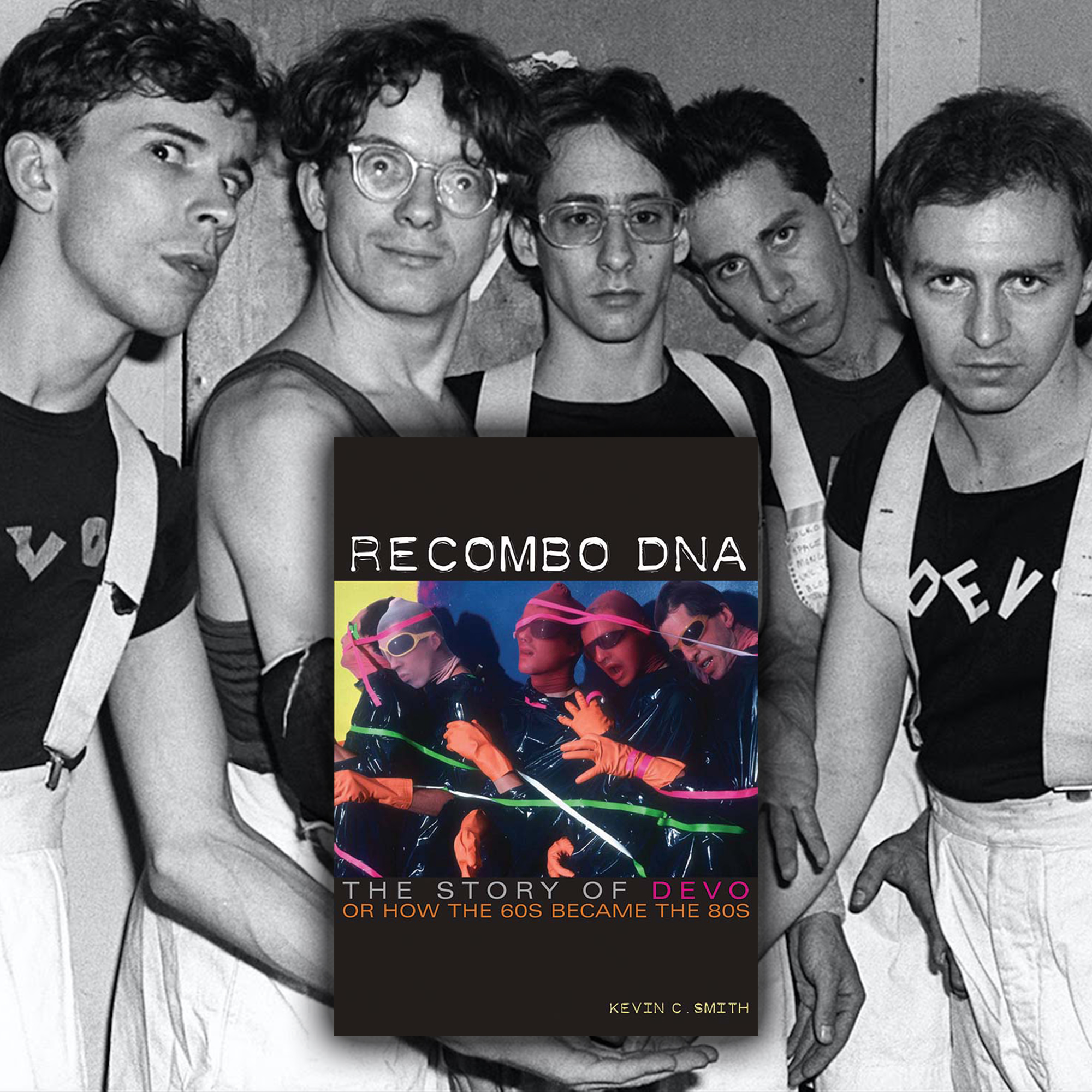
BOOK MUSIK - "Recombo DNA: The Story of DEVO" by Kevin C. Smith


Book Musik 033 – Recombo DNA-The Story of Devo or How the 60s Became the 80s by Kevin C. Smith

Recombo DNA-The Story of Devo or How the 60s Became the 80s by Kevin C. SmithTosh and Kimley discuss Recombo DNA-The Story of Devo or How the 60s Became the 80s by Kevin C. Smith. Smith takes a deep dive examining just what made Devo tick and twitch. From 1970 to 1979, he takes us through the background and influences of this Ohio band who experienced the Kent State shootings, discovered Dada, enjoyed manipulating the ideas of de-evolution, experimented with film and multimedia shows and ultimately became a band with top 40 appeal. They managed to find themselves in the company of the people best suited to further their cause from Toni Basil to Brian Eno to Neil Young. Talent and timing is everything.

Theme music: “Behind Our Efforts, Let There Be Found Our Efforts” by LG17


Sunday, January 7, 2018

Bruce Conner Artist on Tea With Tosh


Along with my father Wallace Berman, Bruce Conner is one of the great artists to come out of 20th mid-Century America.  I have known Bruce throughout my life, and one day, out of the blue, he called me to ask if he can be on "Tea With Tosh."   I remember being nervous interviewing him, due to his nature, but also my appreciation for him as an artist and filmmaker.  Shot in 1987, this is a snapshot of Bruce and his world.   - Tosh Berman, the host of "Tea With Tosh"

Wednesday, November 8, 2017


"Tea With Tosh" was a cable access TV program that was produced and done in 1986 through 1987. I did exactly 20 shows. My chit-chat guests were everyone from Philip Glass to Phranc to Peter Case to George Herms to Russ Tamblyn to Bruce Conner to Jack Hirschman to my soon to be wife Lun*na Menoh. I imagine myself as a combination of Dick Cavett and William F. Buckley. With no money, but we all had a vision (of sorts) to define our culture as we lived it. Now, I digitalized the entire series and will slowly (and surely) make it available to the public. What we call "Tea With Tosh."

Thursday, October 8, 2015

Semina Culture Wallace Berman & His Circle ARTBOOK | D.A.P. 2015 Catalog Books Exhibition Catalogues 9781938922725


Semina Culture: Wallace Berman & His Circle

Published by D.A.P./Santa Monica Museum of Art
Edited with text by Michael Duncan, Kristine McKenna. Text by Stephen Fredman.

Featured image, Wallace Berman's "Untitled" verifax collage, 1961–62, is reproduced from <I>Semina Culture</I>.This reprint of the now classic and much sought-after 2005 volume celebrates the circle of the quintessential visual artist of the Beat era, Wallace Berman (1926–76), who remains one of the best-kept secrets of the postwar era. A crucial figure in California's underground culture, Berman was a catalyst who traversed many different worlds, transferring ideas and dreams from one circle to the next. His larger community is the subject of Semina Culture, which includes previously unseen works by 52 artists. Anchoring this publication is Semina, a loose-leaf art and poetry journal that Berman published in nine issues between 1955 and 1964. Although printed in extremely short runs and distributed to only a handful of friends and sympathizers, Semina is a brilliant and beautifully made compendium of the most interesting artists and poets of its time, and is today a very rare collector's item. Showcasing the individuals that defined a still-potent strand of postwar counterculture, Semina Culture outlines the energies and values of this fascinating circle. Also reproduced here are works by those who appear in Berman's own photographs, approximately 100 of which were recently developed from vintage negatives, and which are seen here for the first time. These artists, actors, poets, curators, musicians and filmmakers include Robert Alexander, John Altoon, Toni Basil, Wallace Berman, Ray Bremser, Bonnie Bremser, Charles Britten, Joan Brown, Cameron, Bruce Conner, Jean Conner, Jay DeFeo, Diane DiPrima, Kirby Doyle, Bobby Driscoll, Robert Duncan, Joe Dunn, Llyn Foulkes, Ralph Gibson, Allen Ginsberg, George Herms, Jack Hirschman, Walter Hopps, Dennis Hopper, Billy Jahrmarkt, Jess, Lawrence Jordan, Patricia Jordan, Bob Kaufman, Philip Lamantia, William Margolis, Michael McClure, David Meltzer, Taylor Mead, Henry Miller, Stuart Perkoff, Jack Smith, Dean Stockwell, Ben Talbert, Russ Tamblyn, Aya (Tarlow), Alexander Trocchi, Edmund Teske, Zack Walsh, Lew Welch and John Wieners.

Featured image, Wallace Berman's "Untitled" verifax collage, 1961–62, is reproduced from Semina Culture.

Semina Culture Wallace Berman & His Circle ARTBOOK | D.A.P. 2015 Catalog Books Exhibition Catalogues 9781938922725

Tuesday, November 18, 2014

November 18, 2014


November 18, 2014

“Art is the expression of an enormous preference.”  The key reason why I like art.  For me personally, art is pretty much anything that I’m interested in.  I see a pretty girl walking down the street, and I think to myself “wow that’s a great piece of art.” But now that we live in the “art of advertisement, after the American manner, has introduced into all our life such a lavish use of superlatives, that no standard of value whatever is intact.” So in a nutshell, it is getting harder and harder to express myself in such a world that we all live together in.  There is a woman that I live with, and I want to tell her that “I love her,” but that phrase seems meaningless.  Holidays are even worse, because any true sentiment is always tied to a bigger event that is happening outside one’s life.  When you give a present on Christmas, it is no longer a present from love, but more likely a collective manner due to a holiday everyone has to acknowledge.  I often wish to break free of the restrictions that I’m placed in, but alas, to fall so apart from society or my culture would give me freedom, but also alienation.   On the other hand, I feel so distant.  There is no win-win, only lose-lose.


Art is the only place where I can go to, and feel I’m interacting with a set of values that are my choice or choices.  For me, beauty is totally subjective, I even find ugly as being beautiful.   So what I’m looking for is something that will give meaning to my life.  And I think whatever that “meaning” is - it is usually expressed as a work of art.   I have been writing poetry not to express a moment, but to dig deeper into ‘that’ moment.   I’m a scientist, who is tearing into the different layers, and it is like I take each layer with my fingers and take it up to a light to examine it.  The French philosopher Jacques Maritain wrote that “the more the poet grows, the deeper the level of creative intuition descends into the density of his soul.  Where formerly he could be moved to song, he can do nothing now, he must dig deeper.” So for me, writing poetry is very much like taking a shovel and digging into a hole, or at the very least, my consciousness.


The other day I went to the Bruce Conner show at the Kohn Gallery, and was totally frozen in time, while sitting in the main huge gallery, watching his “Crossroads,” which is a film that uses footage of the Operation Crossroads underwater nuclear test at Bikini Atoll in the Pacific.   The film technically lasts for 36 minutes, but I couldn’t tell you if I was there for three minutes or the whole film time.  Everything stopped.  There is a beginning and an ending, but I couldn’t really tell where the beginning starts and the end ‘ends.' All I know I was transformed watching the super slow-motion of the bomb going off, and just getting lost in the textures of the atomic cloud.  Beyond that beauty is horror.  So like everything else in life, horror and beauty walk down the sunny side of the street, holding hands, and skipping down the street together.  It could have been my imagination, or I was asleep at the wheel, but “once upon a time the world was sweeter than we knew.  Everything was ours; how happy we were then, but then once upon a time never comes again.” So it is best to live for the moment, and then reflect on it with a shovel and dig deep.


Sunday, January 26, 2014

The Beyond Baroque Literary Art Center's Film Festival (curated by Tosh Berman)


Being a poetry/fiction mad obsessed man, I pretty much hung out at Beyond Baroque Literary Arts Center in Venice California.  This was in 1991/1992.  Benjamin Weissman was the program director for literary readings, and he brought incredible talent to the center.  I asked him and the Director at the time if I could show films there.  Or maybe Benjamin asked me?  Nevertheless they said 'yes,' but I had to raise funds to purchase a pair of 16mm film projectors. With a little sweat, good luck, and kindness of a few backers, we got the equipment we needed.  All minimal, but nevertheless we could project 16mm films onto to a stand up screen.  Very old school.

With the help of Lun*na Menoh, and a couple of projectionists, but mostly with Relah Eckstein, we did a show.  One of the first ideas I had was to bring Buster Keaton in a more adventuresome  light.  Famous at the time of course, but still I felt people were looking at him as just as a slapstick clown.  In my eyes he was the ultimate 20th Century man.  I decided to put him on a program with Luis Bunuel films.  It was a perfect fit.


Alice Guy-Blaché and Lois Weber were pioneering filmmakers from the teens and Twenties.  Alice Guy was a major producer who ran a film studio in France.  The films she made were charming and funny.  The American Lois Weber's films dealt with the politics of its day.  When you think of it now quite daring for her time. 


Another program focusing on the works of pioneering women filmmakers. Here I focused on Weber and Guy but also Leni Reienstahl, and got a  nasty letter for showing her on this program.  

Add caption

Very interesting double-bill of classic kid novels but versions made in the teens.  "The Wizard of Oz " was actually directed by the book's author L. Frank Baum. 


Early Rene Clair films that were at the time very hard to see.  Remember this was the time of VHS, and a lot of these films didn't make it to the cross over.  "Crazy Ray" was a very funny Clair film. It was about a ray that could stop time, therefore everything is frozen.  Lighthearted yet had serious overtones.  Perfect match.


This was the only time where I actually had the filmmaker showing his films.  Harun Farocki is a German filmmaker, theorist, and writer.  The work was fascinating, and I was very lucky to get him to do this.   The Goethe Institute was very helpful with respect to this program.


At the time I was crazy about Peter Greenaway.  He was the only filmmaker at that time that drove people batty.  I never have been in an audience where someone's work really pissed people off.  These short films he made before he became big, were charming, funny, and hypnotic. 


What a wonderful night.  I showed all the classic Joseph Cornell films, but also a woman came by early with a film reel under her arm.  She told me that Cornell made this film for her, and she never saw it.  So the film has never been projected or shown to anyone.  It was a 'wow.'  But a secret 'wow' because no one, including me was expecting someone to bring such a treasure to our little place.


More Cornell!  Also films by Bruce Conner.  A nice combination because both used found footage in their work.  


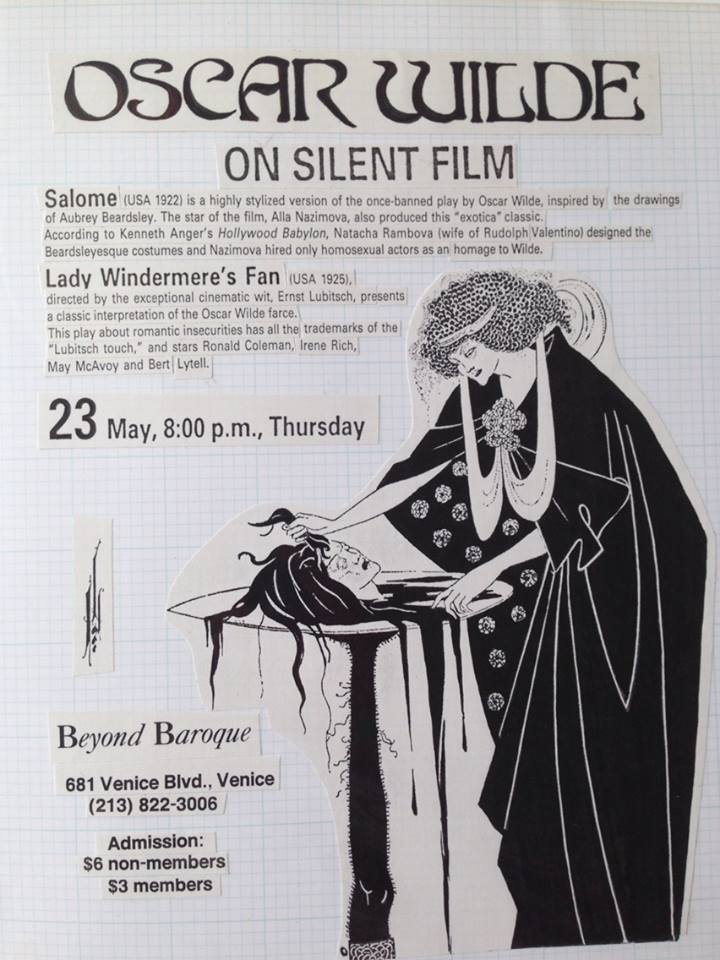
To me there was something subversive of showing a silent Oscar Wilde related films.  A man known for his words, yet we had silent versions of two of his major works.  "Lady Windermere's Fans" and the legendary "Salome."  Both films by the way were excellent.  A sold-out audience where no one was under 70 years old.  And all men!


Odd enough "Band of Outsiders" was not shown that much in Los Angeles at the time.  Nor was it on VHS.  This and a Godard short "All The Boys Called Patrick" was a magical night.  Dancing in the aisles!


It is amazing but right now I can look at the right side of the desk and see my French, British, and American edition of Louis Feuillade's "Fantomas" on DVD.  In 1991, the film was a total mystery and no one, and I mean no one was aware of this piece work.  The film is six 1 hour episodes in total. What I did was show Chapter 2, each episode was a separate and complete narrative - and it was an amazing film.  Without a doubt one of my all-time favorite films. 


The great and kind of tragic Edgar Ulmer.  Odd enough "Detour" was not available on VHS at the time.  So here was the perfect marriage of a film with no budget shown in an organization that barely had a budget.  Kind of sad, but beautiful at the same time.