August 2, 2014
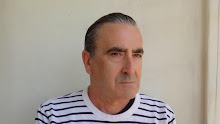
My father received two books from his father, who died, when my dad was 12. The books he left for my dad was a collection of short stories by Oscar Wilde and T. E. Lawrence’s “Seven Pillars of Wisdom.” The latter I think expressed my dad’s sense of adventure and grandness. Some saw him as a quiet man, but I always saw him as being larger than life. When he died he didn’t leave me a lot of possessions, but I think I inherited his romanticism of art and the grand gesture that make him special in my eyes. Perhaps “Lawrence of Arabia” is part of a romantic tradition that men of a certain age could rise to admire. It’s interesting to me that the actor Peter O’Toole who played Lawrence, is the same generation as my father’s - so perhaps due to the ugliness of World War 2 and the racism of that era, they were drawn to another time where men could enjoy the masculine relationship among themselves, as well as galloping in the desert.

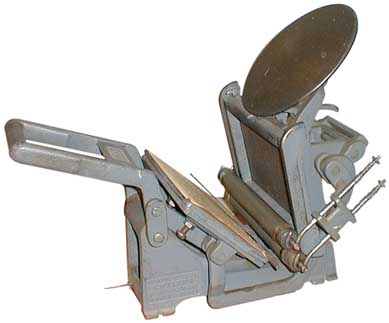
My father is well known for making a journal/zine/mail art publication called “Semina.” Every copy was hand-made by my father, and he only gave it out to people who he found interesting or liked/loved. It was a personal gesture to another person, and Wallace I think believed that it was important or at the very least, some interest to the given from the giver. Lawrence also made unique editions of “Seven Pillars of Wisdom” where he made only eight copies. He couldn’t afford to have the book typed out, so he got the text typeset and printed on a proofing press at the Oxford Times printing works. With those eight copies, he obtained ownership of all eight copies, and chose who was permitted to read them. Even that, this was not perfect copies of the text, due to transcription errors (as a publisher and editor this is hell) and in places lines and even whole paragraphs are missing. He put forward some of his corrections by hand in at least five of those eight bound copies.

To be honest, I have only faint memories of the film “Lawrence of Arabia, ” due to my age at the time. But what I do clearly remember is the beginning of the film with the motorcycle footage. I really identified with that, because at the time, and as a child, I would ride with my father on his motorcycle throughout the hills of Bel Air. This was before the helmet law, so both of us could feel the cold air hitting our nasal passage and eyes. My dad liked to scream while riding the bike through the hills, and he would encourage me to do the same. It seemed like the real-life Lawrence had a thing for motorcycles. He owned 8 Brough Superior motorcycles. They were considered to be the Rolls Royce of cycles and even though ceased production of the motorcycles right after World War ll, they were still making parts up to 1969. My father drove a Triumph, and like the Brough Superior, their bikes were quite beautiful.

Poetry was one of the foundations of my dad’s aesthetic, and it is interesting that he used “Semina” as a exploration of that art, as well as Lawrence’s love for poetry. The dedication in Lawrence’s “Seven Pillars of Wisdom” is of great interest because it is not clear if he’s writing about the Arabs or an individual: Here’s the poem:
I loved you, so I drew these tides of
Men into my hands
And wrote my will across the
Sky and stars
To earn you freedom, the seven
Pillared worthy house,
That your eyes might be
Shining for me
When I came
Death seemed my servant on the
Road, 'til we were near
And saw you waiting:
When you smiled and in sorrowful
Envy he outran me
And took you apart:
Into his quietness
Love, the way-weary, groped to your body,
Our brief wage
Ours for the moment
Before Earth's soft hand explored your shape
And the blind
Worms grew fat upon
Your substance
Men prayed me that I set our work,
The inviolate house,
As a memory of you
But for fit monument I shattered it,
Unfinished: and now
The little things creep out to patch
Themselves hovels
In the marred shadow
Of your gift
-T. E. Lawrence
I often think how an individual can relate to another individual, and what they may or may not share. But for whatever reason, when I see the image of Lawrence of Arabia, I don’t think of Peter O’Toole, but my father on his motorcycle.


 This reprint of the now classic and much sought-after 2005 volume celebrates the circle of the quintessential visual artist of the Beat era, Wallace Berman (1926–76), who remains one of the best-kept secrets of the postwar era. A crucial figure in California's underground culture, Berman was a catalyst who traversed many different worlds, transferring ideas and dreams from one circle to the next. His larger community is the subject of Semina Culture, which includes previously unseen works by 52 artists. Anchoring this publication is Semina, a loose-leaf art and poetry journal that Berman published in nine issues between 1955 and 1964. Although printed in extremely short runs and distributed to only a handful of friends and sympathizers, Semina is a brilliant and beautifully made compendium of the most interesting artists and poets of its time, and is today a very rare collector's item. Showcasing the individuals that defined a still-potent strand of postwar counterculture, Semina Culture outlines the energies and values of this fascinating circle. Also reproduced here are works by those who appear in Berman's own photographs, approximately 100 of which were recently developed from vintage negatives, and which are seen here for the first time. These artists, actors, poets, curators, musicians and filmmakers include Robert Alexander, John Altoon, Toni Basil, Wallace Berman, Ray Bremser, Bonnie Bremser, Charles Britten, Joan Brown, Cameron, Bruce Conner, Jean Conner, Jay DeFeo, Diane DiPrima, Kirby Doyle, Bobby Driscoll, Robert Duncan, Joe Dunn, Llyn Foulkes, Ralph Gibson, Allen Ginsberg, George Herms, Jack Hirschman, Walter Hopps, Dennis Hopper, Billy Jahrmarkt, Jess, Lawrence Jordan, Patricia Jordan, Bob Kaufman, Philip Lamantia, William Margolis, Michael McClure, David Meltzer, Taylor Mead, Henry Miller, Stuart Perkoff, Jack Smith, Dean Stockwell, Ben Talbert, Russ Tamblyn, Aya (Tarlow), Alexander Trocchi, Edmund Teske, Zack Walsh, Lew Welch and John Wieners.


 Posts
Posts